|
|
| | 1,2-Diphenylhydrazine Basic information |
| Product Name: | 1,2-Diphenylhydrazine | | Synonyms: | SYM-DIPHENYLHYDRAZINE;1,2-DIPHENYLHYDRAZINE;1,2-DIPHENYLDIAZANE;Hydrazobenzene solution;1.2-Diphenylhydrazine 100mg [122-66-7];Hydrazobenzene,N,N′-Diphenylhydrazine;sym-DIPHENYLHYDRAZINE, PRACT;1,2-dinitrophenylhydrazine | | CAS: | 122-66-7 | | MF: | C12H12N2 | | MW: | 184.24 | | EINECS: | 204-563-5 | | Product Categories: | Aromatics, Heterocycles, Impurities, Mutagenesis Research Chemicals;Aromatics;Heterocycles;Impurities;Mutagenesis Research Chemicals | | Mol File: | 122-66-7.mol | 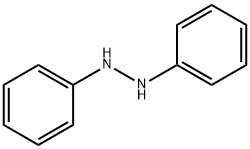 |
| | 1,2-Diphenylhydrazine Chemical Properties |
| Melting point | 123-126 °C(lit.) | | Boiling point | 308.2°C (rough estimate) | | density | 1,158 g/cm3 | | vapor pressure | 2.6 x 10⁻⁵ mmHg at 25 °C (Mabey et al., 1982) | | refractive index | 1.6266 (estimate) | | storage temp. | Refrigerator | | solubility | Soluble in ethanol (Weast, 1986). | | pka | 3.02±0.70(Predicted) | | form | solid | | color | Colorless to pale yellow to orange crystals | | Water Solubility | 221 mg/L at 25 °C (U.S. EPA, 1980a) | | BRN | 639793 | | Henry's Law Constant | 2.1×101 mol/(m3Pa) at 25℃, Duchowicz et al. (2020) | | Stability: | Stable. Incompatible with strong oxidizing agents, strong acids. | | Major Application | cleaning products
cosmetics
environmental
food and beverages
personal care | | InChI | 1S/C12H12N2/c1-3-7-11(8-4-1)13-14-12-9-5-2-6-10-12/h1-10,13-14H | | InChIKey | YBQZXXMEJHZYMB-UHFFFAOYSA-N | | SMILES | N(Nc1ccccc1)c2ccccc2 | | CAS DataBase Reference | 122-66-7(CAS DataBase Reference) | | NIST Chemistry Reference | Hydrazine, 1,2-diphenyl-(122-66-7) | | EPA Substance Registry System | 1,2-Diphenylhydrazine (122-66-7) |
| Hazard Codes | T,N | | Risk Statements | 45-22-50/53 | | Safety Statements | 53-45-60-61 | | RIDADR | UN 3077 9/PG 3 | | WGK Germany | 3 | | RTECS | MW2625000 | | F | 10-23 | | TSCA | TSCA listed | | HazardClass | 6.1 | | PackingGroup | III | | HS Code | 29280000 | | Storage Class | 6.1D - Non-combustible acute toxic Cat.3
toxic hazardous materials or hazardous materials causing chronic effects | | Hazard Classifications | Acute Tox. 4 Oral
Aquatic Acute 1
Aquatic Chronic 1
Carc. 1B | | Hazardous Substances Data | 122-66-7(Hazardous Substances Data) | | Toxicity | Acute oral LD50 for rats 301 mg/kg (quoted, RTECS, 1985). |
| | 1,2-Diphenylhydrazine Usage And Synthesis |
| Description | Diphenylhydrazine is a man-made chemical that occurs in two
isomeric forms: 1,1-diphenylhydrazine and 1,2-diphenylhdrazine.
Diphenylhydrazine is produced by the reduction of
nitrobenzene. Little or no information is available for
1,1-diphenylhydrazine. Most toxicological and use data pertain
to 1,2-diphenylhydrazine. | | Chemical Properties | yellow crystalline powder | | Uses | Impurity in the production of Phenylbutazone (P319570). Hydrazobenzene is a metabolic intermediate of Azobenzene
Carcinogenic | | Uses | Formerly used as a starting material in
the production of benzidine for dyes; production
of certain drugs. | | Uses | Previously, 1,2-diphenylhydrazine was used for producing
benzidine that was used in the synthesis of benzidine-based
dyes. However, these dyes are no longer produced in the United
States. The primary use of 1,2-diphenylhydrazine is in the
production of the anti-inflammatory agent phenylbutazone
and sulfinpyrazone, a uricosuric agent. | | Synthesis Reference(s) | Chemical and Pharmaceutical Bulletin, 36, p. 1529, 1988 DOI: 10.1248/cpb.36.1529
Tetrahedron, 32, p. 2157, 1976 DOI: 10.1016/0040-4020(76)85128-9 | | General Description | Orange powder or a bright orange crystalline solid. | | Air & Water Reactions | 1,2-Diphenylhydrazine oxidizes in air. 1,2-Diphenylhydrazine decomposes in acid solutions. Insoluble in water. | | Reactivity Profile | 1,2-Diphenylhydrazine is a mild reducing agent. Incompatible with strong oxidizing agents, strong acids, acid chlorides and acid anhydrides. Interaction with perchloryl fluoride in the presence of a dilutent below 32°F has caused separation of explosive solids. Is readily oxidized by nitric acid, silver nitrate or permanganate. Is reduced under alkaline conditions . | | Health Hazard | 1,2-Diphenylhydrazine is a liver
toxin in rodents and appears to be carcinogenic
in experimental animals. | | Fire Hazard | Flash point data for 1,2-Diphenylhydrazine are not available; however, 1,2-Diphenylhydrazine is probably combustible. | | Potential Exposure | Tumorigen,Mutagen. 1,2-Diphenylhydrazine (DPH) is a precursor inthe manufacture of benzidine, an intermediate in the production of dyes. 1,2-Diphenylhydrazine is used in the synthesis of phenylbutazone, a potent anti-inflammatory(antiarthritic) drug. Manufacturers of dyes and pharmaceuticals are subject to occupational exposure. Groups workingin the laboratory and forensic medicine may also be subjectto 1,2-diphenylhydrazine exposure. | | First aid | Skin Contact: Flood all areas of body thathave contacted the substance with water. Do not wait toremove contaminated clothing; do it under the water stream.Use soap to help assure removal. Isolate contaminatedclothing when removed to prevent contact by others. EyeContact: Remove any contact lenses at once. Flush eyeswell with copious quantities of water or normal saline for atleast 2030 min. Seek medical attention. Inhalation: Leavecontaminated area immediately; breathe fresh air. Properrespiratory protection must be supplied to any rescuers. Ifcoughing, difficult breathing, or any other symptomsdevelop, seek medical attention at once, even if symptomsdevelop many hours after exposure. Ingestion: If convulsions are not present, give a glass or two of water or milk todilute the substance. Assure that the person’s airway isunobstructed and contact a hospital or poison center imm | | Carcinogenicity | Hydrazobenzene is reasonably anticipated to be a human carcinogen based on sufficient evidence of carcinogenicity from studies in experimental animals. | | Environmental fate | Biological. When 5 and 10 mg/L of diphenylhydrazine was statically incubated in the dark at 25
°C with yeast extract and settled domestic wastewater inoculum, 80 and 72% biodegradation,
respectively, were observed after 7 d (Tabak et al., 1981).
Chemical/Physical. Wet oxidation of 1,2-diphenylhydrazine at 320 °C yielded formic and acetic
acids (Randall and Knopp, 1980). 1,2-Diphenylhydrazine will not hydrolyze (Kollig, 1993).
At influent concentrations of 1.0, 0.1, 0.01, and 0.001 mg/L, the GAC adsorption capacities
were 16,000, 160, 1.5, and 0.015 mg/g, respectively (Dobbs and Cohen, 1980). | | storage | Color Code—Green: General storage may be used.Prior to working with this chemical you should be trainedon its proper handling and storage. Store under nitrogenaway from oxidizers, strong acids, acid chlorides, acidanhydrides. A regulated, marked area should be establishedwhere this chemical is handled, used, or stored in compliance with OSHA Standard 1910.1045. | | Shipping | The name of this material is not in the DOT listof materials for label and packaging standards. However,based on regulations, it may be classified as anEnvironmentally hazardous substances, solid, n.o.s. Thischemical requires a shipping label of “CLASS 9.” It falls inHazard Class 9 and Packing Group III.[20,21] | | Purification Methods | Crystallise hydrazobenzene from hot EtOH containing a little ammonium sulfide or H2SO3 (to prevent atmospheric oxidation), preferably under N2. Dry it in a vacuum desiccator, and store it in the dark or under N2. Alternatively, crystallise it from pet ether (b 60-100o) to constant absorption spectrum. It is almost colourless but in air it turns yellow, then red with the formation of azobenzene. The hydrochloride crystallises from EtOH and has m 163-164o(dec); however, hydrazobenzene readily rearranges to benzidine in the presence of acid. The picrate crystallises from *C6H6 and has m 123o(dec). [Beilstein 15 H 123.] | | Toxicity evaluation | The mechanism of action of diphenylhydrazine is not known.
It is possible that some toxic effects may be attributed to its
major metabolites, aniline and azobenzene, both of which are
known carcinogens. Results of metabolism studies reporting
aniline, benzidine, hyroxybenzidines, and aminophenols as
metabolites in rats following multiple routes of administration
suggest that the diphenylhydrazine metabolism may be similar
to that of azobenzene and aniline. It is also possible that
conversion of 1,2-diphenylhydrazine to aniline in the gastrointestinal
tract may occur due to intestinal microflora and via
acid hydrolysis. | | Incompatibilities | Not compatible with oxidizers, strongacids, acid chlorides, acid anhydrides, and mineral acidsforming benzidine. Store under nitrogen. |
| | 1,2-Diphenylhydrazine Preparation Products And Raw materials |
|