| Company Name: |
Energy Chemical |
| Tel: |
400-0056266 |
| Email: |
sales8178@energy-chemical.com |
- Glycogen
-

- $1.00
-
2026-09-11
- CAS:9005-79-2
- Min. Order: 100g
- Purity: 98%
- Supply Ability: 50kg/month
- GLYCOGEN
-

- $10.00
-
2026-03-20
- CAS:9005-79-2
- Min. Order: 1kg
- Purity: 99%
- Supply Ability: 100 mt
|
| | GLYCOGEN Basic information |
| Product Name: | GLYCOGEN | | Synonyms: | Glycogen(Ⅲ) froM rabbit liver;(2S,3R,4S,5S,6R)-2-[[(2R,3S,4R,5R,6R)-4,5-dihydroxy-3-[(2R,3R,4S,5S,6R)-3,4,5-trihydroxy-6-(hydroxymethyl)oxan-2-yl]oxy-6-[(2R,3S,4R,5R,6S)-4,5,6-trihydroxy-2-(hydroxymethyl)oxan-3-yl]oxyoxan-2-yl]methoxy]-6-(hydroxymethyl)oxane-3,4,5-triol;Glycogen from oyster Vetec(TM) reagent grade, Type II;Glycogen from oyster Type II;Glycogen Solution(20mg/ml) from Oyster, Nuclease tested;animalstarch;GlycogenTypeIX;lyoglycogen | | CAS: | 9005-79-2 | | MF: | (C6H10O5)n | | MW: | 666.58 | | EINECS: | 232-683-8 | | Product Categories: | Biochemistry;Polysaccharides;Sugars;Dextrins、Sugar & Carbohydrates;Biochemicals and Reagents;Carbohydrate;Metabolic Pathways;Metabolites and Cofactors on the Metabolic Pathways Chart;Carbohydrates;Carbohydrates A to;Carbohydrates GBiochemicals and Reagents;Polysaccharide;Carrier MoleculesMolecular Biology;DNA&RNA Purification;Molecular Biology;Plant Nucleic Acid Purification;Reagents;ReagentsPlant Molecular Biology;CarbohydrateResearch Essentials;CarbohydratesBiochemicals and Reagents;Core Bioreagents | | Mol File: | 9005-79-2.mol |  |
| | GLYCOGEN Chemical Properties |
| Melting point | 270-280 °C (dec.) | | alpha | D25 +196 to +197° | | density | 1.629 g/cm3(Temp: -5 °C) | | storage temp. | 2-8°C | | solubility | H2O: 20 mg/mL, clear to hazy, faintly yellow | | form | liquid | | color | Off-white powder | | Odor | Odorless | | biological source | rabbit liver | | Optical Rotation | +191~+200 | | Water Solubility | Soluble in water | | Merck | 4496 | | Cosmetics Ingredients Functions | HUMECTANT
SKIN CONDITIONING | | InChIKey | BYSGBSNPRWKUQH-UJDJLXLFSA-N | | LogP | -5.590 (est) | | CAS DataBase Reference | 9005-79-2(CAS DataBase Reference) | | EPA Substance Registry System | Glycogen (9005-79-2) |
| Risk Statements | 36/37/38 | | Safety Statements | 24/25-26 | | WGK Germany | 3 | | RTECS | MC2700000 | | F | 3-10 | | TSCA | TSCA listed | | HS Code | 39139000 | | Storage Class | 11 - Combustible Solids |
| | GLYCOGEN Usage And Synthesis |
| Chemical Properties | White to off-white powder | | Uses | An inert carrier which significantly increases the efficiency of extracted DNA and RNA by ethanol precipitation. | | Uses | glycogen is a skin-conditioning agent. It is a high molecular-weight polymer distributed through the cell protoplasm. | | Uses | - Glycogen from rabbit liver has been use as a standard for measurement of the hepatic glycogen content.
- In the1,4-α-D gIucan:orthophosphate α-glucosyl transferase assay, it has been used in the assay mixture.
- It has also been used as a standard for myocardial tissue glycogen analysis.
| | Definition | A
polysaccharide that is the main carbohydrate
store of animals. It is composed of
many glucose units linked in a similar way
to starch. Glycogen is readily hydrolyzed in
a stepwise manner to glucose itself. It is
stored largely in the liver and in muscle but
is found widely distributed in the body. | | Definition | A glycose polysaccharide, the storage carbohydrate of the animal organism, found especially in the liver and rested muscle. | | General Description | Glycogen is a branched polymer of glucose synthesized by animal cells for energy storage and release. It is constructed of predominantly α1→4 glycosidic bonds with branches created through α1→6 glycosidic bonds. | | Biochem/physiol Actions | Glycogen from rabbit liver helps in maintaining blood glucose levels by regulating the release of glucose in between meals. It also provides energy during sudden, strenuous activity. Two important areas of glycogen storage are the liver and skeletal muscle. | | Synthesis | Glycogen synthesis occurs in the cytoplasm and can be divided into the following four steps:
(1) Glycogenesis begins with the phosphorylation of glucose by glucokinase in the liver and by hexokinase in muscle and other tissues.
(2) Glucose-6-phosphate is then converted into glucose-1-phosphate by phosphoglucomutase, a reaction similar to that catalysed by phosphoglycerol mutase.
(3) Glucose-1-phosphate is converted into uridine diphosphate (UTP)-glucose, the immediate precursor of glycogen synthesis, by reaction with uridine triphosphate (UTP). This reaction is catalysed by glucose 1-phosphate uridylyltransferase (or UDP-glucose pyrophosphorylase).
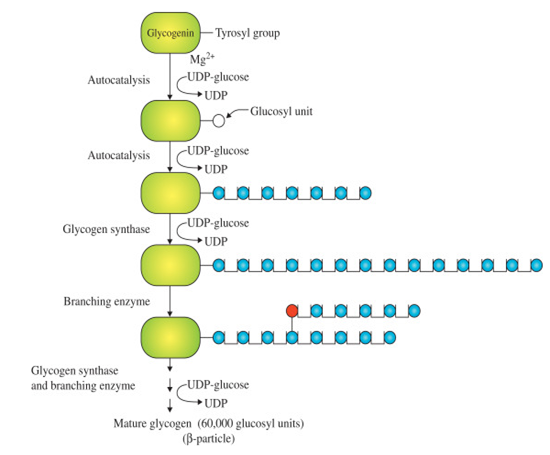
(4) Finally, the glucosyl residue at the C-1 position of UDP-glucose is added to the tyrosyl group at position 194 of glycogen protease in an Mg2+-dependent autocatalytic reaction. Glycosidases similarly extend the glucan chain by α(1→4) glycosidic bonds by adding 6 to 7 glucosyl units, using UDP-glucose as the substrate, in an autocatalytic reaction. The glucan primer of glycogen proteins is elongated by glycogen synthase using UDP glucose. Initially, the glycogenin primer and glycogen synthase are strongly bound using a 1:1 complex. As the dextran chain grows, glycogen synthase separates from glycogen.
 | | Purification Methods | A 5% aqueous solution (charcoal) of D(+)-glycogen is filtered, and an equal volume of EtOH is added. After standing overnight at 3o the precipitate is collected by centrifugation, washed with absolute EtOH, then EtOH/diethyl ether (1:1) and diethyl ether, and dried. [Sutherland & Wosilait J Biol Chem 218 459 1956.] |
| | GLYCOGEN Preparation Products And Raw materials |
|