|
|
| | 7-Ethyl-10-hydroxycamptothecin Basic information |
| Product Name: | 7-Ethyl-10-hydroxycamptothecin | | Synonyms: | (4S)-4,9-Dihydroxy-4,11-diethyl-1H-pyrano[3',4':6,7]indolizino[1,2-b]quinoline-3,14(4H,12H)-dione;(4S)-4,9-Dihydroxy-4α,11-diethyl-3,4,12,14-tetrahydro-1H-pyrano[3',4':6,7]indolizino[1,2-b]quinoline-3,14-dione;EHCPT;7-Ethyl-10-hydroxy-CPT (Camptothecine), SN-38;10-Hydroxycamptothecin acetate salt ,99%;Irinotecan Related Compound B (10 mg) ((S)-4,11-diethyl-4,9-dihydroxy-1H-pyrano[3',4':6,7]indolizino[1,2-b]quinoline-3,14(4H,12H)-dione);SN 38(7-Ethyl-10-hydroxycaMptothecin);CaMptothecin, 7-ethyl-10-hydroxy (SN-38) | | CAS: | 86639-52-3 | | MF: | C22H20N2O5 | | MW: | 392.4 | | EINECS: | 643-093-9 | | Product Categories: | Inhibitors;Miscellaneous Natural Products;chemical reagent;pharmaceutical intermediate;phytochemical;reference standards from Chinese medicinal herbs (TCM).;standardized herbal extract;Chiral Reagents, Metabolites & Impurities, Pharmaceuticals, Intermediates & Fine Chemicals;Natural Anti-cancer Medical Materials and It's Derivatives;Pharmaceutical Raw Materials;Antitumors for Research and Experimental Use;Biochemistry;Natural Plant Extract;Chiral Reagents;Intermediates & Fine Chemicals;Metabolites & Impurities;Pharmaceuticals | | Mol File: | 86639-52-3.mol | 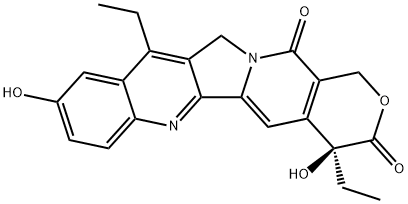 |
| | 7-Ethyl-10-hydroxycamptothecin Chemical Properties |
| Melting point | 217 °C | | Boiling point | 810.3±65.0 °C(Predicted) | | density | 1.51±0.1 g/cm3(Predicted) | | refractive index | 21.5 ° (C=0.2, THF) | | storage temp. | 2-8°C | | solubility | DMSO: soluble1mg/mL | | form | powder | | pka | 9.13±0.40(Predicted) | | color | Off-white | | Optical Rotation | Consistent with structure | | Stability: | Stable for 2 years from date of purchase as supplied. Solutions in DMSO may be stored at -20° for up to 1 month. | | InChI | InChI=1S/C22H20N2O5/c1-3-12-13-7-11(25)5-6-17(13)23-19-14(12)9-24-18(19)8-16-15(20(24)26)10-29-21(27)22(16,28)4-2/h5-8,25,28H,3-4,9-10H2,1-2H3/t22-/m0/s1 | | InChIKey | FJHBVJOVLFPMQE-QFIPXVFZSA-N | | SMILES | N1C2C(=CC(O)=CC=2)C(CC)=C2CN3C(C=12)=CC1[C@](CC)(O)C(=O)OCC=1C3=O | | CAS DataBase Reference | 86639-52-3(CAS DataBase Reference) |
| Hazard Codes | T | | Risk Statements | 25 | | Safety Statements | 45 | | RIDADR | 2811 | | WGK Germany | 3 | | RTECS | UQ0491000 | | HazardClass | 6.1 | | PackingGroup | Ⅲ | | HS Code | 29399990 | | Storage Class | 6.1C - Combustible acute toxic Cat.3
toxic compounds or compounds which causing chronic effects | | Hazard Classifications | Acute Tox. 4 Oral
Repr. 1B
STOT RE 1 |
| | 7-Ethyl-10-hydroxycamptothecin Usage And Synthesis |
| Description | SN-38 (86639-52-3), also known as 7-Ethyl-10-hydroxycamptothecin, is the active metabolite of CPT-11 that inhibits DNA topoisomerase I (IC50 values are 0.74 and 1.9 μM in P388 and Ehrlich cells respectively). Inhibits DNA and RNA synthesis (IC50 values are 0.077 and 1.3 μM respectively) but does not affect protein synthesis. SN-38 displays potent antitumor activity against a range of human tumor cell lines (IC50 values are 3.3, 13, 19 and 22 nM for HCT-116, BEL-7402, HL60 and HeLa cells respectively). | | Chemical Properties | Light-Yellow Solid | | Uses | 7-ethyl-10-hydroxycamptothecin (SN 38) is a metabolite of Irinotecan, a DNA topoisomerase inhibitor. SN 38 has been used in trials studying the treatment of Cancer, Advanced Solid Tumors, Small Cell Lung Cancer, Metastatic Colorectal Cancer, and Triple Negative Breast Cancer, among others. | | Definition | ChEBI: SN-38 (7-Ethyl-10-hydroxycamptothecin) is a member of the class of pyranoindolizinoquinolines that is (4S)-pyrano[3',4':6,7]indolizino[1,2-b]quinoline-3,14-dione bearing two additional ethyl substituents at positions 4 and 11 as well as two additional hydroxy substituents at positions 4 and 9. It is the active metabolite of irinotecan and is ~1000 times more active than irinotecan itself. It has a role as an apoptosis inducer, an EC 5.99.1.2 (DNA topoisomerase) inhibitor, a drug metabolite and an antineoplastic agent. It is a pyranoindolizinoquinoline, a delta-lactone, a tertiary alcohol and a member of phenols. | | Biological Activity | Active metabolite of CPT-11 that inhibits DNA topoisomerase I (IC 50 values are 0.74 and 1.9 μ M in P388 and Ehrlich cells respectively). Inhibits DNA and RNA synthesis (IC 50 values are 0.077 and 1.3 μ M respectively) but does not affect protein synthesis. Displays potent antitumor activity against a range of human tumor cell lines (IC 50 values are 3.3, 13, 19 and 22 nM for HCT-116, BEL-7402, HL60 and HELA cells respectively). | | Cytotoxicity | 7-Ethyl-10-hydroxycamptothecin has been found to be 200–2000 times more cytotoxic than CPT-11, but has not been used as an anticancer drug due to its poor solubility in pharmaceutically acceptable solvents and low affinity to lipid membranes. SN-38 also undergoes a reversible conversion to an inactive open lactone ring structure at physiological pH. | | storage | Store at +4°C | | structure and hydrogen bonding | 7-Ethyl-10-hydroxycamptothecin belongs to the class of organic compounds known as camptothecins. These are heterocyclic compounds comprising a planar pentacyclic ring structure, that includes a pyrrolo[3,4-beta]-quinoline moiety (rings A, B and C), conjugated pyridone moiety (ring D) and one chiral center at position 20 within the alpha-hydroxy lactone ring with (S) configuration (the E-ring). | | References | [1] FUMIAKI KOIZUMI. Novel SN-38-incorporating polymeric micelles, NK012, eradicate vascular endothelial growth factor-secreting bulky tumors.[J]. Cancer research, 2006, 66 20: 10048-10056. DOI:10.1158/0008-5472.can-06-1605
[2] HEYONG GAO. Synthesis and antitumor activity of the hexacyclic camptothecin derivatives[J]. Bioorganic & Medicinal Chemistry Letters, 2005, 15 13: Pages 3233-3236. DOI:10.1016/j.bmcl.2005.04.063
[3] Y KAWATO. Intracellular roles of SN-38, a metabolite of the camptothecin derivative CPT-11, in the antitumor effect of CPT-11.[J]. Cancer research, 1991, 51 16: 4187-4191. |
| | 7-Ethyl-10-hydroxycamptothecin Preparation Products And Raw materials |
|