- Tralomethrin
-
-
2020-04-25
- CAS:66841-25-6
- Min. Order: 1KG
- Purity: 99.0%
- Supply Ability: 600 tons
- tralomethrin
-
- $1.00
-
2020-02-06
- CAS:66841-25-6
- Min. Order: 1KG
- Purity: Min98% HPLC
|
| | TRALOMETHRIN Basic information |
| Product Name: | TRALOMETHRIN | | Synonyms: | SCOUT;SCOUT(R);SAGA(R);(S)-A-CYANO-3-PHENOXYBENZYL-(1R,3S)-2,2-DIMETHYL-3-[(RS)-1,2,2,2-TETRABROMOETHYL]-CYCLOPROPANE CARBOXYLATE;TRACKER;TRACKER(R);TRALATE;TRALATE(R) | | CAS: | 66841-25-6 | | MF: | C22H19Br4NO3 | | MW: | 665.01 | | EINECS: | 266-493-1 | | Product Categories: | Insecticide | | Mol File: | 66841-25-6.mol |  |
| | TRALOMETHRIN Chemical Properties |
| Melting point | 143℃ | | Boiling point | 185~190℃ (0.1mmHg) | | density | 1.70 g/cm3 (20℃) | | vapor pressure | 4.8×10⁻⁹ Pa (25 °C) | | refractive index | 1.6300 (estimate) | | storage temp. | 0-6°C | | Water Solubility | 0.08 mg l-1 | | Henry's Law Constant | 2.5×10⁴ mol/(m3Pa) at 25℃, Duchowicz et al. (2020) | | InChI | 1S/C22H19Br4NO3/c1-21(2)17(19(23)22(24,25)26)18(21)20(28)30-16(12-27)13-7-6-10-15(11-13)29-14-8-4-3-5-9-14/h3-11,16-19H,1-2H3 | | InChIKey | YWSCPYYRJXKUDB-UHFFFAOYSA-N | | SMILES | O=C(OC(C#N)C1=CC=CC(OC2=CC=CC=C2)=C1)C3C(C(Br)C(Br)(Br)Br)C3(C)C | | EPA Substance Registry System | Tralomethrin (66841-25-6) |
| Hazard Codes | Xn,N | | Risk Statements | 22-36/38-50/53 | | Safety Statements | 26-60-61 | | RIDADR | 2588 | | WGK Germany | 3 | | HazardClass | 6.1(b) | | PackingGroup | III | | Storage Class | 11 - Combustible Solids | | Hazard Classifications | Acute Tox. 4 Oral
Aquatic Acute 1
Aquatic Chronic 1
Eye Irrit. 2
Skin Irrit. 2 | | Hazardous Substances Data | 66841-25-6(Hazardous Substances Data) |
| | TRALOMETHRIN Usage And Synthesis |
| Description | Orange-to-yellow resinous solid (technical grade
>39%) | | Chemical Properties | The prodrug is yellow to orange-yellow resin-like substance. Relative density 1.7 (20℃), vapor pressure 1.7Pa (1.73×10⁻¹¹Pa) (25℃), [α]D+21 o~+27 o(50g/L toluene). Soluble in acetone, xylene, toluene, dichloromethane, dimethyl sulfoxide, ethanol and other organic solvents; solubility in water is 70mg/L. When 50 ℃, 6 months without decomposition, stable to light, non-corrosive. | | Uses | Tralomethrin can be used as insecticide. | | Uses | Tralomethrin controls a range of insects, especially Lepidoptera, in
cereals, coffee, cotton, fruit, maize, oilseed rape, rice, tobacco and vegetables.
It is also effective for wood protection, household use, in public
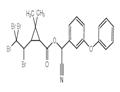
health, in stored grains and for ectoparasite control on animals. | | Definition | ChEBI: A carboxylic ester resulting from the formal condensation between (1R)-cis-2,2-dimethyl-3-(1,2,2,2-tetrabromoethyl)cyclopropanecarboxylic acid and the alcoholic hydroxy group of (2S)-hydroxy(3-phenoxypheny
)acetonitrile. | | Agricultural Uses | Insecticide: Not approved for use in EU countries. Registered
for use in the U.S. | | Trade name | DETHMOR®; HAG-107®; RU-25472®;
RU-25474®; SCOUT®; SCOUT® X-TRA Gel insecticide | | Mechanism of action | Non-systemic with contact and stomach action. Sodium channel modulator. | | Synthesis | The laboratory synthesis of Tralomethrin is a multi-step process. The final key step involves the bromination of its precursor, Deltamethrin. Deltamethrin itself is synthesized via the esterification of (1R)-cis-3-(2,2-dibromovinyl)-2,2-dimethylcyclopropanecarboxylic acid with (S) cyano-(3-phenoxyphenyl)methanol.
step 1. Synthesis of Deltamethrin (Precursor)
Dissolve (S)-cyano-(3-phenoxyphenyl)methanol in anhydrous toluene in a reaction vessel
equipped with a stirrer and under a nitrogen atmosphere.
Cool the solution to a low temperature (e.g., -10°C).
Slowly add a solution of (1R)-cis-3-(2,2-dibromovinyl)-2,2-dimethylcyclopropanecarboxylic
acid chloride in anhydrous toluene to the cooled solution.
Add a solution of pyridine in toluene dropwise to the reaction mixture.
Allow the reaction to proceed at a controlled temperature (e.g., 20°C) for several hours.
Upon completion, wash the reaction mixture with dilute hydrochloric acid, followed by a
sodium bicarbonate solution.
Dry the organic layer over anhydrous sodium sulfate and evaporate the solvent under
reduced pressure to obtain crude Deltamethrin.
Purify the crude product by a suitable method, such as crystallization or column
chromatography.
step 2. Synthesis of Tralomethrin from Deltamethrin
Dissolve Deltamethrin in a suitable solvent in a reaction vessel protected from light.
Cool the solution to a low temperature.
Slowly add a solution of bromine in the same solvent to the Deltamethrin solution.
Stir the reaction mixture at a controlled temperature until the reaction is complete.
Remove any excess bromine, for example, by bubbling nitrogen through the solution or by
washing with a solution of sodium thiosulfate.
Evaporate the solvent under reduced pressure to yield crude Tralomethrin.
 | | Metabolic pathway | Tralomethrin probably owes most of its action to rapid conversion by
several mechanisms to deltamethrin. Information on its photodegradation,
degradation in soil, and its metabolism in plants, insects and animals
has been published and supports this conclusion. | | Degradation | Tralomethrin is stable as a solid but is labile to base. Acidic media reduce
the tendency to hydrolysis and epimerisation. It was readily debrominated
when solutions or thin films were irradiated at 360 nm or by
sunlight. Homolytic fission of a C-Br bond initiates this reaction,
which affords deltamethrin (2). Some epimerisation to trans-tralomethrin
and thence trans-deltamethrin also occurred. Dehydrobromination
also affords deltamethrin and the tribromo derivative (8). Ester cleavage
to the acid (3) and to the cyanohydrin (5) and thence to 3PBAl (6) and
3PBA (7) is important in the solid phase but not in solution (Ruzo and
Casida, 1981). The products are shown in Scheme 1. | | Toxicity evaluation | Acute oral LD50 for rats: 99-3,000 mg/kg depending on the
carrier used | | Pesticide Type | Insecticide; Veterinary substance |
| | TRALOMETHRIN Preparation Products And Raw materials |
|