|
|
| Product Name: | Allylcyclohexane acetate | | Synonyms: | Cyclohexaneacetic acid, 2-propenyl ester;ALLYLCYCLOHEXYLACETATE;Cyclohexylacetic acid allyl ester;ALLYLCYCLOHEXANE ACETATE USP/EP/BP;Cyclohexaneacetic acid, 2-propen-1-yl ester;Allylcyclohexane acetate | | CAS: | 4728-82-9 | | MF: | C11H18O2 | | MW: | 182.26 | | EINECS: | 225-230-0 | | Product Categories: | | | Mol File: | 4728-82-9.mol | 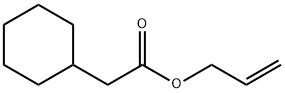 |
| | Allylcyclohexane acetate Chemical Properties |
| TSCA | TSCA listed | | toxicity | The acute oral LD50 value in rats was reported as 0.90 g/kg (0.56-1.24 g/kg) (Moreno, 1974) and the acute dermal LD50 value in rabbits as 1.25 g/kg (0.35-2.15 g/kg) (Moreno, 1974). |
| | Allylcyclohexane acetate Usage And Synthesis |
| Identification |
CAS.No.:
4728-82-9
FL.No.:
9.482
FEMA.No.:
2023
NAS.No.:
2023
CoE.No.:
2070
EINECS.No.:
225-230-0
JECFA.No.:
12
| | Description | A liquid with an intense, sweet, long-lasting fruital (pineapple, peach, apricot) aroma. It is used as a flavor enhancer, flavoring agent and adjuvant.
| | Regulatory Status | CoE: n/a
FDA: 21 CFR 172.515
FDA (other): n/a
JECFA: ADI: Acceptable. No safety concern at current levels of intake when used as a flavoring agent (1996).
| | Usage | Reported uses (ppm): (FEMA, 1994)
Gelatins, puddings
11.42
17.17
Nonalcoholic beverages
4.69
7.59
| | Natural occurrence | Not reported found in nature.
| | Chemical Properties | Colorless liquid, almost insoluble in water, miscible with alcohol, essential oils and flavor chemicals, perfume materials, etc. Pronounced “mixed-fruity“ odor, sweet, lasting and less ethereal than the lower aliphatic acetates. The flavor is overall fruity (“tutti-frutti”) with some resemblance to Pineapple, Peach and Apricot. | | Occurrence | Has apparently not been reported to occur in nature. | | Preparation | By esterfication of cyclohexane, acetic acid and allyl alcohol in the presence of benzene | | Taste threshold values | Taste characteristics at 15 ppm: pineapple with a sweet, ripe, fruity nuance. | | Metabolism | The hydrolysis of ester linkages in foreign compounds may be catalysed by many different esterases; most of these have a low degree of substrate specificity and they are to be found in all animals and bacteria (Parke, 1968). In the rat, allyl acetate and allyl alcohol are metabolized to 3-hydroxypropylmercapturic acid, which is excreted in the urine (Clapp, Kaye & Young,
1969). In dogs, cyclohexylacetic acid was not aromatized and was probably completely oxidized in the body by β-oxidation (Bernhard, 1937; Williams, 1959). |
| | Allylcyclohexane acetate Preparation Products And Raw materials |
|