|
|
| | Butoxyethyl (2,4-dichlorophenoxy)acetate Basic information |
| Product Name: | Butoxyethyl (2,4-dichlorophenoxy)acetate | | Synonyms: | (2,4-Dichlorophenoxy)acetic acid 2-butoxyethyl ester;(2,4-Dichlorophenoxy)acetic acid butoxyethanol ester;(2,4-dichlorophenoxy)-aceticaci2-butoxyethylester;(2,4-dichlorophenoxy)-aceticacibutoxyethylester;2,4-D Butoxyethanol ester;2,4-d,butoxyethanolester;2,4-dbee;2,4-D-BEE | | CAS: | 1929-73-3 | | MF: | C14H18Cl2O4 | | MW: | 321.2 | | EINECS: | 217-680-1 | | Product Categories: | | | Mol File: | 1929-73-3.mol | 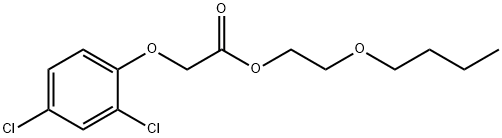 |
| | Butoxyethyl (2,4-dichlorophenoxy)acetate Chemical Properties |
| | Butoxyethyl (2,4-dichlorophenoxy)acetate Usage And Synthesis |
| Chemical Properties | 2,4-Dichlorophenoxyacetic acid is a white
to yellow crystalline powder with a slight phenolic odor. | | Uses | 2,4-D-Butylglycol Ester is a reagent used in the preparation of fungicides, herbicides and insecticides.Environmental toxin on US EPA Toxic Release Inventory list (TRI) list. | | Production Methods | The commercial production of 2,4-D-butotylester begins with purified 2,4-D acid, obtained via the standard phenoxyacetic acid route. The free acid is dissolved in water or a mixed solvent and then neutralised with butotyl alcohol (a branched C4-C6 alcohol blend used historically in specialty esters) under controlled pH and temperature, forming the ester. | | Health Hazard | Recommended Personal Protective Equipment: Face shield or goggles; rubber gloves; Symptoms Following Exposure: Contact with eyes may cause mild irritation; General Treatment for Exposure: INGESTION: if large amounts are swallowed, induce vomiting and get medical help. EYES: flush with plenty of water and see a doctor. SKIN: flush with water, wash with soap and water; Toxicity by Inhalation (Threshold Limit Value): Data not available; Short-Term Exposure Limits: Data not available; Toxicity by Ingestion: Grade 2 or 3:LD50 = 320-617 mg/kg; Late Toxicity: Data not available; Vapor (Gas) Irritant Characteristics: Data not available; Liquid or Solid Irritant Characteristics: Data not available; Odor Threshold: Data not available. | | Chemical Reactivity | Reactivity with Water No reaction; Reactivity with Common Materials: May attack some forms ofplastics; Stability During Transport: Stable; Neutralizing Agents for Acids and Caustics: Not pertinent; Polymerization: Not pertinent; Inhibitor of Polymerization: Not pertinent. | | Mechanism of action | Selective, systemic, absorbed through roots and increases biosynthesis and production of ethylene causing uncontrolled cell division and so damages vascular tissue. Synthetic auxin. | | Potential Exposure | 2,4-Dichlorophenoxyacetic acid,
was introduced as a plant growth-regulator in 1942. It
is registered in the United States as a herbicide for control
of broadleaf plants and as a plant growth-regulator. Thus,
workers engaged in manufacture, formulation or application
are affected, as may be citizens in areas of application. The
Vietnam war era defoliant, Agent Orange, was a mixture of
2,4-D and 2,4,5-T. | | Shipping | UN3345 Phenoxyacetic acid derivative pesticide,
solid, toxic, Hazard Class: 6.1; Labels: 6.1-Poisonous
materials. A DOT regulated marine pollutant. | | Incompatibilities | A weak acid, incompatible with bases.
Decomposes in sunlight or heat, forming hydrogen chloride
and phosgene. Contact with strong oxidizers may cause fire
and explosions. | | Waste Disposal | Incineration of phenoxys is
effective in 1 second @ 982
C, using a straight combustion
process or @ 482℃
using catalytic combustion. Over 99%
decomposition was reported when small amounts of 2,4-D
were burned in a polyethylene bag. See “References”
for additional detail. In accordance with 40CFR165, follow
(31); recommendations for the disposal of pesticides and
pesticide containers. Must be disposed properly by follow-
ing (100) Package (2) label directions or by contacting
your local or federal environmental control agency, or by
contacting your regional EPA office. Consult with environ-
mental regulatory agencies for guidance on acceptable
disposal practices. Generators of waste containing this
contaminant (≥100 kg/mo) must conform with EPA regu-
lations governing storage, transportation, treatment, and
waste disposal. | | Pesticide Type | Herbicide |
| | Butoxyethyl (2,4-dichlorophenoxy)acetate Preparation Products And Raw materials |
|