| Company Name: |
Alfa Aesar |
| Tel: |
400-6106006 |
| Email: |
saleschina@alfa-asia.com |
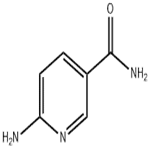
- 6-Aminonicotinamide
-
-
2022-02-22
- CAS:329-89-5
- Min. Order: 1KG
- Purity: 98.0%
- Supply Ability: 100 tons
|
| | 6-Aminopyridine-3-carboxamide Basic information |
| | 6-Aminopyridine-3-carboxamide Chemical Properties |
| Melting point | 245-248 °C (lit.) | | Boiling point | 251.97°C (rough estimate) | | density | 1.2620 (rough estimate) | | refractive index | 1.6910 (estimate) | | storage temp. | Keep in dark place,Inert atmosphere,Room temperature | | solubility | insoluble in H2O; insoluble in EtOH; ≥13.7 mg/mL in DMSO | | form | powder to crystal | | pka | 15.66±0.50(Predicted) | | color | White to Light yellow | | Water Solubility | Soluble in Dimethyl sulfoxide (DMSO). Insoluble in water. | | BRN | 116042 | | InChI | InChI=1S/C6H7N3O/c7-5-2-1-4(3-9-5)6(8)10/h1-3H,(H2,7,9)(H2,8,10) | | InChIKey | ZLWYEPMDOUQDBW-UHFFFAOYSA-N | | SMILES | C1=NC(N)=CC=C1C(N)=O | | CAS DataBase Reference | 329-89-5(CAS DataBase Reference) | | NIST Chemistry Reference | Nicotinamide, 6-amino-(329-89-5) | | EPA Substance Registry System | 6-Aminonicotinamide (329-89-5) |
| Hazard Codes | T | | Risk Statements | 61 | | Safety Statements | 53-45 | | RIDADR | 1655 | | WGK Germany | 3 | | RTECS | US4550000 | | Hazard Note | Toxic | | HazardClass | 6.1 | | PackingGroup | II | | HS Code | 29333990 | | Storage Class | 6.1C - Combustible acute toxic Cat.3
toxic compounds or compounds which causing chronic effects | | Hazard Classifications | Repr. 1B |
| | 6-Aminopyridine-3-carboxamide Usage And Synthesis |
| Uses | 6-Aminonicotinamide induces apoptosis in tumor cells. It is clinically used in disseminated neoplastic disease. It also acts as 6-phosphogluconate dehydrogenase inhibitor. It aids in the treatment of psoriasis. It is used as cancer chemotherapeutic drug in animals. | | Uses | antineoplastic, apoptosis inducer | | Definition | ChEBI: A monocarboxylic acid amide resulting from the formal condensation of the carboxy group of 6-aminonicotinic acid with ammonia. An inhibitor of the NADP+-dependent enzyme, 6-phosphogluconate dehydrogenase, it interferes with glycolysis
resulting in ATP depletion and synergizes with DNA-crosslinking chemotherapy drugs, such as cisplatin, in killing cancer cells. | | General Description | White crystalline solid. | | Air & Water Reactions | Insoluble in water. | | Reactivity Profile | An amine and amide. Amines are chemical bases. They neutralize acids to form salts plus water. These acid-base reactions are exothermic. The amount of heat that is evolved per mole of amine in a neutralization is largely independent of the strength of the amine as a base. Amines may be incompatible with isocyanates, halogenated organics, peroxides, phenols (acidic), epoxides, anhydrides, and acid halides. Flammable gaseous hydrogen is generated by amines in combination with strong reducing agents, such as hydrides. Organic amides/imides react with azo and diazo compounds to generate toxic gases. Flammable gases are formed by the reaction of organic amides/imides with strong reducing agents. Amides are very weak bases (weaker than water). Imides are less basic yet and in fact react with strong bases to form salts. That is, they can react as acids. Mixing amides with dehydrating agents such as P2O5 or SOCl2 generates the corresponding nitrile. The combustion of these compounds generates mixed oxides of nitrogen (NOx). | | Health Hazard | ACUTE/CHRONIC HAZARDS: When heated to decomposition 6-Aminopyridine-3-carboxamide emits toxic fumes of NOx. | | Fire Hazard | Flash point data for 6-Aminopyridine-3-carboxamide are not available; however, 6-Aminopyridine-3-carboxamide is probably combustible. | | Biological Activity | ki: 0.46 μm6-aminonicotinamide is a 6-phosphogluconate dehydrogenase inhibitor.6-phosphogluconate dehydrogenase, an enzyme in the pentose phosphate pathway, can produce ribulose 5-phosphate from 6-phosphogluconate. 6-phosphogluconate dehydrogenase is also an oxidative carboxylase catalyzing the decarboxylating reduction of 6-phosphogluconate into ribulose 5-phosphate in the presence of nadp. | | Synthesis | 2-Amino-5-cyanopyridine [CAS-No. 4214-73-7] (5.0 g, 42 mmol) was used as a raw material, which was stirred with hydroxylamine hydrochloride (17.5 g, 0.25 mol) and sodium carbonate (31.1 g, 0.29 mol) in a solvent mixture of water (95 mL) and ethanol (21 mL) and heated for 6 hr under reflux conditions. Upon completion of the reaction, the reaction mixture was poured into water (150 mL) and extracted with ethyl acetate (4 × 100 mL). The organic layers were combined, washed with brine (150 mL), subsequently dried with anhydrous magnesium sulfate, and concentrated under reduced pressure. The crude product was purified by silica gel column chromatography with ethyl acetate/methanol/ammonia (4:1:0.5) as eluent and further purified by crystallization (ethyl acetate/methanol/hexanes as eluent) to afford 6-aminonicotinamidoxime (1.39 g) and 6-aminonicotinamide (1.42 g, 22% yield) as off-white solid. Mass spectrometry (EI) showed a molecular ion peak m/z 152.1 [M]+; the melting point was 300°C. The molecular ion peak was found to be a solid. | | in vitro | 6-aminonicotinamide could be metabolized to 6-amino-nad(p+), a competitive inhibitor of nad(p+)-requiring processes, especially the pentose phosphate pathway enzyme, 6-phosphogluconate dehydrogenase. moreove, 6-aminonicotinamide as a single agent could cause a significant inhibition of glycolytic flux but had no effect on the pentose phosphate pathway. 31p-nmr studies of perifused rif-1 cells indicated that 4 h of exposure to 6-aminonicotinamide was enough to cause significant accumulation of 6-phosphogluconate, the substrate for this enzyme [1]. | | in vivo | the influence of 6-aminonicotinamide on the g-6-p-dh- and 6-pg-dh-levels of the pentose phosphate pathway in the kidney was investigated. following i.p. administration of 6-aminonicotinamide at 6 mg/kg, the 6-pg-level rose from a value less than 10 nmoles/g to 1000 nmoles/g fresh weight within 24 h. in addition, at the end of the assay, after 7 days, a 6-pg-concentration of about 150 nmoles/g fresh weight was still seen. moreove, the g-6-p level simultaneously rose with the 6-pg-level to about 150% of the control level and returned to normal on the 5th day [2]. | | references | [1] street, j. c.,alfieri, a.a. and koutcher, j.a. quantitation of metabolic and radiobiological effects of 6-aminonicotinamide in rif-1 tumor cells in vitro. cancer research 57, 3956-3962 (1997).
[2] lange, k. and proft, e.r. inhibition of the 6-phosphogluconate dehydrogenase in the rat kidney by 6-aminonicotinamide. naunyn-schmiedeberg's archives of pharmacology 267, 177-180 (1970). |
| | 6-Aminopyridine-3-carboxamide Preparation Products And Raw materials |
|