|
|
| | H-Val-Asp-OH Basic information |
| Product Name: | H-Val-Asp-OH | | Synonyms: | L-VALYL-L-ASPARTIC ACID;L-Aspartic acid, L-valyl-;VAL-ASP;H-Val-Asp-OH | | CAS: | 20556-16-5 | | MF: | C9H16N2O5 | | MW: | 232.23 | | EINECS: | | | Product Categories: | | | Mol File: | 20556-16-5.mol | 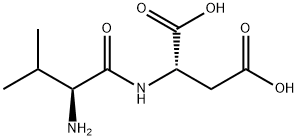 |
| | H-Val-Asp-OH Chemical Properties |
| Melting point | >212o C | | Boiling point | 454.3±45.0 °C(Predicted) | | density | 1.311±0.06 g/cm3(Predicted) | | storage temp. | -15°C | | solubility | Methanol (Slightly), Water (Slightly, Sonicated) | | pka | 2.91±0.10(Predicted) | | form | Solid | | color | White to Off-White | | Sequence | H-Val-Asp-OH | | Stability: | Hygroscopic |
| | H-Val-Asp-OH Usage And Synthesis |
| Uses | H-Val-Asp-OH is a polypeptide that can be found by peptide screening. Peptide screening is a research tool that pools active peptides primarily by immunoassay. Peptide screening can be used for protein interaction, functional analysis, epitope screening, especially in the field of agent research and development[1]. | | Definition | ChEBI: Val-Asp is a dipeptide formed from L-valine and L-aspartic acid residues. It has a role as a metabolite. | | References | [1] Birnbaum S, et al. Peptide screening. Current Opinion in Biotechnology, 1992, 3(1): 49-54. |
| | H-Val-Asp-OH Preparation Products And Raw materials |
|