- BAY 11-7082
-

- $43.00
-
2026-07-27
- CAS:19542-67-7
- Purity: 98.32%
- Supply Ability: 10g
- BAY 11-7082
-
- $1.10
-
2026-07-02
- CAS:19542-67-7
- Min. Order: 1kg
- Purity: 99%
- Supply Ability: 100kg
- BAY 11-7082
-

-
2026-06-30
- CAS:19542-67-7
- Min. Order: 1kg
- Purity: 98%
- Supply Ability: 1000kg
|
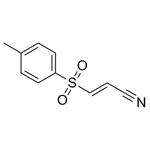
| Product Name: | BAY 11-7082 | | Synonyms: | BAY 11-7082;BAY 11-7821;(E)-3-(4-METHYLPHENYLSULFONYL)-2-PROPENENITRILE;(e)-3-(4-methylphenyl)sulfonylprop-2-enenitrile;CS-608;100824;Bay 11-7821(BAY 11-7082);BAY 11-7082 - CAS 19542-67-7 - Calbiochem | | CAS: | 19542-67-7 | | MF: | C10H9NO2S | | MW: | 207.25 | | EINECS: | | | Product Categories: | Cytokine signaling;Inhibitors;NF-kB | | Mol File: | 19542-67-7.mol |  |
| | BAY 11-7082 Chemical Properties |
| Melting point | 133-135℃ | | Boiling point | 397.6±42.0 °C(Predicted) | | density | 1.237±0.06 g/cm3(Predicted) | | storage temp. | Keep in dark place,Inert atmosphere,2-8°C | | solubility | DMSO: 25 mg/mL, soluble | | form | solid | | color | white | | Stability: | Stable for 1 year from date of purchase as supplied. Solutions in DMSO or ethanol may be stored at -20° for up to 3 months. | | InChI | InChI=1S/C10H9NO2S/c1-9-3-5-10(6-4-9)14(12,13)8-2-7-11/h2-6,8H,1H3/b8-2+ | | InChIKey | DOEWDSDBFRHVAP-KRXBUXKQSA-N | | SMILES | C(#N)/C=C/S(C1=CC=C(C)C=C1)(=O)=O |
| WGK Germany | 3 | | RTECS | UD1430000 | | HS Code | 2926907090 | | Storage Class | 11 - Combustible Solids |
| | BAY 11-7082 Usage And Synthesis |
| Description | BAY 11-7082 (19542-67-7)inhibits cytokine-induced IκB-α phosphorylation via inhibition of IκB Kinase which results in inhibition of NFκB .1 Inhibits anchorage-independent growth of mammary epithelial cells induced with 4-hydroxyestradiol via inhibition of NFκB activation.2 Inhibits IFNα production and blocks nuclear translocation of IRF7 in plasmacytoid dendritic cells.3 Facilitates wound healing by inhibiting TNFα-induced MMP expression.4 A useful tool for probing the involvement of NFκB in physiological and pathophysiological processes.5 Cell permeable. | | Uses | Bay 11-7082 has been used as:
- a nuclear factor-kappa B (NF-kB) inhibitor to verify the action of the NF-kB signaling pathway in the production of interleukin (IL)-8
- a nuclear factor-kappa B (NF-kB) inhibitor to study the role of NF-kB activation in Mycoplasma hyorhinis -induced epithelial-mesenchymal transition (EMT) and cell migration
- a nod-like receptor family pyrin domain containing 3 (NLRP3) selective inhibitor to examine its effects on liver inflammation in mice after hematopoietic stem cell transplantation
| | Definition | ChEBI: A nitrile that is acrylonitrile in which the hydrogen located beta,trans to the cyano group is replaced by a tosyl group. It is an inhibitor of cytokine-induced IkappaB-alpha phosphorylation i
cells. | | General Description | Potential anti-inflammatory agent that selectively and irreversibly inhibits the TNF-α-inducible phosphorylation of IκBα (IC50 = 10 μM), resulting in a decreased expression of NF-κB and of adhesion molecules. Does not affect constitutive IκBα autophosphorylation. Inhibits TNF-α-induced surface expression of the endothelial-leukocyte cell adhesion molecules E-selectin, VCAM-1, and ICAM-1. A 100 mM (10 mg/483 μl) solution of BAY 11-7082 (Cat. No. 196871) in DMSO is also available is also available. | | Biological Activity | Irreversible inhibitor of TNF- α -stimulated I κ B α phosphorylation (IC 50 ~ 10 μ M); leads to decreased NF- κ B and subsequent decreased expression of adhesion molecules. Also reversibly activates MAP kinases and stimulates apoptosis. | | Biochem/physiol Actions | Bay 11-7082 acts as a selective inhibitor for nod-like receptor family pyrin domain containing 3 (NLRP3) inflammasome pathway. In addition, to the inhibition of nuclear factor-kappa B (NF-kB), Bay 11-7082 also triggers apoptosis in anucleated erythrocytes, human T-cell leukemia virus type I (HTLV-I)-infected T-cell lines and primary adult T-cell leukemia cells. | | Enzyme inhibitor | This protein kinase inhibitor (FW = 207.31 g/mol; CAS 19542-67-7; lmax = 251 nm), also named 3-[(4-methylphenyl)sulfonyl]-(2E)-propenenitrile, targets NF-κB activation, selectively and irreversibly blocking TNF-α- induced phosphorylation of IκB-α without affecting phosphorylation of constitutive IκB-α. Mechanism of Inhibitory Action: NF-κB transcription factor regulates expression of inflammatory cytokines, various chemokines and immunoreceptors, as well as cell adhesion molecules. When stationed within the cytoplasm, NF-κB is kept inactive through its binding to the inhibitory factor IκB; however, certain stimuli result in IκB phosphorylation and ubiquitin-mediated degradation, freeing NF-κB for translocation to the nucleus. In endothelial cells, IκB-α phosphorylation and degradation occur within 15 min of TNFα treatment, allowing NF-κB to translocate to the nucleus to activate gene expression. Treatment of humnan vascular endothelial cells (HUVEC) with TNFα results in rapid loss of IκB-α from the cytoplasm. BAY11-7082 stabilizes IκB-α in a dose-dependent manner (IC50 ≈ 10 μM). There is a clear correlation between the concentration of drug that stabilizes IκB-α, the concentration that inhibits nuclear levels of NF-κB, and the concentration that inhibits adhesion molecule expression. More recent studies demonstrate that BAY 11- 7082 prevents ubiquitin conjugation to Ubc13 and UbcH7 by forming a covalent adduct with their cysteine residues via Michael addition at the C-3 atom of BAY 11-7082, followed by the release of 4-methylbenzenesulfinate. BAY 11-7082 stimulated Lys48-linked polyubiquitin chain formation in cells and protected Hypoxia-Inducible Factor-1α (HIF1α) from proteasomal degradation, suggesting it inhibits the proteasome. These results indicate that the anti-inflammatory effects of BAY 11-7082, its ability to induce B-cell lymphoma and leukemic T-cell death and to prevent the recruitment of proteins to sites of DNA damage are exerted via inhibition of components of the ubiquitin system– not by inhibiting NF-κB. BAY11-7082 also inhibits proliferation and promotes apoptosis in breast carcinoma MCF-7 cells by inhibiting phosphorylation of ATP citrate lyase. | | storage | +4°C | | Background | BAY 11-7082 is a selective and irreversible inhibitor of cytokine-induced IκBα phosphorylation. Treatment with TNF-α leads to the activation of IκBα resulting in nuclear translocation of NF-κB where it regulates gene expression. Inhibition of IκBα phosphorylation leads to the inactivation of NF-κB. The effect that BAY 11-7082 has on proinflammatory cytokine production as it relates to the NF-κB/IκB kinase pathways makes it useful when studying inflammation. This compound inhibits IFN-α production and nuclear translocation of interferon regulatory factor 7 in human plasmacytoid dendritic cells, both important factors when studying immunotherapeutic strategies as they relate to autoimmune disorders. BAY 11-7082 inhibits TNF-α-induced surface expression of ICAM-1, VCAM-1, and E-Selectin in human endothelial cells with an IC50 value between 5–10 μM. | | References | [1] J W PIERCE. Novel inhibitors of cytokine-induced IkappaBalpha phosphorylation and endothelial cell adhesion molecule expression show anti-inflammatory effects in vivo.[J]. The Journal of Biological Chemistry, 1997, 272 34: 21096-21103. DOI:10.1074/jbc.272.34.21096
[2] SIN-AYE PARK. 4-hydroxyestradiol induces anchorage-independent growth of human mammary epithelial cells via activation of IkappaB kinase: potential role of reactive oxygen species.[J]. Cancer research, 2009: 2416-2424. DOI:10.1158/0008-5472.can-08-2177
[3] RIE MIYAMOTO. Inhibitor of IkappaB kinase activity, BAY 11-7082, interferes with interferon regulatory factor 7 nuclear translocation and type I interferon production by plasmacytoid dendritic cells.[J]. Arthritis Research & Therapy, 2010, 12 3: R87. DOI:10.1186/ar3014
[4] CHUNMING XU. Bay11-7082 facilitates wound healing by antagonizing mechanical injury- and TNF-α-induced expression of MMPs in posterior cruciate ligament.[J]. Connective Tissue Research, 2019, 60 4: 311-322. DOI:10.1080/03008207.2018.1512978
[5] MIRI KIM. TNF-α induces human neural progenitor cell survival after oxygen–glucose deprivation by activating the NF-κB pathway[J]. Experimental and Molecular Medicine, 2018, 50 4: 1-14. DOI:10.1038/s12276-018-0033-1 |
| | BAY 11-7082 Preparation Products And Raw materials |
|