|
|
| | 1,5-Dinitronaphthalene Basic information |
| Product Name: | 1,5-Dinitronaphthalene | | Synonyms: | 1,5-dinitro-naphthalen;Naphthalene,1,5-dinitro-;1,5-DINITRONAPHTHALENE;LABOTEST-BB LT00436936;1,5-Dinitroaphthalene;1,5-Dinitronaphthalene98%;1,5-Dinitronaphthalene,tech.90%;1,5-DINITRO NAPHTALENE | | CAS: | 605-71-0 | | MF: | C10H6N2O4 | | MW: | 218.17 | | EINECS: | 210-095-2 | | Product Categories: | Building Blocks;Chemical Synthesis;Nitro Compounds;Nitrogen Compounds;Organic Building Blocks;Nitro Compounds;Nitrogen Compounds;Organic Building Blocks;Intermediates of Dyes and Pigments;Naphthalene derivatives | | Mol File: | 605-71-0.mol | 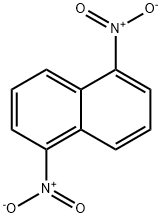 |
| | 1,5-Dinitronaphthalene Chemical Properties |
| Melting point | 214 °C | | Boiling point | 358.84°C (rough estimate) | | density | 1.58 | | refractive index | 1.7040 (estimate) | | solubility | Acetonitrile (Very Slightly), Chloroform (Slightly), DMSO (Very Slightly) | | form | Solid:granular | | Water Solubility | 60 ppm (12 ºC), 90 ppm (50 ºC) | | BRN | 527184 | | Henry's Law Constant | 1.1×10² mol/(m3Pa) at 25℃, Parnis et al. (2015) | | InChI | 1S/C10H6N2O4/c13-11(14)9-5-1-3-7-8(9)4-2-6-10(7)12(15)16/h1-6H | | InChIKey | ZUTCJXFCHHDFJS-UHFFFAOYSA-N | | SMILES | [O-][N+](=O)c1cccc2c(cccc12)[N+]([O-])=O | | CAS DataBase Reference | 605-71-0(CAS DataBase Reference) | | NIST Chemistry Reference | Naphthalene, 1,5-dinitro-(605-71-0) | | EPA Substance Registry System | 1,5-Dinitronaphthalene (605-71-0) |
| Hazard Codes | Xi,Xn | | Risk Statements | 41-43-52/53-68-36/37/38 | | Safety Statements | 26-36/37/39-61-29 | | RIDADR | 2811 | | WGK Germany | 3 | | RTECS | QJ4551000 | | HazardClass | 6.1(b) | | PackingGroup | III | | Storage Class | 11 - Combustible Solids | | Hazard Classifications | Aquatic Chronic 3
Eye Dam. 1
Muta. 2
Skin Sens. 1 |
| | 1,5-Dinitronaphthalene Usage And Synthesis |
| Chemical Properties | Yellow to yellow-green needles or fluffy powder | | Uses | 1,5-Dinitronaphthalene is an intermediate in the production of naphthazarin (5,8- dihydroxy-1,4-naphthoquinone) and 1,5- naphthalenediamine, which is mainly converted to naphthalene 1,5-diisocyanate. As a sensitizing agent for ammonium nitrate explosives the use of mixed isomers is adequate. | | Production Methods | Naphthalene is added slowly to mixed acid (22/58/20) at 40 ℃, and the temperature is raised to 80 ℃ over 4 h to give a mixture of 1,5- and 1,8-dinitronaphthalenes. The isomers are separated by fractional crystallization (e.g., from ethylene dichloride) or, preferably, by solvent extraction. The 1,5-isomer can be extracted with toluene, leaving 99 % pure 1,8- dinitronaphthalene. After evaporation of the toluene, the residue is extracted with a strongly polar solvent (e.g., sulfolane) to leave 99 % pure 1,5-isomer. | | Definition | ChEBI: 1,5-dinitronaphthalene is a dinitronaphthalene carrying nitro groups at positions 1 and 5. It has a role as a genotoxin. | | General Description | Yellowish white needles or light yellow fluffy solid. | | Air & Water Reactions | Insoluble in water. | | Reactivity Profile | 1,5-Dinitronaphthalene is incompatible with strong oxidizers and strong bases. Mixtures with sulfur or sulfuric acid may explode if heated to 248° F . | | Fire Hazard | Flash point data for 1,5-Dinitronaphthalene are not available; however, 1,5-Dinitronaphthalene is probably combustible. | | Safety Profile | A suspected
carcinogen. Mutation data reported.
Mxtures with sulfur or sulfuric acid (used in
commercial reactions) may explode if heated
to 120℃. Initiation temperature depends on
the quality of the dinitronaphthalene. When
heated to decomposition it emits toxic
fumes of NOx. See also NITRO COMPOUNDS of AROMATICHYDROCARBONS |
| | 1,5-Dinitronaphthalene Preparation Products And Raw materials |
| Raw materials | Naphthalene | | Preparation Products | Decahydro-1,5-naphthalenediamine-->5-nitronaphthalen-1-amine-->5,8-Dihydroxy-1,4-naphthoquinone-->4-Nitro-1-naphthylamine-->C.I. Sulphur Brown 63-->Copper, cresol-1,5-dinitronaphthalene-sodium polysulfide reaction products complexes, leuco derivs.-->Disperse Blue 20-->5,8-Dihydroxy-1,4-naphthoquinone-->Copper, cresol-1,5-dinitronaphthalene-sodium polysulfide reaction products complexes |
|