


Tranexamic Acid

- CAS No.
- 1197-18-8
- Chemical Name:
- Tranexamic Acid
- Synonyms
- Tranexamic;AMCA;(1r,4r)-4-(aminomethyl)cyclohexane-1-carboxylic acid;TRANS-4-(AMINOMETHYL)CYCLOHEXANECARBOXYLIC ACID;cyklokapron;(1r,4r)-4-(aMinoMethyl)cyclohexanecarboxylic acid;transamin;amstat;TRANS-4-AMINOMETHYL-1-CYCLOHEXANECARBOXYLIC ACID;Tranexamic Acid D2
- CBNumber:
- CB1117189
- Molecular Formula:
- C8H15NO2
- Molecular Weight:
- 157.21
- MDL Number:
- MFCD00001466
- MOL File:
- 1197-18-8.mol
- MSDS File:
- SDS
- TDS File:
- TDS
| Melting point | >300 °C (lit.) |
|---|---|
| Boiling point | 281.88°C (rough estimate) |
| Density | 1.0806 (rough estimate) |
| vapor pressure | 1.72hPa at 25℃ |
| refractive index | 1.4186 (estimate) |
| storage temp. | 2-8°C |
| solubility | Freely soluble in water and in glacial acetic acid, practically insoluble in acetone and in ethanol (96 per cent). |
| form | Crystalline Powder |
| pka | pKa 4.3 (Uncertain);10.6 (Uncertain) |
| color | White |
| Water Solubility | 1g/6ml |
| Merck | 14,9569 |
| BRN | 2207452 |
| Stability | Hygroscopic |
| Cosmetics Ingredients Functions |
ASTRINGENT SKIN CONDITIONING |
| InChI | 1S/C8H15NO2/c9-5-6-1-3-7(4-2-6)8(10)11/h6-7H,1-5,9H2,(H,10,11)/t6-,7- |
| InChIKey | GYDJEQRTZSCIOI-LJGSYFOKSA-N |
| SMILES | NC[C@H]1CC[C@@H](CC1)C(O)=O |
| CAS DataBase Reference | 1197-18-8 |
| EWG's Food Scores | 1 |
| FDA UNII | 6T84R30KC1 |
| NCI Drug Dictionary | Cyklokapron |
| UNSPSC Code | 41116107 |
| NACRES | NA.24 |
SAFETY
Risk and Safety Statements
| Symbol(GHS) |  GHS07 |
|||||||||
|---|---|---|---|---|---|---|---|---|---|---|
| Signal word | Warning | |||||||||
| Hazard statements | H315-H319-H335 | |||||||||
| Precautionary statements | P261-P264-P271-P280-P302+P352-P305+P351+P338 | |||||||||
| target organs | Respiratory system | |||||||||
| PPE | dust mask type N95 (US), Eyeshields, Gloves | |||||||||
| Hazard Codes | Xi | |||||||||
| Risk Statements | 36/37/38 | |||||||||
| Safety Statements | 26-36-37/39 | |||||||||
| WGK Germany | 2 | |||||||||
| RTECS | GU8400000 | |||||||||
| HazardClass | IRRITANT | |||||||||
| HS Code | 29224999 | |||||||||
| Storage Class | 11 - Combustible Solids | |||||||||
| Hazard Classifications | Eye Irrit. 2 Skin Irrit. 2 STOT SE 3 |
|||||||||
| Toxicity | LD50 in mice, rats (mg/kg): 1500, 1200 i.v. (Melander) | |||||||||
| REACH Registrations | Active | |||||||||
| NFPA 704 |
|
Tranexamic Acid price More Price(100)
| Manufacturer | Product number | Product description | CAS number | Packaging | Price | Updated | Buy |
|---|---|---|---|---|---|---|---|
| Sigma-Aldrich | T1810000 | Tranexamic acid European Pharmacopoeia (EP) Reference Standard | 1197-18-8 | 20 mg | $241 | 2026-04-30 | Buy |
| Sigma-Aldrich | 857653 | trans-4-(Aminomethyl)cyclohexanecarboxylic acid 97% | 1197-18-8 | 10g | $75.7 | 2026-04-30 | Buy |
| Sigma-Aldrich | BP734 | Tranexamic acid impurity standard British Pharmacopoeia (BP) Reference Standard | 1197-18-8 | 25MG | $251 | 2026-04-30 | Buy |
| Sigma-Aldrich | BP1263 | Tranexamic acid British Pharmacopoeia (BP) Reference Standard | 1197-18-8 | 100 mg | $196 | 2026-04-30 | Buy |
| Sigma-Aldrich | 1672745 | Tranexamic acid United States Pharmacopeia (USP) Reference Standard | 1197-18-8 | 200mg | $455 | 2026-04-30 | Buy |
Tranexamic Acid Chemical Properties, Uses, Production
Description
Tranexamic acid is a derivative of aminomethylbenzoic acid, and a kind of antifibrinolytic drugs to stop bleeding. The hemostasis mechanism of tranexamic acid is similar to aminocaproic acid and aminomethylbenzoic acid, but the effect is stronger. The strength is 7 to 10 times of aminocaproic acid, 2 times of aminomethylbenzoic acid, but toxicity is similar.
The chemical structure of tranexamic acid is similar to lysine, competitive inhibition of plasmin original in fibrin adsorption, to prevent their activation, protection fiber protein not to degrade by plasmin and dissolve, eventually achieve hemostasis. Applicable in the treatment of acute or chronic, localized or systemic primary fiber fibrinolytic hyperthyroidism caused by bleeding, such as obstetric hemorrhage, renal hemorrhage, hemorrhage of hypertrophy of the prostate, hemophilia, pulmonary tuberculosis hemoptysis, stomach bleeding, after operation of liver, lung, spleen and other viscera hemorrhage; also can be used in surgery when abnormal bleeding etc..
Clinical tranexamic acid has effect significantly to insect bites disease, dermatitis and eczema, simple purpura, chronic urticaria, artificial sex urticaria, toxic eruption and eruption. And also has a certain effect on erythroderma, scleroderma, systemic lupus erythematosus (SLE), Erythema multiforme, shingles and alopecia areata. Treatment of hereditary angioedema effect is also good. In the treatment of Chloasma, general medicine is effective about 3 weeks, markedly effective 5 weeks, a course of 60 days. Given orally in doses of 0.25 ~ 0.5 g, a day 3 ~ 4 times. A few patients can nausea, fatigue, pruritus, abdominal discomfort, and diarrhea side effects after withdrawal symptoms disappear.
Chemical Properties
Tranexamic acid is a White or almost white, crystalline powder. It is freely soluble in water and in glacial acetic acid and is very slightly soluble in ethanol and practically insoluble in ether.
Originator
Anvitoff,Knoll,W. Germany,1967
Uses
Fibrinolysis, the cleavage of fibrin by plasmin, is a normal step in the dissolution of fibrin clots after wound repair. Tranexamic acid is an inhibitor of fibrinolysis that blocks the interaction of plasmin with fibrin (IC50 = 3.1 μM). It is a lysine mimetic that binds the lysine binding site in plasmin. Antifibrinolytic agents have value when fibrinolytic activity is abnormally high or when coagulation is impaired.
Indications
Various bleedings caused by acute or chronic, localized or systemic primary hyperfibrinolysis; secondary hyperfibrinolytic state caused by disseminated intravascular coagulation. Generally do not use this product before heparinization.
Trauma or surgical bleeding in tissue and organs with abundant plasminogen activators such as prostate, urethra, lung, brain, uterus, adrenal glands, and thyroid.
An antagonist of tissue plasminogen activator (t-PA), streptokinase, and urokinase.
Fibrinolytic hemorrhage caused by artificial abortion, early placental detachment, stillbirth and amniotic fluid embolism; and increased menorrhagia caused by pathological intrauterine fibrinolysis.
Cerebral neuropathy mild bleeding, such as subarachnoid hemorrhage and intracranial aneurysm hemorrhage, the effect of Amstat in this condition is better than that of other anti-fibrinolytic agents. Special attention must be paid to the risk of cerebral edema or cerebral infarction.For severe patients with surgical indications, this product can only be used as an adjuvant drug.
For the treatment of hereditary angioneurotic edema, it can reduce the number and severity of episodes.
Used in patients with hemophilia for their active hemorrhage in combination with others drug.
Hemophilia patients with factor VIII or factor IX deficiency in their tooth extraction or oral surgery in case of operating bleeding.
Definition
ChEBI: Tranexamic acid is a monocarboxylic acid. It has a role as an antifibrinolytic drug and a hematologic agent. It is functionally related to a cyclohexanecarboxylic acid.
Manufacturing Process
In an autoclave, 2 grams of a mixture of cis- and trans-4- aminomethylcyclohexane-1-carboxylic acid, which is obtained by catalytic reduction of p-aminomethylbenzoic acid in the presence of platinum catalyst and contains 60% by weight of cis-isomer was reacted at 200°C, for 8 hours with 20 ml of ethyl alcohol in which 0.44 gram of sodium metal had been dissolved. After cooling, the reaction solution was concentrated under a reduced pressure to give a white residue. This residue was dissolved in 40 ml of water and passed through a column of a strongly acidic cation ion_x0002_exchanger resin (NH4+). The eluate was concentrated under reduced pressure to form a white mass. An adequate amount of acetone was added thereto and 1.95 grams of white powder was obtained. This powder was recrystallized from water-acetone to give 1.85 grams (yield, 92.5%) of white crystalline powder having a melting point of 380° to 390°C (decomposition). This product was identified as trans-4-aminomethylcyclohexane-1-carboxylic acid by means of infrared spectrum.
Therapeutic Function
Coagulant
General Description
Tranexamic acid is an antifibrinolytic agent and is commonly used for heavy menstrual bleeding.
Mechanism of action
Tranexamic acid is a synthetic lysine amino acid derivative, which diminishes the dissolution of hemostatic fibrin by plasmin. In the presence of tranexamic acid, the lysine receptor binding sites of plasmin for fibrin are occupied, preventing binding to fibrin monomers, thus preserving and stabilizing fibrin’s matrix structure. This agent has a longer half-life, is approximately ten times more potent, and is less toxic than aminocaproic acid, which possesses similar mechanisms of action.
Clinical Use
Haemostatic agent
Side effects
Tranexamic acid is mostly well-tolerated.
Common
nausea (upset stomach)
vomiting (throwing up)
diarrhea
headache
Occasional
dizziness
giddiness
vision changes
Rare
stroke
blood clots in undesired areas
deep vein thrombosis
Synthesis
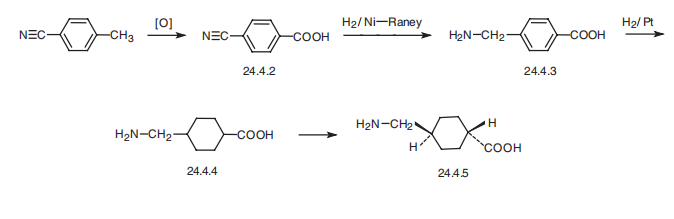
Tranexamic acid, trans-4-(aminomethyl)cyclohexane carboxylic acid (24.4.5), is synthesized from 4-methylbenzonitrile. Oxidation of the methyl group gives the mononitrile of terephthalic acid 24.4.2. The cyano group in this compound is reduced by hydrogen using Raney nickel as a catalyst. The benzene ring of the resulting 4- aminomethylbenzoic acid (24.4.3) is reduced to a cyclohexane moiety by hydrogen and a platinum catalyst, which forms an isomeric mixture of 4-aminomethylcyclohexane carboxylic acids (24.4.4), and the desired trans-isomer 24.4.5 is isolated by crystallization of the mixture of its sodium salts.
target
GABA Receptor
Metabolism
Tranexamic acid is excreted as unchanged drug mainly by urinary excretion via glomerular filtration.
Pharmacokinetics
Tranexamic acid 1 g was given intravenously to three healthy volunteers. Plasma concentrations decayed in three monoexponential phases. Most elimination occurred during the first eight hours, giving an apparent elimination half-life of approximately two hours. Plasma clearance ranged between 110-116 ml/min. The urinary recovery of tranexamic acid exceeded 95% of the dose. The oral bioavailability of tranexamic acid, calculated from 24-hour urinary excretion after oral and intravenous administration, was 34% of the dose[1].
References
Intravenous use of tranexamic acid reduces postoperative blood loss in total knee arthroplasty DOI:10.1007/s00402-014-2081-x
www.childrensmn.org
dermnetnz.org
Tranexamic acid for the prevention and treatment of postpartum haemorrhage. DOI:10.1097/01.aoa.0000552886.12061.3c
Sittig's Pharmaceutical Manufacturing Encyclopedia
The Renal Drug Handbook
Synthesis of Essential Drugs (2006, Elsevier) - libgen.lc
Spectrophotometric and spectrofluorimetric methods for the determination of tranexamic acid in pharmaceutical formulation. DOI:10.1248/CPB.55.364
Determination of plasma tranexamic acid using cation-exchange high-performance liquid chromatography with fluorescence detection. DOI:10.1016/S0378-4347(00)84573-9
[1] A Pilbrant, J Vessman, M Schannong. “Pharmacokinetics and bioavailability of tranexamic acid.” European Journal of Clinical Pharmacology 20 1 (1981): 65–72.

Tranexamic Acid Preparation Products And Raw materials
Raw materials
1of2
Preparation Products
| Supplier | Tel | Country | ProdList | Advantage | |
|---|---|---|---|---|---|
| LoongZe (NanJing) Medicine Chemical Industry CO.,LTD | 025-58392866-05 17766083849 | 3696999150@qq.com | China | 10 | 58 |
| Changzhou josenchem Pharmaceutical Chemical Material Co.,Ltd. | 519-519-85286950 13338194135 | info@josenchem.com | China | 73 | 58 |
| Spec-Chem Industry Inc. | 025-84523390 13505162978 | sc@specchemind.com | China | 123 | 58 |
| Changzhou Sunchem Pharmaceutical Chemical Material Co.,Ltd. | 0519-85195575 15861192208;15861192208;13685253038 | 850305@sunkechem.com | China | 72 | 69 |
| Hubei Hongjing Chemical Co., Ltd. | 027-82333386 13669024603 | 617019505@qq.com | China | 264 | 58 |
| Wuhan Huajiu Pharmaceutical Technology Co.,Ltd. | 027-59225746 18062681621 | 730880265@qq.com | China | 4800 | 58 |
| Hubei YiKangYuan Chemical Co., Ltd. | 027-87182908 18064088908 | 65824125@qq.com | China | 90 | 55 |
| Hubei widely chemical technology Co., Ltd. | 186-02735115 18602735115 | 18602735115@163.com | China | 1896 | 64 |
| Hubei wei shi reagent group ltd., company | 027-59102966 18717199209 | 2853877583@QQ.com | China | 7304 | 58 |
| Hangzhou Linran Biotechnology Co. LTD | 0571-18067987-92 18067987892;13738142397 | 2543558860@qq.com | China | 137 | 58 |
Related articles
- Tranexamic Acid: Pharmacological Effects and Adverse Effects
- Tranexamic acid inhibits plasmin formation, enhances hemostasis, and modulates melanocyte activity, with adverse effects inclu....
- Nov 7,2024
- Medical effects of tranexamic acid
- Tranexamic acid, also known as tranexamic acid, tranexamic acid, hemostatic acid, molecular formula is C8H15NO2
- Mar 30,2022
- Side effects of Tranexamic acid
- Tranexamic acid (TXA) is a medication used to treat or prevent excessive blood loss from major trauma, postpartum bleeding, su....
- Mar 8,2022
Related Questions
Ask a questionView Latest Price from Tranexamic Acid manufacturers
| Image | Update time | Product | Price | Min. Order | Purity | Supply Ability | Manufacturer | |
|---|---|---|---|---|---|---|---|---|
 |
2026-09-18 | Tranexaminsure
1197-18-8
|
1g | More Than 99% | 100kg/Month | BEIJING SJAR TECHNOLOGY DEVELOPMENT CO., LTD. | ||
 |
2026-09-18 | Tranexamic Acid
1197-18-8
|
$75.00-100.00 | 1kg | 99% | 5000Ton | HEBEI SHENGSUAN CHEMICAL INDUSTRY CO.,LTD | |
 |
2026-09-18 | Tranexamic Acid
1197-18-8
|
1kg | 0.99 | 20tons | HANGZHOU INVERTIN BIOPHARMA CO., LTD. |
-
- Tranexaminsure
1197-18-8
- $0.00
- More Than 99%
- BEIJING SJAR TECHNOLOGY DEVELOPMENT CO., LTD.
-
- Tranexamic Acid
1197-18-8
- $75.00-100.00
- 99%
- HEBEI SHENGSUAN CHEMICAL INDUSTRY CO.,LTD
-
- Tranexamic Acid
1197-18-8
- 0.99
- HANGZHOU INVERTIN BIOPHARMA CO., LTD.
1197-18-8 (Tranexamic Acid) Related Search:
1of4
