


Clofarabine
- CAS No.
- 123318-82-1
- Chemical Name:
- Clofarabine
- Synonyms
- 200mg;Clolar;2-chloro-9-(2-deoxy-2-fluoroarabinofuranosyl)adenine;2-Chloro-9-(2-deoxy-2-fluoro-β-D-arabinofuranosyl)-9H-purin-6-amine;CAFDA; Clola;Evoltra;CS-1954;Clofarex;Clorabine
- CBNumber:
- CB2277491
- Molecular Formula:
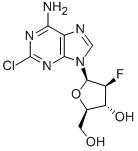
- C10H11ClFN5O3
- Molecular Weight:
- 303.68
- MDL Number:
- MFCD00871077
- MOL File:
- 123318-82-1.mol
- MSDS File:
- SDS
- TDS File:
- TDS
| Melting point | 228-2310C |
|---|---|
| Boiling point | 550.0±60.0 °C(Predicted) |
| Density | 1.4804 (estimate) |
| RTECS | UD7473000 |
| storage temp. | 2-8°C |
| solubility | DMSO: >10mg/mL |
| form | Powder |
| pka | 12.56±0.70(Predicted) |
| color | white |
| optical activity | 40.9°(C=0.01g/ml DMF) |
| λmax | 263nm(EtOH)(lit.) |
| Merck | 14,2372 |
| InChI | InChI=1/C10H11ClFN5O3/c11-10-15-7(13)5-8(16-10)17(2-14-5)9-4(12)6(19)3(1-18)20-9/h2-4,6,9,18-19H,1H2,(H2,13,15,16)/t3-,4+,6-,9-/s3 |
| InChIKey | INHHKRVRRUIAPA-KJHIFWANSA-N |
| SMILES | C12N=C(N=C(N)C=1N=CN2[C@H]1[C@@H](F)[C@H](O)[C@@H](CO)O1)Cl |&1:10,11,13,15,r| |
| CAS DataBase Reference | 123318-82-1(CAS DataBase Reference) |
| NCI Dictionary of Cancer Terms | clofarabine; Clolar |
| FDA UNII | 762RDY0Y2H |
| NCI Drug Dictionary | clofarabine |
| ATC code | L01BB06 |
| UNSPSC Code | 41116107 |
| NACRES | NA.77 |
SAFETY
Risk and Safety Statements
| Symbol(GHS) |   GHS07,GHS08 |
|||||||||
|---|---|---|---|---|---|---|---|---|---|---|
| Signal word | Warning | |||||||||
| Hazard statements | H302+H312+H332-H315-H319-H335-H351 | |||||||||
| Precautionary statements | P280-P301+P312-P302+P352+P312-P304+P340+P312-P305+P351+P338-P308+P313 | |||||||||
| target organs | Respiratory system | |||||||||
| PPE | Eyeshields, Faceshields, Gloves, type P2 (EN 143) respirator cartridges | |||||||||
| Hazard Codes | T | |||||||||
| Risk Statements | 25 | |||||||||
| Safety Statements | 45 | |||||||||
| RIDADR | UN 2811 6.1 / PGIII | |||||||||
| WGK Germany | 2 | |||||||||
| HazardClass | 6.1 | |||||||||
| HS Code | 29349990 | |||||||||
| Storage Class | 6.1C - Combustible acute toxic Cat.3 toxic compounds or compounds which causing chronic effects |
|||||||||
| Hazard Classifications | Acute Tox. 4 Dermal Acute Tox. 4 Inhalation Acute Tox. 4 Oral Carc. 2 Eye Irrit. 2 Skin Irrit. 2 STOT SE 3 |
|||||||||
| NFPA 704 |
|
Clofarabine price More Price(90)
| Manufacturer | Product number | Product description | CAS number | Packaging | Price | Updated | Buy |
|---|---|---|---|---|---|---|---|
| Sigma-Aldrich | C7495 | Clofarabine ≥98% (HPLC) | 123318-82-1 | 5mg | $136 | 2026-04-30 | Buy |
| Sigma-Aldrich | C7495 | Clofarabine ≥98% (HPLC) | 123318-82-1 | 25mg | $572 | 2026-04-30 | Buy |
| TCI Chemical | C2500 | Clofarabine >98.0%(HPLC)(T) | 123318-82-1 | 20mg | $27 | 2026-04-30 | Buy |
| TCI Chemical | C2500 | Clofarabine >98.0%(HPLC)(T) | 123318-82-1 | 100mg | $69 | 2026-04-30 | Buy |
| Cayman Chemical | 14125 | Clofarabine ≥98% | 123318-82-1 | 5mg | $42 | 2026-04-30 | Buy |
Clofarabine Chemical Properties,Uses,Production
Anti-cancer drugs
Clofarabine is a novel purine nucleoside anticancer drugs is first successfully developed by the Top10 biopharmaceutical company of the United States---Genzyme Corporation, NASDAQ: GENZ) with the trade names being “Clofarabine”. On December 28, 2004 the US food and Drug Administration (FDA) used fast-track for approval of clofarabine for application to children with refractory or relapsed acute lymphocytic leukemia. It is currently the only available drugs for the special treatment of children with acute myelogenous leukemia (ALL); it has an excellent efficacy on the treatment of leukemia with well tolerance and no unpredictable adverse reactions. It can be administrated through either administered intravenously or administered orally. This drug is the first product approved for being dedicated to the treatment of the children's leukemia in more than ten years.
Pharmacological effects
Clofarabine has also combined the advantages of fludarabine and cladribine that can inhibit both DNA polymerase as well as inhibit ribonucleotide reductase with strong anti-cancer activity against different cell lines and tumor models. Early studies have also shown that the product, when having a concentration of micromolar or less, can already effectively inhibit the proliferation of human CNS tumors, lung cancer, kidney cancer, and leukemia and melanoma cell lines. In vivo and in vitro experiments have showed that clofarabine can induce apoptosis of leukemia cells with the mechanism being the down-regulation of de-phosphorylation of BCL-2 family proteins BCL-X and MCL-1 as well as the AKT. Its inhibitory effect on the human leukemia cells K-562 is stronger than cladribine and fluorine with the IC50 being 5 nmol/L while the IC50 for cladribine and fluorine is 16 nmol/L and 460nmol/L, respectively. Preclinical and drug combination experiments have showed that clofarabine, similar as other deoxynucleotide analogs as well as other types of anti-cancer drugs such as Etoposide, can enhance the activity of the deoxycytidine kinase in normal or abnormal human lymphocytes, and therefore increasing the anti-cancer effect.
Dosage
Clofarabine belongs to the anticancer drug which affects tubulin and is mainly used for clinical treatment of the following diseases:
1. treatment of relapsed or refractory acute lymphocytic leukemia;
2. it also has efficacy in treating acute myeloid leukemia and myelodysplastic syndrome (MDS) in older patients and can be used in combination with cytarabine.
General adult dose:
1. relapsed or refractory acute lymphoblastic leukemia: suitable for the patient (1 to 21 years) should have previously received at least two kinds of treatment programs; take 52 mg/m2 daily X 5 days, have intravenous injection (more than 2 hours) until the organ get function recovery or return back to the baseline level, repeat 1 time every 2 to 6 weeks.
2. Acute myeloid leukemia and MDS: daily 52 mg/m2 × 5 days, have intravenous infusion for 1 hour; After 4 hours, administer cytarabine with 1 g(daily)/m2 X 5 days, perform intravenous infusion for 2 hours, it has positive effect for the newly diagnosed elderly patients with acute myelogenous leukemia and high-risk MDS.
Child:
It can be used for treating refractory and relapsed acute lymphocytic leukemia with the same amount for adults. For the treatment of the refractory and relapsed acute non-lymphocytic leukemia, use daily 52mg/m2 × 5 days, perform intravenous infusion (more than 2 hours) and repeat the treatment per 2-6 weeks depending on the reaction and toxicity in patients.
The above information is edited by the Chemicalbook of Dai Xiongfeng.
Adverse reactions and precautions
Common adverse reactions about clofarabine are as follows:
Blood system: leukocytes and neutropenia, thrombocytopenia, anemia.
Digestive system: loss of appetite, nausea, vomiting, abdominal pain, constipation; stomatitis, gingival bleeding, sore throat.
Nervous System: fatigue, drowsiness, headache, dizziness; anxiety, depression; irritability, excitability.
Cardiovascular System: tachycardia, hypertension, hypotension, transient systolic dysfunction of the left ventricular; the drug should be discontinued upon any causes of hypotension; it was occasionally observed in pediatric patient of capillary leak syndrome and systemic inflammatory response syndrome (SIRS) which can be prevented by administration of hormone during the 1st to 3rd day of treatment. During the medication, once the above syndrome occurs, it should be discontinued immediately and combined with concurrent support treatment. Once the condition is stabilized and the organ gets function recovery, the patients can re-initiate the administration from low dosage.
Liver toxicity: reversible liver damage, increased level of aspartate aminotransferase, alanine aminotransferase and bilirubin; hepatomegaly and jaundice.
Respiratory system: respiratory distress, coughing, pleural effusions.
Urogenital: hematuria, secondary hyperuricemia, elevated level of serum creatinine and creatine.
Other: dermatitis, erythema; muscle pain, joint pain; fever and infection.
[Note] women of childbearing age should take care of contraception during medication, lactation women should stop breastfeeding. Patients of hypotension, dehydration, liver and kidney dysfunction as well as secondary infection of bone marrow suppression should take with caution. Clofarabine may cause tumor lysis syndrome and should drawn attention.
Category
toxic substances.
Flammability and hazard characteristics
It is combustible with fire decomposition releasing toxic nitrogen oxides; fluorides and chlorides fume.
Storage characteristics
warehouse: low-temperature, dry and ventilated.
Extinguishing media
Water, carbon dioxide, dry, sandy soil.
Description
Clofarabine is a new member of the purine nucleoside antimetabolite class of drugs, and it was launched as an intravenous infusion for treating pediatric patients (1–21 years old) with relapsed or refractory acute lymphoblastic leukemia (ALL) after at least two prior regimens. Adenosine-related antimetabolites, such as cladribine and fludarabine have proven successful in treating low-grade lymphomas, chronic lymphocytic leukemia, and hairy-cell leukemia. Although structurally similar to cladribine and fludarabine, a key differentiator for clofarabine is the presence of a fluorine in the C-2′ position, which renders it less susceptible to phosphorolytic cleavage of the glycosydic bond and inactivation by purine nucleoside phosphorylases. In addition, the C-2′ fluoro group improves the acid stability relative to its predecessors. As seen with other purine nucleoside analogs, the mechanism of action of clofarabine involves intracellular phosphorylation to active triphosphate by 2′ -deoxycytidine kinase, and subsequent inhibition of RNA reductase and DNA polymerase a. Clofarabine is cytotoxic to rapidly proliferating and quiescent cancer cell types in vitro.The higher potency of clofarabine relative to other purine nucleoside analogs is attributed to the higher efficiency of its phosphorylation by deoxycytidine kinase, and the longer intracellular half-life of the triphosphate metabolite (>24 h). The chemical synthesis of clofarabine involves the conversion of 2-deoxy-2-β-fluoro-1,3,5-tri-O-benzoyl- 1-α-D-arabinofuranose to the corresponding bromosugar with hydrogen bromide, subsequent coupling with 2-chloroadenine, and the removal of benzoyl protecting groups with catalytic sodium methoxide in methanol. The recommended pediatric dosage of clofarabine is 52mg/m2 daily, administered by i.v. infusion over 2 h, for 5 consecutive days. Treatment cycles are repeated following recovery or return to baseline organ function, approximately every 2–6weeks.Clinical efficacy of clofarabine was evaluated in a single-arm study involving 49 pediatric patients, who had relapsed or failed two or more prior therapies. Fifteen patients (30.6%) demonstrated either a complete remission, a complete remission minus platelet recovery, or a partial response. For patients experiencing complete remission, the response lasted from 43 days to >160 days. Adverse events associated with clofarabine were similar to other chemotherapy agents, including vomiting, nausea, febrile neutropenia, and diarrhea.
Chemical Properties
White Solid
Originator
Southern Research Institute (US)
Uses
Clofarabine has been used in a cell viability assay to analyze the sensitivity of the isogenic cell lines towards clofarabine. It is also used to study the interaction of anticancer drug clofarabine with human serum albumin and human α-1 acid glycoprotein.
Uses
ISecond generation purine nucleoside analog; antimetabolite that inhibits DNA synthesis and resists deamination by adenosine deaminase. Antineoplastic
Definition
ChEBI: A purine nucleoside analogue consisting of a 6-amino-2-chloropurin-9-yl group attached to the 1beta position of 2'-deoxy-2'-fluoro-D-arabinofuranose. It is metabolized intracellularly to the active 5'-triphosphate metaboli e, which inhibits DNA synthesisis and so stops the growth of cancer cells. Clofarabine is used as an antimetabolite antineoplastic agent in the treatment of relapsed or refractory acute lymphoblastic leukaemia.
brand name
Clolar
Biological Activity
Deoxycytidine kinase (dCK) substrate. Phosphorylated to form clofarabine triphosphate, which competes with dATP for DNA polymerase- α and - ε and potently inhibits ribonucleotide reductase (IC 50 = 65 nM). Induces apoptosis by directly altering mitochondrial transmembrane potential. Demonstrates growth inhibition and cytotoxic activity in a variety of leukemias and solid tumors.
Biochem/physiol Actions
Clofarabine is a second-generation nucleoside analog, used in cancer treatments. Clofarabine is metabolized to 5′-triphosphate and is known to block DNA synthesis. The human equilibrative nucleoside transporters (hENT1 and hENT2) and human concentrative nucleoside transporter (hCNT2 and hCNT3) mediates clofarabine transport into the cell. It also serves as a substrate for mitochondrial deoxyguanosine kinase. Clofarabine is an inhibitor of ribonucleotide reductase. It resists the phosphorolytic cleavage catalyzed by purine nucleoside phosphorylase of bacterias. Clofarabine also withstands deamination by adenosine deaminase.
Synthesis
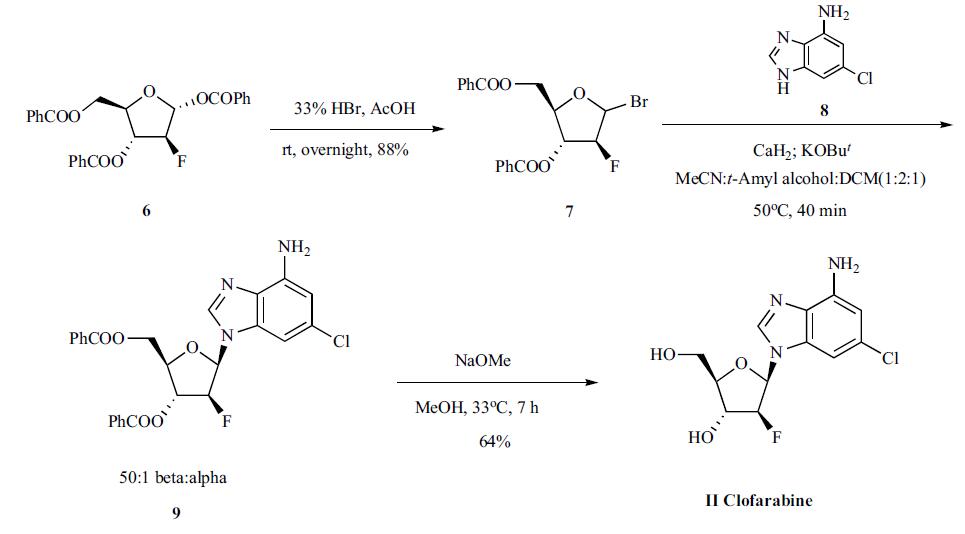
The drug was discovered by Ilex oncology (now Genzyme) and currently marketed by Genzyme [3,6]. Several routes to the synthesis of clofarabine have been published, including a process scale-up chemistry as shown in the Scheme. Treatment of commercially available 2-deoxy-2-|-fluoro-1,3,5-tri- O-benzoyl-1-R-D-arabinofuranose (6) with 33%HBr in acetic acid provided the bromo sugar 7 in 88% yield. The bromide 7 was reacted with 2-chloroadenine (8) in optimized mixed solvent system in the presence of calcium hydride and potassium t-butoxide to give the desired |-anomeric product 9 in 50:1 ratio. Deprotection of the benzoyl groups with sodium methoxide then provided clofarabine (II).
storage
Store at +4°C
References
[1] Patent: WO2011/3018, 2011, A2. Location in patent: Page/Page column 57
[2] Nucleosides, Nucleotides and Nucleic Acids, 2010, vol. 29, # 2, p. 113 - 122


Clofarabine Preparation Products And Raw materials
Raw materials
Preparation Products
| Supplier | Tel | Country | ProdList | Advantage | |
|---|---|---|---|---|---|
| Wuhu Nuowei Chemical Technology Co., Ltd | 0553-8233716 18055326116 | sales@nuowei-chem.com | China | 742 | 55 |
| Shanghai Boyle Chemical Co., Ltd. | sales@boylechem.com | China | 2915 | 55 | |
| J & K SCIENTIFIC LTD. | 18210857532 18210857532 | jkinfo@jkchemical.com | China | 96815 | 76 |
| Meryer (Shanghai) Chemical Technology Co., Ltd. | 4006356688 18621169109 | market03@meryer.com | China | 40202 | 62 |
| 3B Pharmachem (Wuhan) International Co.,Ltd. | 18930552037 | 3bsc@sina.com | China | 15813 | 69 |
| Chembest Research Laboratories Limited | 021-20908456 | sales@BioChemBest.com | China | 5996 | 61 |
| TCI (Shanghai) Development Co., Ltd. | 021-67121386 | Sales-CN@TCIchemicals.com | China | 24512 | 81 |
| Energy Chemical | 400-0056266 | sales8178@energy-chemical.com | China | 44850 | 61 |
| Capot Chemical Co., Ltd | +86 (0) 571 85 58 67 18 | China | 18187 | 66 | |
| Jia Xing Isenchem Co.,Ltd | 0573-85285100 18627885956 | isenchem@163.com | China | 9389 | 66 |
View Lastest Price from Clofarabine manufacturers
| Image | Update time | Product | Price | Min. Order | Purity | Supply Ability | Manufacturer | |
|---|---|---|---|---|---|---|---|---|
 |
2026-09-11 | Clofarabine
123318-82-1
|
1g | 99%min HPLC | 1000G | WUHAN FORTUNA CHEMICAL CO., LTD | ||
 |
2026-08-20 | Clofarabine USP/EP/BP
123318-82-1
|
$1.10 | 1g | 99.9% | 100 Tons Min | Dideu Industries Group Limited | |
 |
2026-08-20 | Clofarabine
123318-82-1
|
$36.00-87.00 | 99.94% | 10g | TargetMol Chemicals Inc. |
-
- Clofarabine
123318-82-1
- $0.00
- 99%min HPLC
- WUHAN FORTUNA CHEMICAL CO., LTD
-
- Clofarabine USP/EP/BP
123318-82-1
- $1.10
- 99.9%
- Dideu Industries Group Limited
-
- Clofarabine
123318-82-1
- $36.00-87.00
- 99.94%
- TargetMol Chemicals Inc.
