


CYCLANDELATE

- CAS No.
- 456-59-7
- Chemical Name:
- CYCLANDELATE
- Synonyms
- 3,3,5-TRIMETHYLCYCLOHEXYL MANDELATE;bs572;Cydel;Natil;andeL;BS 572;Capilan;Anaspat;Lejopan;Dilatan
- CBNumber:
- CB8668024
- Molecular Formula:
- C17H24O3
- Molecular Weight:
- 276.37
- MDL Number:
- MFCD00056623
- MOL File:
- 456-59-7.mol
- MSDS File:
- SDS
- TDS File:
- TDS
| Product description | Number | Pack Size | Price |
| 3,3,5-Trimethylcyclohexyl Mandelate (mixture of isomers) >94.0%(GC) | M0821 | 25g | $108 |
| Mandelic acid 3,3,5-trimethylcyclohexyl ester Asreported | 283240 | 25g | $359 |
| Mandelic acid 3,3,5-trimethylcyclohexyl ester Asreported | 283240 | 50g | $490 |
| Mandelic acid 3,3,5-trimethylcyclohexyl ester Asreported | 283240 | 100g | $613 |
| Mandelic acid 3,3,5-trimethylcyclohexyl ester Asreported | 283240 | 250g | $832 |
| More product size | |||
| Melting point | 55.0-56.5° |
|---|---|
| Boiling point | bp14 192-194° |
| Density | 1.0535 (rough estimate) |
| refractive index | 1.5490 (estimate) |
| storage temp. | Sealed in dry,Room Temperature |
| Water Solubility | Insoluble in water |
| solubility | Chloroform (Slightly), Methanol (Slightly, Sonicated) |
| pka | 12.13±0.20(Predicted) |
| form | powder to crystal |
| color | White to Almost white |
| Merck | 14,2704 |
| InChI | InChI=1S/C17H24O3/c1-12-9-14(11-17(2,3)10-12)20-16(19)15(18)13-7-5-4-6-8-13/h4-8,12,14-15,18H,9-11H2,1-3H3 |
| InChIKey | WZHCOOQXZCIUNC-UHFFFAOYSA-N |
| SMILES | C1(CC(CC(C)(C)C1)C)OC(=O)C(O)C1C=CC=CC=1 |
| FDA UNII | 4139O1OAY2 |
| ATC code | C04AX01 |
| EPA Substance Registry System | Benzeneacetic acid, .alpha.-hydroxy-, 3,3,5-trimethylcyclohexyl ester (456-59-7) |
SAFETY
Risk and Safety Statements
| Symbol(GHS) |  GHS07 |
|---|---|
| Signal word | Warning |
| Hazard statements | H319 |
| Precautionary statements | P264-P280-P305+P351+P338-P337+P313P |
| RTECS | OO8200000 |
| TSCA | TSCA listed |
| HS Code | 2918191350 |
| Hazardous Substances Data | 456-59-7(Hazardous Substances Data) |
| Toxicity | LD50 oral in rat: 5gm/kg |
CYCLANDELATE price More Price(26)
| Manufacturer | Product number | Product description | CAS number | Packaging | Price | Updated | Buy |
|---|---|---|---|---|---|---|---|
| TCI Chemical | M0821 | 3,3,5-Trimethylcyclohexyl Mandelate (mixture of isomers) >94.0%(GC) | 456-59-7 | 25g | $108 | 2026-04-30 | Buy |
| Usbiological | 283240 | Mandelic acid 3,3,5-trimethylcyclohexyl ester Asreported | 456-59-7 | 25g | $359 | 2026-06-03 | Buy |
| Usbiological | 283240 | Mandelic acid 3,3,5-trimethylcyclohexyl ester Asreported | 456-59-7 | 50g | $490 | 2026-06-03 | Buy |
| Usbiological | 283240 | Mandelic acid 3,3,5-trimethylcyclohexyl ester Asreported | 456-59-7 | 100g | $613 | 2026-06-03 | Buy |
| Usbiological | 283240 | Mandelic acid 3,3,5-trimethylcyclohexyl ester Asreported | 456-59-7 | 250g | $832 | 2026-06-03 | Buy |
CYCLANDELATE Chemical Properties,Uses,Production
Description
Almond (Amygdalus communis L) is a kind of nut from Xinjiang, China. Traditional Chinese medicine believes that almond can promote blood circulation to dispel blood stasis, lubricate bowels to relieve constipation, and relieve cough and asthma. The indications include amenorrhea, fever, wind arthralgia, malaria, blood stasis and pain, injuries, and blood stasis with constipation.
Physical properties
Appearance: white or almost white amorphous powder, special smell, and bitter taste. Solubility: very soluble in ethanol or acetone and almost insoluble in water. Melting point: 50–62 °C.
Originator
Cyclospasmol,Ives,US,1958
History
The chemical synthesis of cyclandelate was first synthesized by Funcke et al. from Elan Corporation in Ireland using a-hydroxyphenylacetic acid and cis-3,3,5-cycloalkyl cyclohexanol. The raw material of mandelic acid was obtained by hydrolysis after benzaldehyde reacted to sodium cyanide. However, sodium cyanide is hypertoxic, and because of its unique structure of a-hydroxy acid, it is easy to decompose under the acid condition, which leads to more by-products and low yield. A series of improved methods have been developed, which can reduce the environmental pollution under the premise of ensuring the yield of Zn/HCOONH4/ C2H5OH system . The method was used to synthesize cyclandelate since then. However, this drug has not yet been approved by the Food and Drug Administration in the United States, Canada, and other countries because it easily causes white blood cell deficiency. It has been withdrawn from the market after drug approval in Japan, France, and other countries in the 1970s.
Uses
vasodilator
Definition
ChEBI: The ester obtained by formal condensation of mandelic acid and 3,3,5-tricyclohexanol. It is a direct-acting smooth muscle relaxant used to dilate blood vessels.
Indications
The indications of cyclandelate are arteriosclerosis obliterans, acrocyanosis, cerebral arteriosclerosis, cerebral insufficiency, cerebrovascular disease, brain trauma, and post-traumatic brain syndrome.
Manufacturing Process
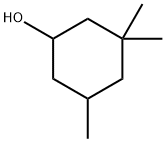
50 g of dl-mandelic acid are heated for 6 hours at approximately 100°C with 50 g of 3,3,5-trimethylcyclohexanol (mixture of cis and trans isomers), while passing dry hydrochloric acid gas as a catalyst through the mixture. The reaction product is subsequently poured out into water. After neutralization with potassium bicarbonate the ester is extracted with ether. The ether extract is dried with sodium sulfate, the ether is distilled off and the residue is distilled in vacuo. The fraction, which has a boiling point of 192° to 194°C at 14 mm, consists of the 3,3,5-trimethylcyclohexyl ester of mandelic acid, which is obtained in a yield of about 70%. The liquid solidifies to a colorless solid substance having a melting point of 50° to 53°C, according to US Patent 2,707,193. It has been found that crude cyclandelate may be purified by the following procedure. Crude cyclandelate is dissolved in a solvent chosen for convenience from the class of saturated hydrocarbons. The crude cyclandelate solution is stirred for a suitable interval, typically 1 to 5 hours, with an aqueous solution of sodium borohydride (NaBH4) at temperatures ranging from 25° to 65°C. The preferred temperature range is 40° to 50°C. The pH of the solution may be adjusted to any desired level in the range between 2.5 to 11.5. The preferred pH range is 8.0 to 11.0 because at lower pH levels borohydride is unstable and decomposes rapidly. The amount of sodium borohydride used ranges from about 0.5 to 2.0 wt % of the amount of cyclandelate present. At the end of the stirring period cyclandelate is recovered by well-known procedures. For instance, the aqueous organic layers may be separated gravimetrically and the product organic layer washed with an appropriate solvent and then distilled, according to US Patent 3,663,597.
brand name
Cyclospasmol (Wyeth-Ayerst).
Therapeutic Function
Spasmolytic
World Health Organization (WHO)
Cyclandelate is a papaverine type spasmolytic and vasodilating drug intended for symptomatic treatment of various peripheral vascular disorders, such as intermittent claudication in arteriosclerosis obliterans as well as a treatment for cognitive dysfunction in patients suffering from senile dementia of the multi-infarct or Alzheimer's type. Cyclandelate remains registered in several countries.
Pharmacology
The chemical structure and effect of cyclandelate are similar to papaverine. It can directly relax vascular smooth muscle and relieve the spasm of ileum and uterus smooth muscle induced by acetylcholine, histamine, and barium chloride in guinea pig. This effect is three to five times stronger than papaverine. Cyclandelate can also expand the cardiovascular, cerebrovascular, and renal blood vessels and limb peripheral vascular and coronary artery, increase blood flow, and promote blood circulation . It can also increase the tolerance to hypoxia, but the effect on human cerebral blood flow has not been confirmed. It was reported that cyclandelate can promote collateral circulation but has little effect on respiration, blood pressure, cardiac output, and myocardial oxygen consumption. It is safe for long-term administration .
Clinical Use
Cyclandelate can be used for clinical treatment of cerebral arteriosclerosis, cerebral vascular accident and its sequelae, post-traumatic brain syndrome, coronary arteriosclerosis, hypertensive heart disease, Raynaud’s disease, thromboangiitis obliterans, acrocyanosis, and Meniere’s disease .


CYCLANDELATE Preparation Products And Raw materials
Raw materials
Preparation Products
| Supplier | Tel | Country | ProdList | Advantage | |
|---|---|---|---|---|---|
| career henan chemical co | +86-0371-86658258 | sales@coreychem.com | China | 29766 | 58 |
| CONIER CHEM AND PHARMA LIMITED | sales@conier.com | China | 49906 | 58 | |
| TargetMol Chemicals Inc. | +1-781-999-5354; +1-00000000000 | marketing@targetmol.com | United States | 32431 | 58 |
| Hefei TNJ Chemical Industry Co.,Ltd. | +86-0551-65418671 +86-189 4982 3763 | sales@tnjchem.com | China | 34526 | 58 |
| AFINE CHEMICALS LIMITED | +86-571-85134551 +86-18958018566 | info@afinechem.com | China | 15050 | 58 |
| BOC Sciences | 16314854226; +8616314854226 | inquiry@bocsci.com | United States | 19852 | 58 |
| Dayang Chem (Hangzhou) Co.,Ltd. | +86-0571-88938639 17705817739 | info@dycnchem.com | China | 52693 | 58 |
| Guangzhou TongYi biochemistry technology Co.,LTD | tongyibiochem@163.com | China | 2988 | 58 | |
| Shaanxi Didu New Materials Co. Ltd | +86-86-17392712779 +86-13289823923 | 1090@dideu.com | China | 8651 | 58 |
| TargetMol Chemicals Inc. | +1-781-999-5354; | support@targetmol.com | United States | 38999 | 58 |
View Lastest Price from CYCLANDELATE manufacturers
| Image | Update time | Product | Price | Min. Order | Purity | Supply Ability | Manufacturer | |
|---|---|---|---|---|---|---|---|---|
 |
2026-05-11 | Cyclandelate
456-59-7
|
$31.00 | 98.00% | 10g | TargetMol Chemicals Inc. | ||
 |
2026-04-22 | Cyclandelate
456-59-7
|
$31.00 | 98.00% | 10g | TargetMol Chemicals Inc. | ||
 |
2026-03-20 | CYCLANDELATE
456-59-7
|
$10.00 | 1KG | 99% | 5tons | Hebei Chuanghai Biotechnology Co., Ltd |
-
- Cyclandelate
456-59-7
- $31.00
- 98.00%
- TargetMol Chemicals Inc.
-
- Cyclandelate
456-59-7
- $31.00
- 98.00%
- TargetMol Chemicals Inc.
-
- CYCLANDELATE
456-59-7
- $10.00
- 99%
- Hebei Chuanghai Biotechnology Co., Ltd
456-59-7(CYCLANDELATE)Related Search:
1of4
