| Company Name: |
LGM Pharma |
| Tel: |
1-(800)-881-8210 |
| Email: |
inquiries@lgmpharma.com |
- Enalapril
-
-
2026-08-17
- CAS:75847-73-3
- Min. Order: 1kg
- Purity: 99%
- Supply Ability: 20tons
- Enalapril
-

- $31.00
-
2026-07-27
- CAS:75847-73-3
- Purity: 99.51%
- Supply Ability: 10g
- Enalapril
-

- $15.00
-
2021-08-12
- CAS:75847-73-3
- Min. Order: 1KG
- Purity: 99%+ HPLC
|
| | Enalapril Basic information |
| Product Name: | Enalapril | | Synonyms: | ENALAPRIL;(s)-1-(n-(1-(ethoxycarbonyl)-3-phenylpropyl)-l-alanyl)-l-proline;1-(n-((s)-1-carboxy-3-phenylpropyl)-l-alanyl)-l-proline 1'-ethyl ester;1-[2-(1-ETHOXYCARBONYL-3-PHENYL-PROPYL)AMINOPROPANOYL]PYRROLIDINE-2-CARBOXYLIC ACID;N-[(1S)-1-(Ethoxycarbonyl)-3-phenylpropyl]-L-alanyl-L-proline;Renitec;Vasotec;Enalapril Maleate USP24 | | CAS: | 75847-73-3 | | MF: | C20H28N2O5 | | MW: | 376.45 | | EINECS: | | | Product Categories: | Angiotensin | | Mol File: | 75847-73-3.mol |  |
| | Enalapril Chemical Properties |
| Melting point | 142-147℃ | | Boiling point | 582.4±50.0 °C(Predicted) | | density | 1.204±0.06 g/cm3(Predicted) | | RTECS | TW3665500 | | storage temp. | under inert gas (nitrogen or Argon) at 2-8°C | | solubility | Soluble in DMSO | | form | Powder | | pka | pKa 2.97 (H2O t=25.0)(Approximate);5.35(H2O t=25.0)(Approximate) | | color | White to off-white | | Optical Rotation | -58.8066°(C=0.7659g/100ml DMF) | | Water Solubility | Soluble in water at 25mg/ml | | BCS Class | 3 | | InChIKey | GBXSMTUPTTWBMN-XIRDDKMYSA-N | | SMILES | C(O)(=O)[C@@H]1CCCN1C(=O)[C@H](C)N[C@H](C(OCC)=O)CCC1=CC=CC=C1 | | CAS DataBase Reference | 75847-73-3(CAS DataBase Reference) | | EPA Substance Registry System | L-Proline, N-[(1S)-1-(ethoxycarbonyl)-3-phenylpropyl]-L-alanyl- (75847-73-3) |
| | Enalapril Usage And Synthesis |
| Uses | angiotensin converting enzyme inhibitor | | Uses | It is used for hypertension and chronic cardiac insufficiency. | | Uses | Enalapril is used in the treatment of hypertension, diabetic nephropathy, and some types of chronic heart failure. It has been proven to protect the function of the kidneys in hypertension, heart failure, and diabetes, and may be used in the absence of hypertension for its kidney protective effects. It is widely used in chronic kidney failure. | | Definition | ChEBI: A dicarboxylic acid monoester that is ethyl 4-phenylbutanoate in which a hydrogen alpha to the carboxy group is substituted by the amino group of L-alanyl-L-proline (S-configuration). | | Mechanism of action | Like captopril, enalapril selectively suppresses the rennin–angiotensin–aldosterone system,
inhibits angiotensin-converting enzyme, and prevents conversion of angiotensin I into
angiotensin II. | | Synthesis | Enalapril, (S)-1-[N-[1-(ethoxycarbonyl)-3-phenylpropyl]-L-alanyl]-L-proline
(22.7.12), is synthesized by reacting the benzyl ester of L-alanyl-L-proline with the ethyl
ester of 3-benzoylacrylic acid, which forms the product 22.7.11, the reduction of which
with hydrogen using a Raney nickel catalyst removes the protective benzyl group, giving
the desired enalapril (22.7.12) [24]. Alternative methods of syntheses have also been proposed. 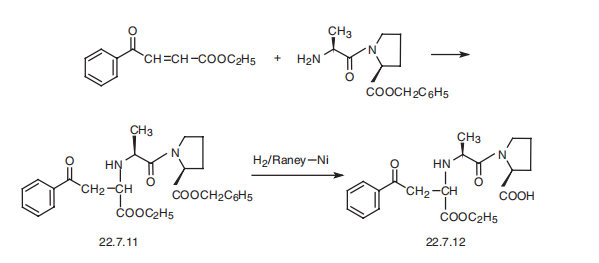
| | in vivo | Enalapril (intraperitoneal injection, 0.03 mg/kg, once, 1 hour) reduces infarct volume due to middle cerebral artery occlusion and lower or higher doses are ineffective in Male NMRI mice[4].
| Animal Model: | Male NMRI mice 20-40 g[4] | | Dosage: | 0.03 mg/kg | | Administration: | Intraperitoneal injection; once | | Result: | Reduced the area of middle cerebral artery infarction in mice at 0.03 mg/kg. |
|
| | Enalapril Preparation Products And Raw materials |
|