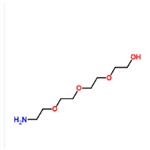
- Amino-PEG4-alcohol
-
- $2.00
-
2026-08-25
- CAS:86770-74-3
- Min. Order: 1kg
- Purity: 99%
- Supply Ability: 100kg
- NH2-PEG4-OH
-

-
2026-07-24
- CAS:86770-74-3
- Min. Order: 1g
- Purity: 98%
- Supply Ability: 1g/bottle, 10g/bottle, 100g/bottle
|
| | 1-Amino-3,6,9-trioxaundecanyl-11-ol Basic information |
| | 1-Amino-3,6,9-trioxaundecanyl-11-ol Chemical Properties |
| Boiling point | 301.6±27.0 °C(Predicted) | | density | 1.068±0.06 g/cm3(Predicted) | | storage temp. | -20°C | | solubility | Chloroform (Slightly), Methanol (Slightly) | | pka | 14.36±0.10(Predicted) | | form | solid or viscous liquid | | color | Colourless to Dark Brown | | Appearance | colorless to yellowish oil | | Water Solubility | Water: 50 mg/mL (258.75 mM) | | InChI | InChI=1S/C8H19NO4/c9-1-3-11-5-7-13-8-6-12-4-2-10/h10H,1-9H2 | | InChIKey | ANOJXMUSDYSKET-UHFFFAOYSA-N | | SMILES | C(O)COCCOCCOCCN | | CAS DataBase Reference | 86770-74-3 | | EPA Substance Registry System | Ethanol, 2-[2-[2-(2-aminoethoxy)ethoxy]ethoxy]- (86770-74-3) |
| WGK Germany | WGK 3 | | TSCA | TSCA listed | | HS Code | 2922190090 | | Storage Class | 11 - Combustible Solids |
| | 1-Amino-3,6,9-trioxaundecanyl-11-ol Usage And Synthesis |
| Description | Amino-PEG4-alcohol is a very popular PEG reagent containing an amino group (NH2) with a hydroxyl group (OH). The amino group is reactive with carboxylic acids, activated NHS esters, carbonyls (ketone, aldehyde) etc. The hydroxyl group enables further derivatization or replacement with other reactive functional groups. | | Chemical Properties | Pale Yellow Oil | | Uses | 1-Amino-3,6,9-trioxaundecanyl-11-ol can be used in a test kit to detect progesterone. | | reaction suitability | reagent type: cross-linking reagent
reactivity: carboxyl reactive | | Synthesis | General procedure for the synthesis of 1-amino-3,6,9-trioxa-11-undecanol from 11-azido-3,6,9-trioxa-11-undecanol: the azide was mixed with Pd/C catalyst (150 mg) in methanol (7.0 mL) and the reaction was stirred for 12 h under hydrogen atmosphere (1 atm). Upon completion of the reaction, the catalyst was removed by diatomaceous earth filtration and the filtrate was concentrated to afford the target product 1-amino-3,6,9-trioxa-11-undecanol in quantitative yield (0.520 g, 2.7 mmol). Ref: Xie, H. Z.; Braha, O.; Gu, L. Q.; Cheley, S.; Bayley, H. Chem. Biol. 2005, 12, 109-120. | | IC 50 | PEGs; Non-cleavable Linker | | References | [1] Helvetica Chimica Acta, 1991, vol. 74, # 8, p. 1697 - 1706
[2] Organic Letters, 2009, vol. 11, # 1, p. 193 - 196
[3] Angewandte Chemie - International Edition, 2015, vol. 54, # 35, p. 10327 - 10330
[4] Angew. Chem., 2015, vol. 35, # 37, p. 10467 - 10471,5
[5] Chemistry - A European Journal, 2018, vol. 24, # 4, p. 813 - 817 |
| | 1-Amino-3,6,9-trioxaundecanyl-11-ol Preparation Products And Raw materials |
| Raw materials | 3,6,9,12-Tetraoxatridecan-1-ol, 13,13,13-triphenyl-, 1-methanesulfonate-->1H-Isoindole-1,3(2H)-dione, 2-[2-[2-[2-(2-hydroxyethoxy)ethoxy]ethoxy]ethyl]--->1-METHANESULFONYL-11-HYDROXY-3,6,9-TRIOXAUNDECANE-->2,5,8,11-Tetraoxatridecan-13-ol, 1,1,1-triphenyl--->Tetraethylene glycol p-toluenesulfonate-->1-Azido-3,6,9-trioxaundecane-11-ol-->N-BOC-AMINOEHTOXY-ETHOXY-ETHOXY-ETHANOL-->2-[2-[2-[2-(Benzyloxy)ethoxy]ethoxy]ethoxy]ethanol-->Methanol-->Hydrogen | | Preparation Products | CBZ-N-AMIDO-PEG4-ALCOHOL |
|