- Basic Red 9
-

- $2.00
-
2019-07-06
- CAS:569-61-9
- Min. Order: 1KG
- Purity: Dye content 70%
|
| | Basic Red 9 Basic information |
| Product Name: | Basic Red 9 | | Synonyms: | 4-((4-aminophenyl)(4-imino-2,5-cyclohexadien-1-ylidene)methyl)-benzenaminm;4,4’-((4-imino-2,5-cyclohexadien-1-ylidene)methylene)dianilinemonohydrochlor;4,4’-((4-imino-2,5-cyclohexadien-1-ylidene)methylene)dianilinemonohydrochlorid;4,4’,4"-triaminotriphenylmethanehydrochloride;4,4’,4"-triaminotriphenylmethan-hydrochlorid;4,4’4’’-triaminotriphenylmethan-hydrochlorid;4-[(4-aminophenyl)(4-imino-2,5-cyclohexadien-1-ylidene)methyl]-benzenaminm;alpha-(p-aminophenyl)-alpha-(4-imino-2,5-cyclohexadien-1-ylidene)-4-toluidin | | CAS: | 569-61-9 | | MF: | C19H17N3.ClH | | MW: | 323.82 | | EINECS: | 209-321-2 | | Product Categories: | Triphenylmethane;Dyes and Pigments;Stains and DyesDerivatization Reagents TLC;Steroids, Terpenes, Lipids, Bile acids;Analytical Reagents;Microscopy Reagents;TLC Visualization Reagents (by application);Stains and Dyes | | Mol File: | 569-61-9.mol | 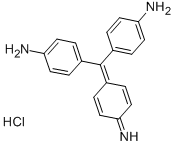 |
| | Basic Red 9 Chemical Properties |
| Melting point | 250 °C | | Boiling point | 479.57°C (rough estimate) | | bulk density | 500kg/m3 | | density | 0.999 g/mL at 20 °C | | refractive index | n20/D 1.334 | | Fp | 11 °C | | storage temp. | Store at RT. | | solubility | ethanol: soluble1mg/mL | | form | Solid | | Colour Index | 42500 | | color | metallic green | | PH Range | 1.0 - 3.1, purple to red | | PH | 5.0-6.0 (1g/L) | | Water Solubility | 10 g/L (25 ºC) | | λmax | 545 nm | | ε(extinction coefficient) | ≥11000 at 235-239nm in 50% ethanol at 0.003g/L
≥17000 at 287-291nm in 50% ethanol at 0.003g/L | | BRN | 4164603 | | Stability: | Stable. Incompatible with strong oxidizing agents. | | Biological Applications | Detecting breast cancer; treating pathogens | | Major Application | cleaning products
cosmetics
food and beverages
personal care | | InChI | 1S/C19H17N3.ClH/c20-16-7-1-13(2-8-16)19(14-3-9-17(21)10-4-14)15-5-11-18(22)12-6-15;/h1-12,20H,21-22H2;1H | | InChIKey | JUQPZRLQQYSMEQ-UHFFFAOYSA-N | | SMILES | [Cl-].Nc1ccc(cc1)C(\c2ccc(N)cc2)=C3/C=CC(=[NH2+])C=C3 | | CAS DataBase Reference | 569-61-9 | | IARC | 2B (Vol. 57, 99) 2010 | | EPA Substance Registry System | C.I. Basic Red 9, monohydrochloride (569-61-9) |
| Hazard Codes | F,T,Xn | | Risk Statements | 40-45-11 | | Safety Statements | 7-16-53-45-36/37 | | RIDADR | UN 2924 3/PG 2 | | WGK Germany | 3 | | RTECS | CX9850000 | | TSCA | TSCA listed | | HS Code | 32041300 | | Storage Class | 6.1D - Non-combustible acute toxic Cat.3
toxic hazardous materials or hazardous materials causing chronic effects | | Hazard Classifications | Carc. 1B | | Hazardous Substances Data | 569-61-9(Hazardous Substances Data) |
| | Basic Red 9 Usage And Synthesis |
| Chemical Properties | green crystalline powder | | Chemical Properties | C.I. Basic red 9 is a colorless to red crystalline
solid or green powder. | | Uses | Antischistosoma. | | Uses | Pararosaniline Hydrochloride is a red dye used for textiles. Dyes and metabolites, Environmental Testing. | | Definition | ChEBI: A hydrochloride that is the monohydrochloride of 4,4'-[(4-iminocyclohexa-2,5-dien-1-ylidene)methanediyl]dianiline. One of the major constituents of Basic fuchsin, together with rosanilin, magenta II and new fuchsin. | | Preparation | commonly known as (Para Magenta, Para Rosaniline) (a) 4-(4-Aminobenzyl)benzenamineand aniline, Aniline hydrochloride, the difficulties and ferric chloride in 170 ℃ heating hours;(b) aniline,p-Methylaniline and its hydrochloride and iron, ferrous chloride or 1-Nitrobenzeneheating; (C) anilineand p-Methylanilinewas treated with arsenic oxide; (d) anilinetetrachloride carbon heat. | | General Description | Colorless to red crystals or green powder. | | Air & Water Reactions | Insoluble in water. | | Health Hazard | ACUTE/CHRONIC HAZARDS: When heated to decomposition Basic Red 9 emits very toxic fumes of hydrogen chloride and nitrogen oxides. | | Fire Hazard | Flash point data for Basic Red 9 are not available; however, Basic Red 9 is probably combustible. | | Biological Activity | Basic fuchsin possesses anesthetic, bactericidal (gram-positive), and fungicidal properties. | | Safety Profile | Confirmed carcinogen with experimental carcinogenic and tumorigenic data. Mildly toxic by ingestion. Mutation data reported. When heated to decomposition it emits very toxic fumes of HCl and NOx. | | Synthesis | Basic magenta was prepared by synthesizing 4,4'-((4-iminocyclohexane-2,5-diene-1-idene)methylene)diphenylamine hydrochloride by air oxidation reaction in the presence of a cesium vanadate catalyst using 4,4'-diaminodiphenylmethane and aniline as raw materials in the following steps: (1) in a four-necked flask, a mixture of 4,4'-diaminodiphenylmethane and aniline was added at a weight ratio of 20:1 to obtain Mixture A. Four ports of the four-necked flask were fitted with a condenser, a water separator, a thermometer and an air introduction tube, and the flask was equipped with a stirrer. aniline in a four-necked flask at a weight ratio of 20:1 to obtain mixture A. The four ports of the four-necked flask were respectively fitted with a condenser, a water separator, a thermometer, and an air introduction tube, and the flask was equipped with a stirrer; (2) under stirring conditions, a 30% HCl solution weighing 0.77 times the weight of 4,4'-diaminodiphenylmethane was added to mixture A until it was completely dissolved, obtaining solution B; (3) solution B was added to solution B weighing 1% to 4% by weight of 4,4'-diaminodiphenylmethane as cesium vanadate catalyst to solution B to obtain solution C; (4) heating solution C to 140° C. and continuously passing air at this temperature for 5 hours until no water is generated, and product D is obtained at the end of the reaction; and (5) azeotropic distillation of the product D, removing and recovering excess aniline to obtain crude oil. The crude oil was poured out of a four-neck flask and cooled to become brittle; (6) the brittle crude oil was ground and stirred with a dilute hydrochloric acid solution to pH ≤ 1 to obtain solution E; (7) solution E was stirred continuously for 6.5 hr, and then filtered through diatomaceous earth to obtain filtrate F; (8) the pH of the filtrate F was adjusted to 5 with a 0.4 mol/L NaOH solution at 24 °C, and filtered to obtain the filter cake G; ( (9) The filter cake G was dissolved in boiling water at pH=4, cooled to room temperature and left to crystallize for 16 hours, and finally filtered to obtain the solid product basic magenta crystals in 70% yield. | | Potential Exposure | Used as a dye for textiles, paper;
printing, computer and photo imaging inks, leather, and
many consumer products; as a microbiological/microscopy
stain for bacilli, including tubercle and influenza. | | Carcinogenicity | Basic red 9 monohydrochloride is reasonably anticipated to be a human carcinogen based on sufficient evidence of carcinogenicity fromstudies in experimental animals. | | Shipping | UN 3143 Dyes, solid, toxic, n.o.s., or dye intermediates,
solid, toxic, n.o.s., Hazard Class: 6.1; Labels:
6.1—Poisonous materials, Technical Name Required. | | Properties and Applications | colourful red blue light. Slightly soluble in cold water, soluble in hot water for red, easily soluble in ethanol is cherry red. The strong sulfuric acid for yellow brown, after dilute for purple. Used in the manufacture of blue ink, also can dye tannins mordant dyeing cotton.
|
Standard( Cotton )
|
Light Fastness
|
Persperation Fastness
|
Ironing Fastness
|
Soaping
|
|
Fading
|
Stain
|
Fading
|
Stain
|
Fading
|
Stain
|
|
A
|
2
|
1
|
|
|
|
1
|
|
| | Incompatibilities | May be combustible; powder or liquid
may form explosive mixture with air. Incompatible with
oxidizers (chlorates, nitrates, peroxides, permanganates,
perchlorates, chlorine, bromine, fluorine, etc.); contact may
cause fires or explosions. Keep away from alkaline materials,
strong bases, strong acids, oxoacids, epoxides. | | Waste Disposal | Use a licensed professional
waste disposal service to dispose of this material. Dissolve
or mix the material with a combustible solvent and burn in
a chemical incinerator equipped with an afterburner and
scrubber. All federal, state, and local environmental regulations
must be observed. | | References | [1] Patent: CN105936752, 2016, A. Location in patent: Paragraph 0323 - 0333 |
| | Basic Red 9 Preparation Products And Raw materials |
|