- XMC
-

- $1.00
-
2020-01-13
- CAS:2655-14-3
- Min. Order: 1g
- Purity: 99.0%
- Supply Ability: 100kg
|
| Product Name: | XMC | | Synonyms: | XMC;XMC emulsion;XMC STANDARD;3,5-dimethyl-phenomethylcarbamate;3,5-Dimethylphenyl Methylcarbamate;3,5-Dimethylphenyl N-methylcarbamate;3,5-dimethylphenylmethylcarbamate;3,5-dimethylphenyln-methylcarbamate | | CAS: | 2655-14-3 | | MF: | C10H13NO2 | | MW: | 179.22 | | EINECS: | | | Product Categories: | Pharmaceutical Raw Materials | | Mol File: | 2655-14-3.mol | 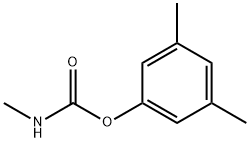 |
| Melting point | 101-102℃ (toluene pentane ) | | Boiling point | 311.75°C (rough estimate) | | density | 0.54 g/cm3 | | vapor pressure | 6.8 x 10⁻³ Pa (25 °C) | | refractive index | 1.5150 (estimate) | | storage temp. | 0-6°C | | Water Solubility | 470 mg l-1 (20 °C) | | pka | 12.38±0.46(Predicted) | | Henry's Law Constant | 5.5×101 mol/(m3Pa) at 25℃, Duchowicz et al. (2020) | | CAS DataBase Reference | 2655-14-3 | | EPA Substance Registry System | Phenol, 3,5-dimethyl-, 1-(N-methylcarbamate) (2655-14-3) |
| Chemical Properties | Colorless crystals. Melting point 99°C. Soluble in various organic solvents such as benzene and cyclohexanone, poorly soluble in water. Luminescence and stable below 90°C. | | Uses | XMC is an insecticide with primarily contact action. It is mainly
used to control leafhoppers and planthoppers on rice, and tea green leafhoppers
on tea. | | Uses | XMC (pesticide) is a pesticide used in pesticide formulation for the protection of green tea crops. | | Definition | ChEBI: XMC is a carbamate ester. It has a role as a carbamate insecticide, an EC 3.1.1.7 (acetylcholinesterase) inhibitor and an agrochemical. It is functionally related to a methylcarbamic acid and a 3,5-xylenol. | | Production Methods | The commercial synthesis of XMC begins with 3,5-xylenol as the primary raw material. This compound is dissolved in toluene, and then phosgene gas is introduced at low temperatures to form 3,5-xylyl chloroformate through esterification. Simultaneously, a 20% sodium hydroxide solution is added to neutralise the reaction medium. In the next step, monomethylamine is introduced along with additional sodium hydroxide at 0 DegC to carry out an amidation reaction, converting the chloroformate intermediate into the final XMC product. | | Production Methods | Dimethacarb is commercially produced through a phosgenation and carbamate formation process. The synthesis begins by dissolving 3,5-xylenol in toluene, then passing phosgene gas at low temperatures while simultaneously adding sodium hydroxide to form 3,5-xylyl chloroformate. This intermediate is then reacted with monomethylamine under controlled cooling to yield the methylcarbamate structure. After the amination step, the product is purified, dried, and milled to achieve technical-grade dimethacarb. | | Mechanism of action | Non-systemic. Acetylcholinesterase (AchE) inhibitor. | | Mechanism of action | Mainly contact action. Acetylcholinesterase (AchE) inhibitor. | | Metabolic pathway | Metabolic pathways for XMC involve hydroxylation of ring-methyl
groups, N-methyl groups and of the phenyl ring. Hydrolysis of the ester
moiety occurs in soils. | | Degradation | XMC is rapidly hydrolysed in alkaline media to afford the phenol (2). It is
relatively stable in neutral and weakly acidic aqueous solutions even at
temperatures up to 90 °C. Aqueous solutions of XMC are stable to light(PM). | | Pesticide Type | Insecticide | | Pesticide Type | Insecticide |
| | XMC Preparation Products And Raw materials |
|