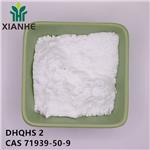
- DHQHS 2
-

-
2026-09-11
- CAS:71939-50-9
- Min. Order: 1KG
- Purity: ≥98% HPLC
- Supply Ability: 1000KG
- DHQHS 2
-
-
2026-08-25
- CAS:71939-50-9
- Min. Order: 1kg
- Purity: 0.99
- Supply Ability: 1000kg
|
| | DHQHS 2 Basic information |
| Product Name: | DHQHS 2 | | Synonyms: | Dihydroartemisinin 71939-50-9;Dihydroartemisinin (3R,5aS,6R,8aS,9R,10S,12R,12aR)-Decahydro-3,6,9-trimethyl-3,12-epoxy-12H-pyrano[4,3-j]-1,2-benzodioxepin-10-ol;]hexadecan-6-ol;Dihydroarteminisin;(3R,5aS,6R,8aS,9R,10S,12R,12aR)-Decahydro-3,6,9-trimethyl- 3,12-epoxy-12H-pyrano[4,3-j]-1,2-benzodioxepin-10-ol;Alaxin;b-Dihydroartemisinin;Cotecxin | | CAS: | 71939-50-9 | | MF: | C15H24O5 | | MW: | 284.35 | | EINECS: | | | Product Categories: | Inhibitors;Metabolites & Impurities, Pharmaceuticals, Intermediates & Fine Chemicals;API;chemical reagent;pharmaceutical intermediate;phytochemical;reference standards from Chinese medicinal herbs (TCM).;standardized herbal extract;Intermediates & Fine Chemicals;Metabolites & Impurities;Pharmaceuticals;Miscellaneous Natural Products;71939-50-9 | | Mol File: | 71939-50-9.mol | 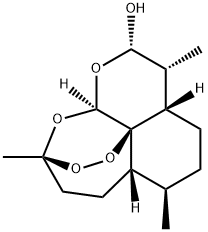 |
| | DHQHS 2 Chemical Properties |
| Melting point | 144-149°C | | Boiling point | 375.6±42.0 °C(Predicted) | | density | 1.24 | | storage temp. | Inert atmosphere,2-8°C | | solubility | DMSO : 41.67 mg/mL (146.54 mM; Need ultrasonic) | | pka | 12.61±0.70(Predicted) | | form | solid | | color | White to Almost white | | Merck | 14,817 | | Major Application | pharmaceutical (small molecule) | | InChI | InChI=1S/C15H24O5/c1-8-4-5-11-9(2)12(16)17-13-15(11)10(8)6-7-14(3,18-13)19-20-15/h8-13,16H,4-7H2,1-3H3/t8-,9-,10+,11+,12+,13-,14-,15-/m1/s1 | | InChIKey | BJDCWCLMFKKGEE-ISOSDAIHSA-N | | SMILES | O1[C@]23[C@@]4([H])O[C@@](C)(CC[C@@]2([H])[C@H](C)CC[C@@]3([H])[C@@H](C)[C@@H](O)O4)O1 | | CAS DataBase Reference | 71939-50-9(CAS DataBase Reference) |
| Safety Statements | 22-24/25 | | WGK Germany | 2 | | RTECS | KD4165550 | | HS Code | 29329990 | | Storage Class | 5.2 - Organic peroxides and self-reacting hazardous materials | | Hazard Classifications | Aquatic Chronic 2
Org. Perox. C |
| | DHQHS 2 Usage And Synthesis |
| Chemical Properties | White Solid | | Uses | The main metabolite of Artemisinin, Arteether, Artemether, Artesunate. An active antimalarial metabolite | | Definition | ChEBI: Artenimol is an artemisinin derivative. | | Synthesis | The general procedure for the synthesis of (3R,5aS,6R,8aS,9R,10S,12R,12aR)-3,6,9-trimethyldecahydro-3H-3,12-epoxy[1,2]dioxahepta[4,3-i]isochromene-10-ol from artemisinin was carried out as follows: under nitrogen protection, a solution of LiBHEt3 (a 1 M solution of tetrahydrofuran) was passed through a syringe was slowly added dropwise to a solution of artemisinin (200 mg, 0.71 mmol) dissolved in anhydrous tetrahydrofuran (20 mL). The temperature of the reaction mixture was maintained constant during the reaction by means of a water or ice water bath. The progress of the reaction was monitored by thin layer chromatography (TLC) until the artemisinin was completely consumed (about 5-10 min). Subsequently, THF solution of acetic acid (20 vol%, 100 μL or 50 μL at a time) was added in batches to quench the reaction and the pH of the reaction mixture was adjusted to 5-6. The reaction mixture was concentrated to dryness under reduced pressure. The dried residue was separated by extraction with ethyl acetate and distilled water. After separation of the organic phase, the aqueous phase was extracted twice more with ethyl acetate. All ethyl acetate extracts were combined and dried with anhydrous sodium sulfate for 6 hours. The dried organic phase was filtered and concentrated to dryness under reduced pressure to give a white flaky target product. | | in vivo | ,Single oral doses of Dihydroartemisinin (at 200, 300, 400 or 600 mg/kg), given once on each of day 6-8 post-infection, reduce total-worm burdens by 69.2%-90.6% and female-worm burdens by 62.2%-92.2%, depending on dosage in the first experiment. Similar treatments given on day 34-36 post-infection reduce total-worm burdens by 73.9%-85.5% and female-worm burdens by 83.8%-95.3%[3]. | | IC 50 | RelA; Plasmodium; Autophagy | | References | [1] Molecules, 2011, vol. 16, # 6, p. 4527 - 4538
[2] Journal of the Chemical Society. Perkin Transactions 1, 2001, # 19, p. 2421 - 2429
[3] Patent: WO2013/38206, 2013, A1. Location in patent: Paragraph 10; 11
[4] Journal of the American Chemical Society, 2011, vol. 133, # 7, p. 2076 - 2079
[5] Organic Process Research and Development, 2007, vol. 11, # 3, p. 336 - 340 |
| | DHQHS 2 Preparation Products And Raw materials |
| Raw materials | Tetrahydrofuran-->Lithium Triethylborohydride-->Artemisinin | | Preparation Products | Artesunate-->anhydrodihydroartemisinin-->Deoxy Artemisinin-->(3R,12aR)-3,6α,9β-Trimethyl-3β,12α-epoxy-3,4,5,5aα,6,7,8,8aα,9,10-decahydro-10α-ethoxypyrano[4,3-j]-1,2-benzodioxepin-->Arteether-->alpha-Dihydroartemisinin |
|