|
|
| | 2-Pyridinecarboxylic acid, 4-amino-3,5,6-trichloro-, isooctyl ester Basic information |
| Product Name: | 2-Pyridinecarboxylic acid, 4-amino-3,5,6-trichloro-, isooctyl ester | | Synonyms: | 2-Pyridinecarboxylic acid, 4-amino-3,5,6-trichloro-, isooctyl ester;octan-2-yl 4-amino-3,5,6-trichloro-pyridine-2-carboxylate;picloram isosoctyl ester;Picloram-isooctyl ester | | CAS: | 26952-20-5 | | MF: | C14H19Cl3N2O2 | | MW: | 353.68 | | EINECS: | | | Product Categories: | | | Mol File: | 26952-20-5.mol | 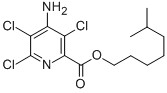 |
| | 2-Pyridinecarboxylic acid, 4-amino-3,5,6-trichloro-, isooctyl ester Chemical Properties |
| | 2-Pyridinecarboxylic acid, 4-amino-3,5,6-trichloro-, isooctyl ester Usage And Synthesis |
| Production Methods | Picloram-isoctyl is produced through an esterification-focused industrial process that begins with preparation and purification of picloram acid via the established chlorinated-pyridine route characteristic of the picolinic acid herbicide family. The acid is then transformed into an activated carboxyl derivative, most commonly an acid chloride, under conditions that protect the stability of the highly chlorinated heterocycle. This activated intermediate is reacted with iso octanol to form the iso-octyl ester, with solvent choice, catalysts, and temperature carefully managed to drive the esterification to completion while limiting hydrolysis or side-reactions. | | Mechanism of action | Selective, systemic absorbed by roots and leaves and translocated. Synthetic auxin. | | Toxics Screening Level | The ITSL for picloram, isooctyl ester is 0.1 μg/m3 based on annual averaging time. | | Pesticide Type | Herbicide |
| | 2-Pyridinecarboxylic acid, 4-amino-3,5,6-trichloro-, isooctyl ester Preparation Products And Raw materials |
|