- Lifitegrast
-

-
2026-09-17
- CAS:1025967-78-5
- Min. Order: 1g
- Purity: More Than 99%
- Supply Ability: 100kg/Month
- Lifitegrast
-
-
2026-09-17
- CAS:1025967-78-5
- Min. Order: 1KG
- Purity: 99%min
- Supply Ability: 100kg
- Lifitegrast
-

- $33.00
-
2026-09-10
- CAS:1025967-78-5
- Purity: 99.53%
- Supply Ability: 10g
|
| Product Name: | lifitegrast | | Synonyms: | CS-2633;Lifitegrast(API);SAR-1118;SAR1118;Lifitegrast-d4;Lifitegrast Impurity;lifitegrast;Lifitegrast, SAR 1118;L-Phenylalanine,N-[[2-(6-benzofuranylcarbonyl)-5,7-dichloro-1,2,3,4-tetrahydro-6-isoquinolinyl]carbonyl]-3-(methylsulfonyl)- | | CAS: | 1025967-78-5 | | MF: | C29H24Cl2N2O7S | | MW: | 615.48 | | EINECS: | 813-044-8 | | Product Categories: | API | | Mol File: | 1025967-78-5.mol | 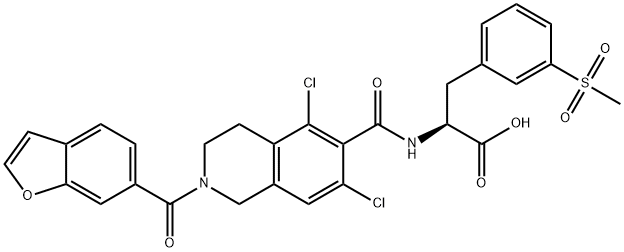 |
| | lifitegrast Chemical Properties |
| Melting point | >163°C (dec.) | | Boiling point | 811.9±65.0 °C(Predicted) | | density | 1.479±0.06 g/cm3(Predicted) | | storage temp. | Hygroscopic, -20°C Freezer, Under inert atmosphere | | solubility | DMSO (Slightly, Heated, Sonicated), Methanol (Slightly, Sonicated) | | form | Solid | | pka | 3.14±0.10(Predicted) | | color | White to Off-White | | Stability: | Hygroscopic | | InChIKey | JFOZKMSJYSPYLN-QHCPKHFHSA-N | | SMILES | C(O)(=O)[C@H](CC1=CC=CC(S(C)(=O)=O)=C1)NC(C1C(Cl)=CC2=C(C=1Cl)CCN(C(C1C=C3OC=CC3=CC=1)=O)C2)=O |
| | lifitegrast Usage And Synthesis |
| Application | Lifitegrast is used for the treatment of signs and symptons of dry eye diseases. It also Inhibites corneal inflammation that is capable of causing pains, blurred vision and ocular discomfort in sufferer. | | Pharmacodynamics | Lifitegrast is soluble in a phosphate-buffered saline at concentrations up to and exceeding 200 mg/ml, which allows up to a 10% (100 mg/ml) preparation that has an osmolality relatively equal to that of human tears (300 mOsm/L). This is preferred to reduce the likelihood of local irritation. In a study that evaluated the conjunctiva in mice, lifitegrast compared to vehicle demonstrated a statistically significant reduction in the expression of inflammatory mediators, including interferon gamma and chemokine ligand 9. In this same study, lifitegrast increased the number of conjunctival goblet cells and goblet cell area by 39% and 22%, respectively (p < 0.05 for both), resulting in a therapeutic improvement within 5 days. In an in vivo study of dogs with keratoconjuctivitis, a 1% solution of lifitegrast administered 3 times a day significantly increased tear production at the end of 12 weeks (Schirmer tear test, 3.4 to 5.8 mm; p < 0.025). In a separate in vitro study, lifitegrast exhibited a preferred negative result in the Ames test and low affinity for cytochrome P450 CYP3A4 and CYP2C9 enzymes (IC50 > 20 µM and IC50 = 3.0 µM, respectively) and the human Ether-à-go-go-Related Gene (hERG, IC50 > 20 µM)[1]. | | Description | Lifitegrast (Xiidra; lifitegrast sodium; SAR1118; SHP606; SPD606) is a lymphocyte functionassociated antigen-1 (LFA-1) antagonist. It inhibits T-cell inflammation by blocking the binding of two key surface proteins (LFA-1 and ICAM-1) that mediate the chronic inflammatory cascade associated with dry eye disease. In a phase III clinical trial, lifitegrast 5% ophthalmic solution (50 mg/mL) is administered as a single 0.2mL eye drop twice a day into each eye for an 84 day treatment period.
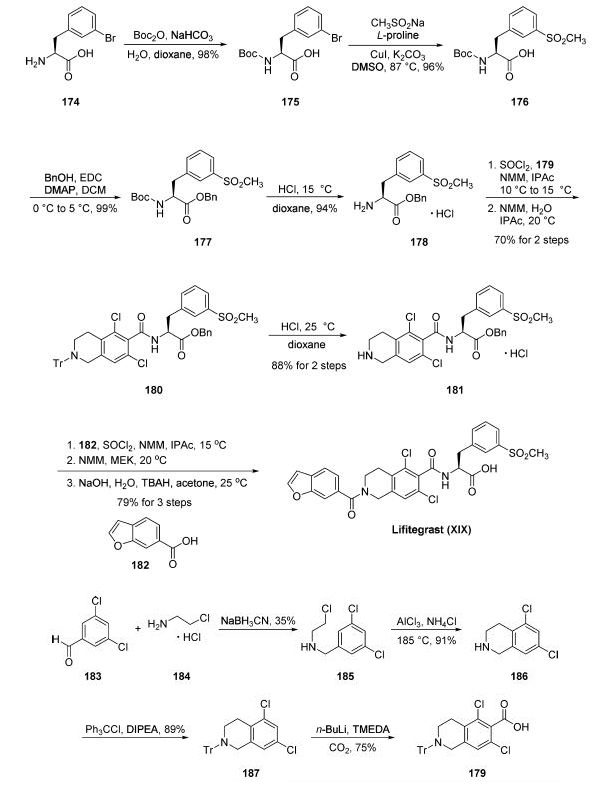
Lifitegrast does not currently have Marketing Authorisation in the EU for any indication. Lifitegrast is licensed for use in the USA for treatment of the signs and symptoms of dry eye disease. The most common adverse reactions (incidence 5-25%) reported following the use of lifitegrast are instillation site irritation, dysgeusia, and decreased visual acuity. | | Chemical Properties | Lifitegrast is a white to off-white powder which is soluble in water. | | Uses | Lifitegrast is used for the treatment of signs and symptons of dry eye diseases. It also Inhibites corneal inflammation that is capable of causing pains, blurred vision and ocular discomfort in sufferer. | | Indications | Topical lifitegrast was approved by the FDA for the treatment of dry eye. Lifitegrast decreases inflammation by blocking the interaction between intercellular adhesion molcule 1 and lymphocyte function- -associated antigen 1. In four, large, multicellular, randomized clinical trials, lifitegrast was shown to be effective in improving the signs and symptoms of dry eye. The side effects of lifitegrast include transient ocular irritation and dysgeusia. Further studies are needed to explore the effectiveness of combination therapy such as the concomitant use of topical cyclosporine and topical liftegrast. | | Definition | ChEBI: Lifitegrast is an N-acyl-L-alpha-amino acid obtained by formal condensation of the carboxy group of N-[2-(1-benzofuran-6-carbonyl)]-5,7-dichloro-1,2,3,4-tetrahydroisoquinoline-6-carboxylic acid with the amino group of 3-(methanesulfonyl)-L-phenylalanine. Used for treatment of keratoconjunctivitis sicca (dry eye syndrome). It has a role as an anti-inflammatory drug and a lymphocyte function-associated antigen-1 antagonist. It is a L-phenylalanine derivative, a sulfone, a N-acyl-L-alpha-amino acid, a member of isoquinolines and a member of 1-benzofurans. | | Mechanism of action | Lifitegrast binds to the integrin lymphocyte function-associated antigen-1 (LFA-1), a cell surface protein found on leukocytes and blocks the interaction of LFA-1 with its cognate ligand intercellular adhesion molecule-1 (ICAM-1). ICAM-1 may be overexpressed in corneal and conjunctival tissues in dry eye disease. LFA-1/ICAM-1 interaction can contribute to the formation of an immunological synapse resulting in T-cell activation and migration to target tissues. In vitro studies demonstrated that lifitegrast may inhibit T-cell adhesion to ICAM-1 in a human T-cell line and may inhibit secretion of inflammatory cytokines in human peripheral blood mononuclear cells. The exact mechanism of action of lifitegrast in dry eye disease is not known. | | Pharmacokinetics | In a subset of dry eye disease patients (n=47) enrolled in a Phase 3 trial, the pre-dose (trough) plasma concentrations of lifitegrast were measured after 180 and 360 days of topical ocular dosing (1 drop twice daily) with Xiidra (lifitegrast ophthalmic solution) 5%. A total of nine (9) of the 47 patients (19%) had plasma lifitegrast trough concentrations above 0.5 ng/mL (the lower limit of assay quantitation). Trough plasma concentrations that could be quantitated ranged from 0.55 ng/mL to 3.74 ng/mL. | | Side effects | A multicenter, randomized, double-masked, placebo-controlled phase 3 study (n = 331) evaluating the safety of lifitegrast ophthalmic solution for the treatment of dry eye disease reported the most common non-ocular effect was dysgeusia (change in taste) occurring in 16.4% of patients in the lifitegrast group and 1.8% of the placebo group. | | Synthesis | After Boc protection, reaction with sodium
methanesulfinate in the presence of copper iodide, K2CO3,
and L-proline gave rise to sulfonate 176. Esterification of 176
with benzyl alcohol followed by removal of the Boc group
within 177 yielded the corresponding HCl salt of the
aminoester 178. Amide bond coupling with acid 179 furnished amide 180, which was then
subjected to 4 N HCl in dioxane resulting in trityl removal and
arrival at HCl salt 181 in 88% yield over two steps.
Tetrahydroisoquinoline 181 was then coupled with commercial
benzofuranyl acid 182 to give rise to lifitegrast benzyl ester in
90% yield. Finally, saponification delivered lifitegrast (XIX) in
88% yield.
Tetrahydroisoquinoline-6-carboxylic acid 179 was prepared
starting from commercial 3,5-dichlorobenzaldehyde 183. Reductive amination with 1-chloro-2-aminoethane
184 gave chloroethyl amine 185, which underwent an
efficient intramolecular Friedel-Crafts reaction using AlCl3 to
generate the corresponding tetrahydroisoquinoline 186 in 91%
yield. N-Tritylation of 186 proceeded in 89% yield, and this was followed by a directed o-metalation reaction and carbon dioxide
quench to furnish the requisite acid 179 in 75% yield.
| | References | [1] Stacy L. Haber. “Lifitegrast: a novel drug for patients with dry eye disease.” ACS Applied Bio Materials (2019).
|
| | lifitegrast Preparation Products And Raw materials |
|