


Mirogabalin vs Pregabalin vs Gabapentin
Aug 31,2026
Mirogabalin (CAS 1138245-13-2) is a novel voltage-gated calcium channel α2δ ligand. It exerts a sustained analgesic effect by selectively binding to the α2δ-1 subunit (dissociation half-life of 11.1 hours vs. 2.4 hours for α2δ-2) while demonstrating a favorable central nervous system safety profile due to its rapid dissociation from the α2δ-2 subunit [1].
Mirogabalin, Pregabalin (CAS 148553-50-8), and Gabapentin (CAS 60142-96-3) are all voltage-gated calcium channel α2δ ligands. They exert analgesic effects by binding to α2δ subunits to reduce calcium influx and the release of excitatory neurotransmitters, and all are approved for the treatment of conditions such as neuropathic pain (NP) [2].

Indications
Mirogabalin is indicated for the treatment of diabetic peripheral neuropathic pain (DPNP), postherpetic neuralgia (PHN), central neuropathic pain (CNP), chemotherapy-induced peripheral neuropathy (CIPN), and orthopedic condition-related NP.
Pregabalin is indicated for the treatment of diabetic peripheral neuropathy (DPN), fibromyalgia, and spinal cord injury (SCI)-associated NP. Additionally, it is used to treat other forms of NP, including peripheral neuropathic pain (PNP)—such as DPNP—and central NP.
Gabapentin was initially approved by the FDA in 1993 for epilepsy. It subsequently received approval for PHN in 2002. In 2006, the EMA authorized the marketing of gabapentin in the European Union for NP, DPNP, and PHN. Currently, gabapentin is considered a first-line treatment for various types of NP in countries such as the United States, Japan, and China.
Mechanism of Action
Mirogabalin, a novel voltage-gated Ca2+ channel (VGCC) α2δ ligand with selective binding affinity for the α2δ-1 subunit over the α2δ-2 subunit, demonstrated a wider safety margin and a relatively lower incidence of adverse events compared with other gabapentinoids[1].
In vitro dissociation kinetic assays—conducted via radioactivity detection of 3H-labeled compounds using a stable α2δ-expressing 293A cell line—revealed higher binding affinity for α2δ-1 and α2δ-2 subunits [equilibrium dissociation constant (Kd) = 13.5 nmol/L and 22.7 nmol/L] for mirogabalin compared with pregabalin (Kd = 62.5 nmol/L and 125.0 nmol/L).
The dissociation half-life (t1/2) of mirogabalin is longer for the α2δ-1 subunit (11.1 h) than for the α2δ-2 subunit (2.4 h); thus, mirogabalin exhibits comparatively slower dissociation from α2δ-1. In contrast, pregabalin showed an identical dissociation t1/2 for both α2δ-1 and α2δ-2 subunits (1.4 h).
Mirogabalin has demonstrated both supraspinal and spinal actions against thermal and mechanical hypersensitivity, thereby alleviating neuropathic pain (NP) following partial sciatic nerve ligation. The supraspinal analgesic effects of mirogabalin involve the recruitment of the descending noradrenergic pain-inhibitory system through spinal activation of α2-adrenergic receptors. The analgesic mechanism of gabapentinoids is largely attributed to the reduction of dorsal horn sensitivity via binding to the α2δ subunit of VGCC.
Dosage
The recommended initial dose of mirogabalin for adult patients is 5 mg twice daily (BID); the dose should be increased by at least 5 mg per administration on a weekly basis, up to a maximum dose of 15 mg BID. Dosage adjustments are required for patients with renal impairment based on creatinine clearance (CrCl) levels: the recommended dose is 15 mg BID for mild impairment, 7.5 mg BID for moderate impairment, and 7.5 mg once daily (QD) for severe impairment.
Side Effects
The most common side effects of mirogabalin are nasopharyngitis, somnolence, dizziness, peripheral edema, and weight gain. For pregabalin, the most common side effects are dizziness, somnolence, peripheral edema, dry mouth, and fatigue. In contrast, the most common side effects of gabapentin are somnolence/drowsiness, dizziness, fatigue, imbalance, and peripheral edema.
Differences Among the Three Drugs
The differences among mirogabalin, pregabalin, and gabapentin are primarily as follows: Gabapentin is a first-generation drug with higher affinity for α2δ-1 than for α2δ-2 (Kd values of 59 nM and 153 nM, respectively). It requires high clinical doses (900–2400 mg/day) and carries a significant risk of adverse reactions such as dizziness, somnolence, and ataxia.
Pregabalin is a second-generation drug that exhibits high affinity for both α2δ-1 and α2δ-2 without subtype selectivity (Kd values of 6.0 nM and 7.2 nM, respectively). It is administered at clinical doses of 300–600 mg/day and has a relatively high incidence of adverse reactions (at 600 mg/day, the incidence of dizziness is 39% and somnolence is 26.8%).
Mirogabalin is a novel drug; while it also possesses high affinity for α2δ-1 and α2δ-2 (Kd values of 13.5 nM and 22.7 nM, respectively). It is characterized by slow dissociation from the α₂δ-1 subunit (dissociation half-life of 11.1 hours vs. 2.4 hours). Consequently, its clinical dosage is far lower than that of the other two (only 15–30 mg/day). Although weight gain and peripheral edema occur (at rates higher than placebo), the overall incidence of central nervous system-related adverse events is relatively low and dose-dependent (at 30 mg/day, somnolence is 14.5% and dizziness is 9.1%); some studies indicate that it has the lowest discontinuation rate among drugs in this class.
References
[1] Yang, F., Wang, Y., Zhang, M., Yu, S. (2024). Mirogabalin as a novel calcium channel α2δ ligand for the treatment of neuropathic pain: a review of clinical update. Frontiers in Pharmacology, 15, 1491570. https://doi.org/10.3389/fphar.2024.1491570
[2] Wu, Y., Guo, X., Zhang, J. (2025). Calcium Channel α2δ Ligands Mirogabalin, Pregabalin, and Gabapentin: Advancements in Diabetic Peripheral Neuropathic Pain Therapeutics. Pain and Therapy, 1647–1686. https://doi.org/10.1007/s40122-025-00771-1
- Related articles
- Related Qustion

Butyl stearate has become an indispensable additive in the chemical, textile, plastic, rubber and even cosmetics industries. It is often used as a mold lubricant, plasticizer and softener.....
Aug 31,2026Chemical Reagents
Diatrizoate sodium can enhance the visibility of internal structures in imaging techniques, this article will introduce its mechanism and side effects.....
Sep 1,2026API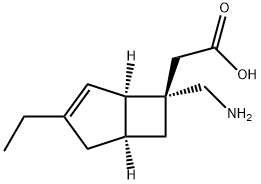
Mirogabalin
1138245-13-2You may like
- Mirogabalin
-

- $10.00
- 2026-09-08
- CAS:1138245-13-2
- Min. Order: 1ASSAYS
- Purity: 99%
- Supply Ability: 1 ton
- Mirogabalin
-

- $1.00
- 2026-08-07
- CAS:1138245-13-2
- Min. Order: 1KG
- Purity: 99%
- Supply Ability: 1KG 100K
- Mirogabalin base
-

- 2026-07-20
- CAS:1138245-13-2
- Min. Order: 1kg
- Purity: 99.5%min
- Supply Ability: 10000KGS