


What are the pathways for glucose synthesis?
Dec 17,2025
Glucose is a fundamental substance sustaining human life activities. Its synthesis pathways differ across organisms. In plants, glucose is synthesized through photosynthesis within chloroplasts of plant cells.
The synthesis equation is: 6CO₂ + 6H₂O + light energy → C₆H₁₂O₆ + 6O₂.
In animals, glucose synthesis occurs in the liver through non-carbohydrate sources (including lactate, glycerol, glycogen, and amino acids), a process known as gluconeogenesis. Gluconeogenesis is a metabolic pathway often regarded as the reverse of glycolysis. The pathways for gluconeogenesis are as follows:
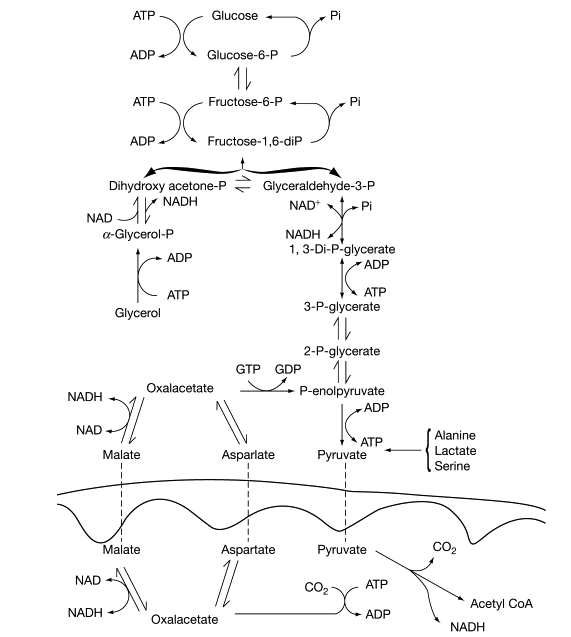
The major substrates for gluconeogenesis include lactate, pyruvate, propionate, glycerol, and 18 of the 20 amino acids (the exceptions are leucine and lysine). Glucose cannot be synthesized from fatty acids, since they are converted by β-oxidation into acetyl coenzyme A (CoA), which subsequently enters the citric acid cycle and is oxidized to CO2. The three-carbon fatty acid, propionate, is an exception since it is carboxylated, converted into succinyl-CoA, and enters the citric acid cycle as a four-carbon intermediate, not as acetyl CoA; acetone, which can be converted into propanediol, is a very minor gluconeogenic precursor. In addition, the last three carbon atoms of the odd-chain fatty acids generate proprionyl CoA during β-oxidation and are thus partly gluconeogenic. There are 14 enzymes involved in the conversion of lactate into glucose; three of these enzymes are classified as gluconeogenic (PEPCK, fructose-1,6-bisphosphatase (FBPase), and glucose-6-phosphatase (G6Pase)) and one is anaplerotic (PC), since it is important in both gluconeogenesis and lipogenesis. The remainder of the pathway is simply a reversal of the enzymes of glycolysis, which is responsible for the breakdown of glucose. Gluconeogenic enzymes are present in the cytosol, mitochondria, and endoplasmic reticulum (ER) of the tissues in which this pathway is present. Net gluconeogenesis occurs during starvation and after a meal high in fat and protein without carbohydrate.
The synthesis of D-Glucose monohydrate is usually achieved through the hydrolysis of starch and subsequent crystallization. The starch sources are commonly starch-rich plants such as cassava, potatoes, and corn.
- Related articles
- Related Qustion
- D-Glucose Monohydrate: A Comprehensive Overview Oct 21, 2024
D-glucose monohydrate is a common natural sugar involved in processes such as energy production, glycosylation, and formation of glycans that provide structure to cells.

D-Glucose monohydrate
5996-10-1You may like
D-Glucose monohydrate manufacturers
- D-Glucose monohydrate
-
- 2025-12-17
- CAS:5996-10-1
- Min. Order:
- Purity: 0.99
- Supply Ability:
- D-Glucose Monohydrate
-

- $0.00 / 1KG
- 2025-12-17
- CAS:5996-10-1
- Min. Order: 1KG
- Purity: 99.7%
- Supply Ability: 1000kg
- D-Glucose monohydrate
-
- $100.00/ kg
- 2025-12-16
- CAS:5996-10-1
- Min. Order: 1kg
- Purity: 99%
- Supply Ability: 5000