


Phenylbutazone

- CAS No.
- 50-33-9
- Chemical Name:
- Phenylbutazone
- Synonyms
- PBZ;phenylbutazon;4-Phenylbutazone;Benzone;Baotaisong;Butadione;Pyrazolidin;4-BUTYL-1,2-DIPHENYL-3,5-PYRAZOLIDINEDIONE;Bute;Butone
- CBNumber:
- CB0370134
- Molecular Formula:
- C19H20N2O2
- Molecular Weight:
- 308.37
- MDL Number:
- MFCD00005500
- MOL File:
- 50-33-9.mol
- MSDS File:
- SDS
- TDS File:
- TDS
| Melting point | 106-108 °C (lit.) |
|---|---|
| Boiling point | 448.76°C (rough estimate) |
| Density | 1.1591 (rough estimate) |
| refractive index | 1.6140 (estimate) |
| storage temp. | 2-8°C |
| solubility | Practically insoluble in water, sparingly soluble in alcohol. It dissolves in alkaline solutions. |
| form | Powder |
| pka | 4.5(at 25℃) |
| color | White to almost white |
| biological source | synthetic (organic) |
| Water Solubility | <0.1 g/100 mL at 23.5 ºC |
| Merck | 14,7277 |
| BRN | 290080 |
| Henry's Law Constant | 1.5×10³ mol/(m3Pa) at 25℃, HSDB (2015) |
| Stability | Stable. Incompatible with strong oxidizing agents, strong acids, strong bases. |
| Major Application |
forensics and toxicology veterinary |
| InChI | 1S/C19H20N2O2/c1-2-3-14-17-18(22)20(15-10-6-4-7-11-15)21(19(17)23)16-12-8-5-9-13-16/h4-13,17H,2-3,14H2,1H3 |
| InChIKey | VYMDGNCVAMGZFE-UHFFFAOYSA-N |
| SMILES | CCCCC1C(=O)N(N(C1=O)c2ccccc2)c3ccccc3 |
| LogP | 3.160 |
| Toxicology and Carcinogenesis | Toxicology and Carcinogenesis Studies of Phenylbutazone (CASRN 50-33-9) in F344/N Rats and B6C3F1 Mice (Gavage Studies) |
| CAS DataBase Reference | 50-33-9(CAS DataBase Reference) |
| EWG's Food Scores | 1 |
| FDA UNII | GN5P7K3T8S |
| ATC code | M01AA01,M02AA01 |
| NIST Chemistry Reference | Phenylbutazone(50-33-9) |
| IARC | 3 (Vol. 13, Sup 7) 1987 |
| EPA Substance Registry System | Phenylbutazone (50-33-9) |
| UNSPSC Code | 41116107 |
| NACRES | NA.77 |
SAFETY
Risk and Safety Statements
| Symbol(GHS) |  GHS06 |
|||||||||
|---|---|---|---|---|---|---|---|---|---|---|
| Signal word | Danger | |||||||||
| Hazard statements | H301-H312+H332-H315-H319-H335 | |||||||||
| Precautionary statements | P261-P280-P301+P310-P302+P352+P312-P304+P340+P312-P305+P351+P338 | |||||||||
| target organs | Respiratory system | |||||||||
| Hazard Codes | Xn,T,F | |||||||||
| Risk Statements | 36/37/38-20/21/22-42/43-45-36-11 | |||||||||
| Safety Statements | 36/37/39-26-45-22-53-36/37-16 | |||||||||
| RIDADR | 3249 | |||||||||
| WGK Germany | 3 | |||||||||
| RTECS | UQ8225000 | |||||||||
| TSCA | TSCA listed | |||||||||
| HazardClass | 6.1(b) | |||||||||
| PackingGroup | III | |||||||||
| HS Code | 29331990 | |||||||||
| Storage Class | 6.1C - Combustible acute toxic Cat.3 toxic compounds or compounds which causing chronic effects |
|||||||||
| Hazard Classifications | Acute Tox. 3 Oral Acute Tox. 4 Dermal Acute Tox. 4 Inhalation Eye Irrit. 2 Skin Irrit. 2 STOT SE 3 |
|||||||||
| Hazardous Substances Data | 50-33-9(Hazardous Substances Data) | |||||||||
| Toxicity | LD50 oral in rabbit: 781mg/kg | |||||||||
| NFPA 704 |
|
Phenylbutazone price More Price(61)
| Manufacturer | Product number | Product description | CAS number | Packaging | Price | Updated | Buy |
|---|---|---|---|---|---|---|---|
| Sigma-Aldrich | PHR2607 | Phenylbutazone | 50-33-9 | 500MG | $201 | 2026-04-30 | Buy |
| Sigma-Aldrich | P1200000 | Phenylbutazone European Pharmacopoeia (EP) Reference Standard | 50-33-9 | 100 mg | $167 | 2026-04-30 | Buy |
| Sigma-Aldrich | 1531007 | Phenylbutazone United States Pharmacopeia (USP) Reference Standard | 50-33-9 | 250mg | $404 | 2026-04-30 | Buy |
| Sigma-Aldrich | 79184 | Phenylbutazone analytical standard | 50-33-9 | 50mg | $59.1 | 2022-05-15 | Buy |
| TCI Chemical | P1686 | Phenylbutazone >98.0%(HPLC)(T) | 50-33-9 | 25g | $32 | 2026-04-30 | Buy |
Phenylbutazone Chemical Properties,Uses,Production
Abstract
Phenylbutazone, often referred to as "bute,"is a nonsteroidal anti-inflammatory, antipyretic, and analgesic drug (NSAID) for the short-term treatment of pain and fever results from rheumatoid arthritis, ankylosing spondylitis, gouty arthritis, and osteoarthritis.
Phenylbutazone has been removed from the United States market due to the availability of newer drugs with less adverse effects. Phenylbutazone is a nonsteroidal anti-inflammatory drug (NSAID) effective in treating fever, pain, and inflammation in the body. As a group, NSAIDs are non-narcotic relievers of mild to moderate pain of many causes, including injury, menstrual cramps, arthritis and other musculoskeletal conditions.
Chemical Property
It is soluble in acetone, chloroform or benzene freely; soluble in ethanol or ether; hardly soluble in water; soluble in sodium hydroxide solution.
Mechanism of action
Recent studies have found that the generating mechanism from phenylbutazone anti-inflammatory, analgesic and anti-rheumatic effect is not due to pituitary-adrenal excitement may be due to drugs that inhibit the generation of inflammatory tissue inflammation related active substances, such as synthesis of prostaglandins, white blood cells activities and transfer, release and activity of lysosomal enzymes; pain may also inhibit prostaglandin synthesis results.
Pharmacokinetic Study
Oral absorption effect is quickly and completely, reached the peak plasma concentration after about 2 hours. Plasma protein binding rate is 98%. The apparent volume of distribution is 0.12L/kg, such as increasing the dose, volume of distribution has also increased, but the blood concentration does not increase. Therefore, when using repeatedly, the steady-state plasma concentration does not increase linearly. The half-life is 56 to 86 hours. It can cross the placenta into the milk. This product is metabolized by the liver, metabolites is hydroxy phenylbutazone and γ-hydroxy phenylbutazone, still active, The final metabolites are excreted in urine and a small amount of bile is excreted through the urine.
Attention and Taboo
The side effects of phenylbutazone incidence rate is about 10%~20%, gastrointestinal irritation can cause nausea, vomiting, abdominal pain, constipation, overdose can cause peptic ulcer, blood in the stool. Damages also occur in other systems, such as rash, dizziness, hematuria, hepatitis, etc. Inhibit the bone marrow caused by neutropenia, or even aplastic anemia, such as the timely withdrawal is more recoverable and therefore should be ground check blood, no effect by 1 week, should not be reused. And double coumarin anticoagulants, sulfonamides, tolbutamide hypoglycemic drugs, increase the plasma concentration, toxicity increases. Sodium, chlorine retention effect, hypertension, edema, heart failure patients cannot use it and limit salt intake during the treatment. Patients with weak liver, osteoporosis, and kidney as well as drug allergy history are contraindicated or appropriate caution.
Preparation
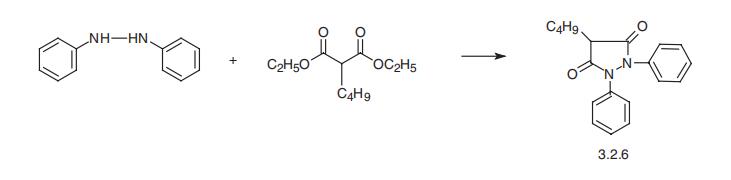
Cyclization reaction of hydrogenated azobenzene and diethylmalonic acid diethyl: hydrazobenzene, butyl diethyl malonate, sodium sulfite and methanol are heated with severe reflux 1.5h, born in Bute salt, acidified with acetic acid to give Bute.
Acute toxicity
oral-rat LD50: 245 mg/kg; Oral-Mouse LD50: 270 mg/kg
Irritation Data: Eye – rabbit, 100 mg, moderate
Flammability hazard properties
thermal decomposition emitted poisonous nitrogen oxides fumes
Storage characteristics
Treasury ventilation low-temperature drying; and food raw materials stored separately
Extinguishing agent
Water, carbon dioxide, dry powder, foam
References
https://en.wikipedia.org/wiki/Phenylbutazone
https://pubchem.ncbi.nlm.nih.gov/compound/phenylbutazone#section=Top
http://www.medicinenet.com/phenylbutazone/article.htm
Description
Phenylbutazone, one of the earliest NSAIDs introduced, is now indicated for the symptomatic relief of rheumatoid arthritis, osteoarthritis, psoriatic arthritis, ankylosing spondylitis, gout, and acute superficial thrombophlebitis. The gastrointestinal and bone marrow toxicity observed in its early use have been greatly reduced by lower dosage (300 mg/d). Nevertheless, it is used primarily where other drugs have failed and then only for short-term therapy. The drug has a long serum half-life of about 100 h. It is a moderately active cyclooxygenase inhibitor and it suppresses both spontaneous and chemotactic motility of neutrophils. In addition to the serious gastrointestinal and hematological adverse effects, sodium and water retention, rash, vertigo, and dermatitis are observed.
Chemical Properties
Off-Whtie Solid
Originator
Butazolidin, Geigy ,US,1952
Uses
A non-steroidal anti-inflammatory compound. An inhibitor of cyclooxygenase that is also a substrate for peroxidation by cyclooxygenase
Uses
For the treatment of backache and ankylosing spondylitis
Uses
An inhibitor of Cox.
Uses
Phenylbutazone, a nonsteroidal anti-inflammatory drug, is an efficient reducing cofactor for the peroxidase activity of COX. Phenylbutazone-dependent inactivation of COX and prostacyclin synthase is markedly increased in the presence of 100 μM hydrogen peroxide with half-maximal effects at Phenylbutazone concentrations of 100 and 25 μM for COX and prostacyclin synthase, respectively.
Definition
ChEBI: Phenylbutazone is a member of the class of pyrazolidines that is 1,2-diphenylpyrazolidine-3,5-dione carrying a butyl group at the 4-position. It has a role as a non-narcotic analgesic, a non-steroidal anti-inflammatory drug, an antirheumatic drug, a peripheral nervous system drug, a metabolite and an EC 1.1.1.184 [carbonyl reductase (NADPH)] inhibitor.
Manufacturing Process
7.6 parts of sodium are dissolved in 190 parts by volume of absolute alcohol; 65 parts of diethyl-n-butyl malonate and 65 parts of hydrazobenzene are added. The alcohol is slowly distilled off and the reaction mixture heated for 12 hours at a bath temperature of 150°C and finally in vacuo, until no more alcohol comes off.
The product is dissolved in water, clarified with a little animal charcoal and 15% hydrochloric acid is slowly added until an acid reaction to Congo red paper is produced. 1,2-Diphenyl-3,5-dioxo-4-n-butyl-pyrazolidine separates as an oil, which rapidly become crystalline. It crystallizes from alcohol as colorless needles with a MP of 105°C.
brand name
Azolid (Sanofi Aventis); Butazolidin (Novartis);Algesin;Algirreudin;Algoverine;Alka butazolidin;Alkabutazone;Alka-phenylbutazone;Alka-sterazolidin;Anarthral;Apophenylbutazone;Apo-phenylbutazone;Arteopan;Arthirikin;Artibrin;Artrisin;Artrodesmol extra;Bizolin 20;Bizolin 700;Butacal;Butacol;Butadilat;Butadin;Butadyne;Butafenil;Butagros;Butakvertin;Butaparin;Butaphen;Buta-phen;Butarex;Butartiril;Butatril;Butazolidin alka;Butazolidina;Butial;Butinol;Butiwas;Buto beta;Butoroid cream;Butrex;Carudol;Celestalgon;Celestazone;Colfezone;Corbuvit;Dartranol;Debutazon;Delta-butazolidin;Delta-demoplas;Delta-myogit;Delta-tomanol;Deltawaukobuzon;Dephimixn;Dexa tomanol;Dexa-attritin;Dexa-escopyrin;Dexamed;Dexatrzona;Dibuzon;Direstop;Ditrone;Doctofril;Dolosin dexa;Dolpirina;Ectobutazone;Ethibute;Exraheudon;Exrheudon;F 650;Fenibutina;Flebosil;Glycyl;Hepabuzon;Inflazone;Intrabuzone;Mammyl;Megazone;Mepha-butazone;Mepropyrin;Mi 540;Naupax;Neuro-demoplas;Neuzoline m;Novobutazone;Oluprin;Oppazoen;Osadrinim;Parazolidin;Parzolidon;Pasirheuman;Penetradol;Phenbuff;Phenbutazone;Phenylarthrite;Phenylbetazone;Phenylon plus;Phlebolan;Pirabutil;Pirarreumol-b;Pirarreumol-p;Prebutex;Precirhemin;Prednirheumin;Proxyfezone;Proydynam;Pyrbutal;Ranocor;Reopin;Reumilene;Rheopyrin;Rheosolon;Rheumanoln;Rheumaphen;Rheumycalm;Salzone;Servizolidin;Sigma-elmedal;Sintobutina;Stabilat;Tevocodyn;Tibutazone;Ticinil calcio;Ticinil calico;Trabit;Zolapelin;Zolidinium.
Therapeutic Function
Antiinflammatory, Antiarthritic
World Health Organization (WHO)
Phenylbutazone, a pyrazolone derivative with anti-inflammatory, analgesic and antipyretic activity, was introduced in 1949 for the treatment of rheumatic disorders. Its use was subsequently associated with serious and sometimes fatal adverse reactions, notably cases of aplastic anaemia and agranulocytosis. Many national drug regulatory authorities consider that more recently introduced drugs offer a safer alternative for most, if not all, patients requiring anti-inflammatory agents. Phenylbutazone has thus been either withdrawn at the national level or retained with rigorously restricted indications for patients unresponsive to other therapy. These restrictions also apply, in general, to combination products containing phenylbutazone.
General Description
Odorless white or off-white crystalline powder. Tasteless at first, but slightly bitter aftertaste. pH (aqueous solution) 8.2.
Air & Water Reactions
Phenylbutazone is relatively stable at ambient temperatures. Aqueous decomposition of Phenylbutazone occurs by hydrolysis and oxidation. Insoluble in water.
Reactivity Profile
Phenylbutazone is incompatible with strong oxidizers, strong acids and strong bases. .
Fire Hazard
Flash point data for Phenylbutazone are not available; however, Phenylbutazone is probably combustible.
Biochem/physiol Actions
Phenylbutazone is a hepatotoxin and binds to plasma proteins. It is used to treat inflammation in horse. Phenylbutazone has potential to treat ankylosing spondylitis. It has therapeutic potential to treat myotonic dystrophy type 1 (DM1) by inducing muscle blind-like protein 1 (MBNL1) expression. It also favors the expression of muscle chloride channel in skeletal muscles.
Clinical Use
Phenylbutazone is a nonsteroidal anti-inflammatory drug used for the acute treatment of ankylosing spondylitis, chronic polyarthritis, and gout. Because of severe side effects including disturbances of the hematopoietic system like agranulocytosis and aplastic anemia the use is limited to conditions in which other nonsteroidal antiinflammatory drugs do not show sufficient efficacy. Phenylbutazone is given as oral, rectal, intramuscular or topical formulation (up to 600 mg/d initial dose, up to 400 mg/d maintenance dose). The peak plasma concentration is reached 2 h after oral application. Phenylbutazone is bound to 98% to plasma protein. Oxyphenbutazone is formed as an active metabolite of phenylbutazone.
Safety Profile
Suspected human carcinogen producing leukemia. A human poison by parenteral route. An experimental poison by ingestion, intraperitoneal, subcutaneous, intravenous, and intramuscular routes. Human systemic effects by ingestion and possibly other routes: fever, blood pressure increase, other unspecified vascular effects, damage to kidney tubules and glomeruli, decreased urine volume, blood in the urine, reduction in the number of whte blood cells, and agranulocytosis. Experimental teratogenic and reproductive effects. Human mutation data reported. An eye irritant. An antiinflammatory agent. When heated to decomposition it emits toxic fumes of NOx
Synthesis
Phenylbutazone, 4-butyl-1,2-diphenyl-3,5-pyrazolidinedione (3.2.6), is synthesized in a single stage by reacting hydrazobenzol with butylmalonic ester [68,69].
Veterinary Drugs and Treatments
One manufacturer lists the following as the indications for phenylbutazone: “For the relief of inflammatory conditions associated with the musculoskeletal system in dogs and horses.” (Package Insert; Butazolidin—Coopers). It has been used primarily for the treatment of lameness in horses and, occasionally, as an analgesic/ antiinflammatory, antipyretic in dogs, cattle, and swine.
Purification Methods
Crystallise the dione from EtOH. Its pK2 3 is 4.52 (in H2O), 4.89 (in 50% aqueous EtOH) and 5.25 (80% 2-methoxyethanol). It complexes with Hg2+, Cd2+ and Zn2+. It has UV with max at 239.5nm in MeOH+50% aqueous HClO4 and 264nm in aqueous 0.1N NaOH. [Beilstein 24 III/IV 1123.]
Phenylbutazone Preparation Products And Raw materials
Raw materials
1of2
Preparation Products
| Supplier | Tel | Country | ProdList | Advantage | |
|---|---|---|---|---|---|
| Wuhan Wiseman Bioengineering Co.,Ltd | 13419526507 13419526507 | 13419526507@163.com | China | 2649 | 58 |
| Joyman BIOTECH (Lianyungang) Co., Ltd. | 0518-85817797 18661269107 | info@joy-man.com | China | 41 | 58 |
| J & K SCIENTIFIC LTD. | 18210857532 18210857532 | jkinfo@jkchemical.com | China | 96815 | 76 |
| Meryer (Shanghai) Chemical Technology Co., Ltd. | 4006356688 18621169109 | market03@meryer.com | China | 40202 | 62 |
| 3B Pharmachem (Wuhan) International Co.,Ltd. | 18930552037 | 3bsc@sina.com | China | 15813 | 69 |
| Alfa Aesar | 400-6106006 | saleschina@alfa-asia.com | China | 30103 | 84 |
| TAIYUAN RHF CO.,LTD. | +86 351 7031519 | sales@RHFChem.com | China | 2334 | 56 |
| TCI (Shanghai) Development Co., Ltd. | 021-67121386 | Sales-CN@TCIchemicals.com | China | 24512 | 81 |
| Energy Chemical | 400-0056266 | sales8178@energy-chemical.com | China | 44850 | 61 |
| Pure Chemistry Scientific Inc. | 001-857-928-2050 or 1-888-588-9418 | sales@chemreagents.com | United States | 10174 | 62 |
View Lastest Price from Phenylbutazone manufacturers
| Image | Update time | Product | Price | Min. Order | Purity | Supply Ability | Manufacturer | |
|---|---|---|---|---|---|---|---|---|
 |
2026-09-12 | Phenylbutazone
50-33-9
|
$10.00 | 1ASSAYS | 99% | 1 ton | RongNa Biotechnology Co.,Ltd | |
 |
2026-09-11 | Phenylbutazone
50-33-9
|
1g | More Than 99% | 100kg/Month | BEIJING SJAR TECHNOLOGY DEVELOPMENT CO., LTD. | ||
 |
2026-09-11 | Phenylbutazone
50-33-9
|
1KG | 98%-102%; USP | 1000KGS | WUHAN FORTUNA CHEMICAL CO., LTD |
-
- Phenylbutazone
50-33-9
- $10.00
- 99%
- RongNa Biotechnology Co.,Ltd
-
- Phenylbutazone
50-33-9
- $0.00
- More Than 99%
- BEIJING SJAR TECHNOLOGY DEVELOPMENT CO., LTD.
-
- Phenylbutazone
50-33-9
- $0.00
- 98%-102%; USP
- WUHAN FORTUNA CHEMICAL CO., LTD
