


Pyrogallol

- CAS No.
- 87-66-1
- Chemical Name:
- Pyrogallol
- Synonyms
- benzene-1,2,3-triol;1,2,3-Trihydroxybenzene;1,2,3-Benzenetriol;C6H6O3;Pyrogallo;1,2,3-Trihydroxybenzen;Piral;pyrogallic;PYROGALLOL (1,2,3-TRIHYDROXYBENZENE);PyrogaL
- CBNumber:
- CB6107909
- Molecular Formula:
- C6H6O3
- Molecular Weight:
- 126.11
- MDL Number:
- MFCD00002192
- MOL File:
- 87-66-1.mol
- MSDS File:
- SDS
- TDS File:
- TDS
| Melting point | 43-47 °C(lit.) |
|---|---|
| Boiling point | 309 °C |
| Density | 1.112 g/mL at 25 °C(lit.) |
| bulk density | 600kg/m3 |
| vapor density | 4.4 (vs air) |
| vapor pressure | 10 mm Hg ( 167.7 °C) |
| refractive index |
n |
| Flash point | >230 °F |
| storage temp. | Store below +30°C. |
| solubility | water: soluble |
| pka | pK1:9.03(0);pK2:11.63(+1) (25°C) |
| form | Very Fine Crystalline Powder |
| color | White |
| PH | 4-5 (50g/l, H2O, 20℃) |
| Water Solubility | 400 g/L (25 ºC) |
| Sensitive | Light Sensitive |
| Merck | 14,8000 |
| BRN | 907431 |
| Henry's Law Constant | 6.3×10⁴ mol/(m3Pa) at 25℃, HSDB (2015) |
| Stability | Stable, but decolourises in light. Combustible. Incompatible with strong oxidising agents, alkalies, metal oxides, ammonia, antipyrine, phenol, iodine, lime water, menthol, potassium permanganate, strong bases. |
| Major Application | pharmaceutical (small molecule) |
| Cosmetics Ingredients Functions | HAIR DYEING |
| InChI | 1S/C6H6O3/c7-4-2-1-3-5(8)6(4)9/h1-3,7-9H |
| InChIKey | WQGWDDDVZFFDIG-UHFFFAOYSA-N |
| SMILES | Oc1cccc(O)c1O |
| LogP | -0.47 |
| Toxicology and Carcinogenesis | Toxicology and Carcinogenesis Studies of Pyrogallol (CASRN 87-66-1) in F344/N Rats and B6C3F1 Mice (Dermal Studies) |
| FDA 21 CFR | 73.1375 |
| CAS DataBase Reference | 87-66-1(CAS DataBase Reference) |
| EWG's Food Scores | 4-7 |
| FDA UNII | 01Y4A2QXY0 |
| NIST Chemistry Reference | 1,2,3-Benzenetriol(87-66-1) |
| EPA Substance Registry System | Pyrogallol (87-66-1) |
| UNSPSC Code | 85151701 |
| NACRES | NA.24 |
SAFETY
Risk and Safety Statements
| Symbol(GHS) |   GHS07,GHS08 |
|||||||||
|---|---|---|---|---|---|---|---|---|---|---|
| Signal word | Warning | |||||||||
| Hazard statements | H302+H312+H332-H341-H412 | |||||||||
| Precautionary statements | P273-P280-P301+P312-P302+P352+P312-P304+P340+P312-P308+P313 | |||||||||
| PPE | dust mask type N95 (US), Eyeshields, Faceshields, Gloves, type P3 (EN 143) respirator cartridges | |||||||||
| Hazard Codes | Xn | |||||||||
| Risk Statements | 20/21/22-52/53-68-40-36/38 | |||||||||
| Safety Statements | 22-24/25-61-36/37-26 | |||||||||
| RIDADR | UN 2811 6.1/PG 3 | |||||||||
| WGK Germany | 3 | |||||||||
| RTECS | UX2800000 | |||||||||
| F | 8 | |||||||||
| TSCA | TSCA listed | |||||||||
| HS Code | 2907 29 00 | |||||||||
| HazardClass | 6.1 | |||||||||
| PackingGroup | III | |||||||||
| Storage Class | 11 - Combustible Solids | |||||||||
| Hazard Classifications | Acute Tox. 4 Dermal Acute Tox. 4 Inhalation Acute Tox. 4 Oral Aquatic Chronic 3 Muta. 2 |
|||||||||
| Hazardous Substances Data | 87-66-1(Hazardous Substances Data) | |||||||||
| Toxicity | LD50 orally in rabbits: 1.6 g/kg (Dollahite) | |||||||||
| REACH Registrations | Active | |||||||||
| Limited Quantities | 5.0 kg (11 lbs) (solid) | |||||||||
| Excepted Quantities | Max Inner Pack (30g or 30ml) and Max Outer Pack (1Kg or 1L) | |||||||||
| NFPA 704 |
|
Pyrogallol price More Price(110)
| Manufacturer | Product number | Product description | CAS number | Packaging | Price | Updated | Buy |
|---|---|---|---|---|---|---|---|
| Sigma-Aldrich | PHL89772 | Pyrogallol phyproof? Reference Substance | 87-66-1 | 100MG | $301 | 2026-04-30 | Buy |
| Sigma-Aldrich | 8.22302 | Pyrogallol for synthesis | 87-66-1 | 50g | $86.5 | 2026-04-30 | Buy |
| Sigma-Aldrich | 8.22302 | Pyrogallol for synthesis | 87-66-1 | 250g | $353 | 2026-04-30 | Buy |
| Sigma-Aldrich | 8.22302 | Pyrogallol for synthesis | 87-66-1 | 1kg | $634 | 2026-04-30 | Buy |
| Sigma-Aldrich | 16040 | Pyrogallol ACS reagent, ≥99% | 87-66-1 | 100g | $173 | 2026-04-30 | Buy |
Pyrogallol Chemical Properties,Uses,Production
Description
Pyrogallol is a natural oxidant that can generate superoxide (O2-) in alkaline solutions through autoxidation to a semiquinone radical. Importantly, the semiquinone radical can react with O2- in an acidic environment to produce a quinone and H2O2. Pyrogallol autoxidation is used in superoxide dismutase activity assays. It can also be used in assays to assess antioxidant capacity. Pyrogallol is used in some biological systems as an O2- scavenger. In other biological systems, it is used as an O2- generator. Pyrogallol effectively scavenges DPPH radical and ABTS+ in vitro. Pyrogallol is a product of tannin degradation to gallic acid by ruminant microbes and has hepatotoxic and nephrotoxic effects in vivo.
Chemical Properties
White or nearly white needle- or leaf-shaped crystals or crystalline powder.Pyrogallol is practically odorless.
Chemical Properties
white crystalline solid
Uses
Pyrogallol is used in the manufacture of various dyes; in dyeing furs, hairs, and feathers; for staining leather; in engraving;as a developer in photography; and as an analytical reagent..
Uses
Pyrogallol possesses importance as a spectrophotometric reagent in the determination of niobium and tantalum. The absorptions of niobium and tantalum complexes are usually measured at 340 and 335 nm, respectively. The niobium complex is formed in slightly acidic medium, and the tantalum complex in strongly acidic medium (4 N HC1). The absorption spectra are pH-dependen.
Uses
Complexing agent; reducing agent; alkaline solution indicator for gaseous oxygen.
Definition
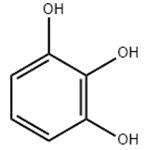
ChEBI: A benzenetriol carrying hydroxy groups at positions 1, 2 and 3.
Production Methods
Pyrogallol is prepared by heating dried gallic acid at about 200°C with the loss of carbon dioxide or by the chlorination of cyclohexanol to tetrachlorocyclohexanone, followed by hydrolysis.
General Description
Odorless white to gray solid. Sinks and mixes with water.
Air & Water Reactions
Turns gray on exposure to light or air. Water soluble.
Reactivity Profile
Pyrogallol is a strong reducing agent. Reacts with alkalis, NH3, antipyrine, camphor, phenol, iron and lead salts, iodine, lime water, menthol and KMnO4.
Hazard
Toxic by ingestion and skin absorption.
Health Hazard
The toxic symptoms are similar to those of phenol. It can enter the body by absorption through skin and ingestion. The poisoning effects are nausea, vomiting, gastritis, hemolysis, methemoglobinemia, kidney and liver damage, convulsions, and congestion of lungs. High doses can cause death. Ingestion of 2–3 g of solid can be fatal to humans. The LD50 values varied widely in species. The oral LD50 value in mice is about 300 mg/kg.
Health Hazard
Inhalation of dust causes irritation of nose and throat. Ingestion may cause severe gastrointestinal irritation, convulsions, circulatory collapse, and death. Contact with eyes causes irritation. Skin contact can cause local discoloration, irritation, eczema, and death; repeated contact can cause sensitization.
Fire Hazard
Pyrogallol is probably combustible.
Contact allergens
Pyrogallol belongs to the phenols group. It is an old photograph developer and a low sensitizer in hair dyes.
Biochem/physiol Actions
Pyrogallol also referred to as 1,2,3-trihydroxybenzene inhibits the response to nitric oxide (NO) in the rat anococcygeus muscle.
Safety Profile
Human poison by ingestion and subcutaneous routes. An experimental poison by ingestion, subcutaneous, intravenous, and intraperitoneal routes. Experimental teratogenic and reproductive effects. Questionable carcinogen with experimental tumorigenic data. Mutation data reported. 1 198 PPRSOO PYROSULFURYL CHLORIDE Readdy absorbed through the skin. Human systemic effects by ingestion: convulsions, dyspnea, gastrointestinal effects. A severe skin and eye irritant. Incompatible with alkalies, NH3, antipyrine, phenol, iron and lead salts, iodine, KMn04. When heated to decomposition it emits acrid smoke and irritating fumes. Used as a topical antibacterial agent, as an intermediate, hair dye component, and analytical reagent.
Carcinogenicity
Pyrogallol was not carcinogenic
in mouse and rabbit chronic dermal studies. Mice were
treated twice weekly with pyrogallol in acetone (50%) on
the shaved flank for life. There was no increase in dermal or
systemic tumors. A similar study in rabbits also
revealed no skin tumors, although positive controls showed
an increase in tumors in both mice and rabbits.
Pyrogallol was considered to be cocarcinogenic when
administered dermally three times a week together with
the skin carcinogen benzo[a]pyrene for 440 days;
pyrogallol administered alone caused no increase in skin
tumors.
Properties and Applications
Due to its oxygen radical generating property, pyrogallol is commonly used as a photographic developing agent, in hair dying industry, as an antiseptic and to calculate the amount of oxygen in the air.
References
[1] LUC MAGNANI Jean C H Emile M Gaydou. Spectrophotometric measurement of antioxidant properties of flavones and flavonols against superoxide anion[J]. Analytica Chimica Acta, 2000, 411 1: Pages 209-216. DOI: 10.1016/s0003-2670(00)00717-0
[2] LI* X. Improved Pyrogallol Autoxidation Method: A Reliable and Cheap Superoxide-Scavenging Assay Suitable for All Antioxidants[J]. Journal of Agricultural and Food Chemistry, 2012, 60 25: 6418-6424. DOI: 10.1021/jf204970r
[3] CHI-SEN CHANG Guia H L Chia Lin Chang. Reactive oxygen species scavenging activities in a chemiluminescence model and neuroprotection in rat pheochromocytoma cells by astaxanthin, beta-carotene, and canthaxanthin[J]. Kaohsiung Journal of Medical Sciences, 2013, 29 8: Pages 412-421. DOI: 10.1016/j.kjms.2012.12.002
[4] TINGTING WANG. Fisetin Protects DNA Against Oxidative Damage and Its Possible Mechanism.[J]. Advanced pharmaceutical bulletin, 2016, 6 2: 267-270. DOI: 10.15171/apb.2016.037
[5] AMY L SINDLER. Age and exercise training alter signaling through reactive oxygen species in the endothelium of skeletal muscle arterioles.[J]. Journal of applied physiology, 2013: 681-693. DOI: 10.1152/japplphysiol.00341.2012
[6] V MORENO-MANZANO. Selective involvement of superoxide anion, but not downstream compounds hydrogen peroxide and peroxynitrite, in tumor necrosis factor-alpha-induced apoptosis of rat mesangial cells.[J]. The Journal of Biological Chemistry, 2000, 275 17: 12684-12691. DOI: 10.1074/jbc.275.17.12684
[7] SINDHU MATHEW Zainul A Z T Emilia Abraham. Reactivity of phenolic compounds towards free radicals under in vitro conditions[J]. Journal of Food Science and Technology, 2015, 52 9: 5790-5798. DOI: 10.1007/s13197-014-1704-0
[8] REED J D. Nutritional toxicology of tannins and related polyphenols in forage legumes.[J]. Journal of animal science, 1995, 73 5: 1516-1528. DOI: 10.2527/1995.7351516x
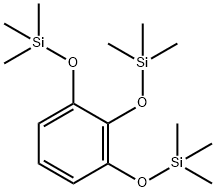

Pyrogallol Preparation Products And Raw materials
Raw materials
Preparation Products
1of4
| Supplier | Tel | Country | ProdList | Advantage | |
|---|---|---|---|---|---|
| HuBei Bass Electronic Material Co.,Ltd | 0716-0716-2852356 18971568347 | sale@basschemical.com | China | 35 | 58 |
| WUFENG CHICHENG BIOTECH CO LTD | 0717-5757168 13997700995 | wfcchem@126.com | China | 15 | 58 |
| Wuhan Jiyesheng Chemical Co., Ltd | 13343438917 | 3904307539@qq.com | China | 2178 | 58 |
| Nanjing Optimal New Materials Technology Co., Ltd. | 173-40521416 17340521416 | 1757224788@qq.com | China | 2000 | 58 |
| Nanjing Optimal New Materials Technology Co., Ltd. | 180-86404407 17340521416 | 1757224788@qq.com | China | 1011 | 58 |
| Shaoguan Mingtu Chemical Co., Ltd | 13411131983 | 2407385074@qq.com | China | 2046 | 58 |
| Jingjiang Lechuang Biotechnology Co.,Ltd | 150-61735421 15370960812 | lechuangsales01@163.com | China | 134 | 58 |
| J & K SCIENTIFIC LTD. | 18210857532 18210857532 | jkinfo@jkchemical.com | China | 96815 | 76 |
| Meryer (Shanghai) Chemical Technology Co., Ltd. | 4006356688 18621169109 | market03@meryer.com | China | 40202 | 62 |
| INTATRADE GmbH | +49 3493/605464 | sales@intatrade.de | Germany | 3563 | 66 |
Related articles
- Pyrogallol: A Multifaceted Chemical Compound
- Pyrogallol is an intestinal microbial metabolite of mango polyphenols, which is well reported for its antiproliferative activi....
- Oct 21,2024
View Lastest Price from Pyrogallol manufacturers
| Image | Update time | Product | Price | Min. Order | Purity | Supply Ability | Manufacturer | |
|---|---|---|---|---|---|---|---|---|
 |
2026-09-12 | Pyrogallol
87-66-1
|
0.99 | RongNa Biotechnology Co.,Ltd | ||||
 |
2026-09-11 | Pyrogallol
87-66-1
|
1kg | 99% | 1000mt/year | Jinan Finer Chemical Co., Ltd | ||
 |
2026-09-11 | Pyrogallol
87-66-1
|
1kg | 99.5%min | 10000kg | WUHAN FORTUNA CHEMICAL CO., LTD |
-
- Pyrogallol
87-66-1
- 0.99
- RongNa Biotechnology Co.,Ltd
-
- Pyrogallol
87-66-1
- $0.00
- 99%
- Jinan Finer Chemical Co., Ltd
-
- Pyrogallol
87-66-1
- 99.5%min
- WUHAN FORTUNA CHEMICAL CO., LTD
