|
|
| | Coagulation factor II receptor-like 2 (1-6) amide (mouse) Basic information |
| Product Name: | Coagulation factor II receptor-like 2 (1-6) amide (mouse) | | Synonyms: | PAR-3 (1-6) AMIDE (MOUSE);PROTEINASE ACTIVATED RECEPTOR 3 (1-6) AMIDE (MOUSE);THROMBIN RECEPTOR-LIKE 2 (1-6) AMIDE (MOUSE);SFNGGPAMIDE;SER-PHE-ASN-GLY-GLY-PRO-NH2;SFNGGP-NH2 PAR3 Tethered Ligand (Murine) / Activates PAR1 and PAR2;Proteinase Activated Receptor 3 (1-6) aMide (Mouse), SFNGGPaMide, ThroMbin Receptor-Like 2 (1-6) aMide (Mouse), Coagulation Factor II Receptor-Like 2 (1-6) aMide (Mouse);L-Seryl-L-phenylalanyl-L-asparaginylglycylglycyl-L-prolinamide | | CAS: | 261521-21-5 | | MF: | C25H36N8O8 | | MW: | 576.6 | | EINECS: | | | Product Categories: | | | Mol File: | 261521-21-5.mol | 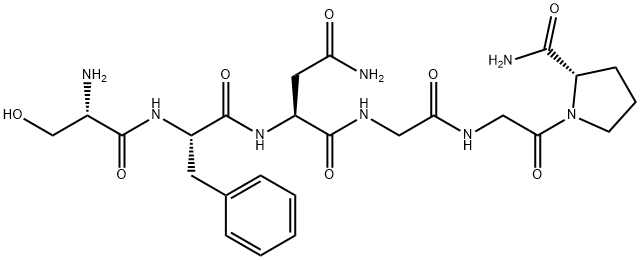 |
| | Coagulation factor II receptor-like 2 (1-6) amide (mouse) Chemical Properties |
| Sequence | Ser-Phe-Asn-Gly-Gly-Pro-NH2 |
| | Coagulation factor II receptor-like 2 (1-6) amide (mouse) Usage And Synthesis |
| Uses | SFNGGP-NH2 is a biological active peptide. (PAR-3 is a high-affinity thrombin receptor. PAR-3 mRNA is expressed in the cutaneous mast cells of humans. Protease-Activated Receptors (PARs) have been studied for their roles in itch and their itch-associated response through histamine-dependent/independent pathways have been reported. PAR-3 has been shown not to induce itching alone but possibly in conjunction with PAR-4. Co-expression of PAR-3 and PAR-4 enhances thrombin action suggesting that PAR-3 alone does not mediate transmembrane signaling but instead functions as a cofactor to activate PAR-4.) |
| | Coagulation factor II receptor-like 2 (1-6) amide (mouse) Preparation Products And Raw materials |
|