


Paeonol
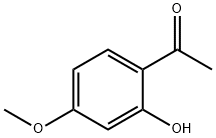
- CAS No.
- 552-41-0
- Chemical Name:
- Paeonol
- Synonyms
- 1-(2-HYDROXY-4-METHOXYPHENYL)ETHAN-1-ONE;Ethanone, 1-(2-hydroxy-4-methoxyphenyl)-;PEONOL;1-(2-HYDROXY-4-METHOXYPHENYL)ETHANONE;Paeonal;Paeonol std.;2-Hydroxy-4-methoxy;Paeonol (white powder);2-HYDROXY-4-METHOXYACETOPHENONE;Paeol
- CBNumber:
- CB7745872
- Molecular Formula:
- C9H10O3
- Molecular Weight:
- 166.17
- MDL Number:
- MFCD00008730
- MOL File:
- 552-41-0.mol
- MSDS File:
- SDS
- TDS File:
- TDS
| Melting point | 48-50 °C(lit.) |
|---|---|
| Boiling point | 154 °C / 20mmHg |
| Density | 1.3102 |
| refractive index | 1.5452 (estimate) |
| Flash point | >230 °F |
| storage temp. | 2-8°C |
| solubility | Acetonitrile (Slightly), Chloroform (Slightly), Methanol (Slightly) |
| form | Crystalline Powder |
| pka | 9.79±0.10(Predicted) |
| color | White to beige |
| Odor | Warm-aromatic odor |
| Odor Type | pungent |
| BRN | 1282794 |
| Cosmetics Ingredients Functions |
SKIN CONDITIONING ANTIOXIDANT |
| InChI | InChI=1S/C9H10O3/c1-6(10)8-4-3-7(12-2)5-9(8)11/h3-5,11H,1-2H3 |
| InChIKey | UILPJVPSNHJFIK-UHFFFAOYSA-N |
| SMILES | C(=O)(C1=CC=C(OC)C=C1O)C |
| LogP | 1.980 |
| CAS DataBase Reference | 552-41-0(CAS DataBase Reference) |
| EWG's Food Scores | 1 |
| FDA UNII | 3R834EPI82 |
| NIST Chemistry Reference | Ethanone, 1-(2-hydroxy-4-methoxyphenyl)-(552-41-0) |
| UNSPSC Code | 41116107 |
| NACRES | NA.24 |
SAFETY
Risk and Safety Statements
| Symbol(GHS) |  GHS07 |
|||||||||
|---|---|---|---|---|---|---|---|---|---|---|
| Signal word | Warning | |||||||||
| Hazard statements | H302+H312+H332-H315-H319-H335 | |||||||||
| Precautionary statements | P261-P264-P280-P302+P352+P312-P304+P340+P312-P337+P313 | |||||||||
| target organs | Respiratory system | |||||||||
| PPE | dust mask type N95 (US), Eyeshields, Faceshields, Gloves | |||||||||
| Hazard Codes | Xn,Xi | |||||||||
| Risk Statements | 20/21/22-36/37/38 | |||||||||
| Safety Statements | 26-28-36/37/39-45 | |||||||||
| WGK Germany | 3 | |||||||||
| RTECS | RT1215000 | |||||||||
| Hazard Note | Irritant | |||||||||
| HS Code | 29145090 | |||||||||
| Storage Class | 11 - Combustible Solids | |||||||||
| Hazard Classifications | Acute Tox. 4 Dermal Acute Tox. 4 Inhalation Acute Tox. 4 Oral Eye Irrit. 2 Skin Irrit. 2 STOT SE 3 |
|||||||||
| Toxicity | LD50 orl-mus: 3430 mg/kg YKKZAJ 89,1205,69 | |||||||||
| NFPA 704 |
|
Paeonol price More Price(99)
| Manufacturer | Product number | Product description | CAS number | Packaging | Price | Updated | Buy |
|---|---|---|---|---|---|---|---|
| Sigma-Aldrich | Y0001947 | Paeonol European Pharmacopoeia (EP) Reference Standard | 552-41-0 | 20 mg | $183 | 2026-04-30 | Buy |
| Sigma-Aldrich | H35803 | 2′-Hydroxy-4′-methoxyacetophenone 99% | 552-41-0 | 1g | $29.9 | 2026-04-30 | Buy |
| Sigma-Aldrich | H35803 | 2′-Hydroxy-4′-methoxyacetophenone 99% | 552-41-0 | 10g | $110 | 2026-04-30 | Buy |
| TCI Chemical | H0789 | 2'-Hydroxy-4'-methoxyacetophenone >98.0%(GC) | 552-41-0 | 5g | $21 | 2026-04-30 | Buy |
| TCI Chemical | H0789 | 2'-Hydroxy-4'-methoxyacetophenone >98.0%(GC) | 552-41-0 | 25g | $58 | 2026-04-30 | Buy |
Paeonol Chemical Properties, Uses, Production
Description
Paeonol is the main active ingredient of the cortex of thePaeonol raw materials with high purity can be derived from plant extracts by chemical synthesis. The commonly used extraction methods of paeonol include boiling method, alcohol extraction, steam distillation, and CO2 supercritical fluid extraction . But due to the limitation of plant resources and the lower content of paeonol in the natural plants, there are many separation and purification difficulties existed in the extraction methods. The chemical synthesis process is relatively easy, and the final product usually can be obtained through two- to three-step reaction and separation process . Ranunculaceae plants including Paeonia suffruticosa Andr. (Moutan cortex, Mudanpi) and Rhododendron plant Cynanchum paniculatum (Bge.) Kitag. (Cynanchi paniculati radix et rhizome, Xuchangqing). Moutan cortex and Xuchangqing are commonly used as traditional Chinese medicine. Moutan cortex has the effects on clearing heat, cooling blood, activating blood, resolving stasis, and retreating heat; Xuchangqing also has many effects, such as dispelling wind, relieving pain and itching, and so on.
Chemical Properties
white to beige crystalline powder
Physical properties
Appearance: white or light yellow, shining, needlelike crystals. Solubility: freely soluble in ethanol and methanol; soluble in diethyl ether, acetone, benzene, chloroform, and carbon disulfide; slightly soluble in water; and soluble in hot water, practically insoluble in cold water, and volatilizing in water vapor. Melting point: 48–51°C.
History
As the main active ingredient of Moutan cortex and Xuchangqing, paeonol has been used in clinical practice since ancient times. Paeonol was first isolated from Moutan cortex by Japanese scholar Changjing Changyi in 1884 . This clinical observation was proceeded at more than 10 medical units in Shanghai and other places and lasted more than 1 year since 1971. Paeonol injection was the earliest recorded in the Chinese pharmacopoeia 1977 edition; it is the main formulation until now. But because of the poor water solubility of paeonol, it is necessary to improve its solubility to be used as injection. Ten times amount of Tween compared to paeonol was used in the injection to increase the dissolution. In the 1970s, paeonol was made into oil solution for intramuscular injection. But these are with security risks and the use of inconvenience and other shortcomings. Pharmacist obtained paeonol sodium sulfonate by sulfonated paeonol, so the problem of water solubility had been resolved, and the injection of paeonol sodium sulfonate also came into being . In 2003, the quality standard of paeonol sodium sulfonate was also promoted from the local standard to the national standard. The dosage form of paeonol for skin is mainly ointment.
Uses
antibacterial, antimutagen, anti-alzheimer
Uses
An anti-inflammatory & anti-lipid peroxidation agent
Uses
Paeonol acting as a β-Secretase inhibitor an anti-apoptotic agent is used in the treatment of memory loss after ischemic stroke. Anti-inflammatory and analgesic.
Definition
ChEBI: A natural product found in Paeonia rockii subspecies rockii.
Indications
This drug has been recorded in Pharmacopoeia of the People’s Republic of China (1977). At present, the dosage forms of paeonol for clinical use include tablet, ointment, injection, and plaster. Paeonol is clinically used for the treatment of fever, headache, neuralgia, muscle pain, abdominal pain, rheumatoid arthritis and rheumatoid arthritis; its ointment can also be used for a variety of eczema, dermatitis, skin itching, mosquito bite redness, and other skin diseases, also has a certain effect for allergic rhinitis, and is used for prevention of cold.
Preparation
Preparation by reaction of methyl iodide, or dimethyl sulfate on resacetophenone in sodium hydroxide or potassium hydroxide solution (quantitative yield) (70–75%).
General Description
This substance is a primary reference substance with assigned absolute purity (considering chromatographic purity, water, residual solvents, inorganic impurities). The exact value can be found on the certificate. Produced by PhytoLab GmbH & Co. KG
Pharmacology
Paeonol has a wide range of pharmacological activities, and its antibacterial, antiinflammatory, antipyretic, analgesic, and antispasmodic pharmacological effects have been well known. With the recent further study of pharmacological effects of paeonol, the improvement of cardiovascular and cerebrovascular function, liver and kidney care, and antitumor, immune regulation, antioxidant, and other new pharmacological activities have also been reported successively. Studies have shown that the protective effects of paeonol on cardiovascular and cerebrovascular systems are displayed in three aspects: it has antiarrhythmic activity because of the blocking effect on calcium channel current; it can affect the endothelial cell inflammatory response, thus protecting the blood vessels and improving blood circulation; and it can stabilize the cell membrane and inhibit myocardial ischemia and membrane damage. Paeonol inhibits the proliferation of a variety of tumor cells, such as human leukemia cell line K562, human breast cancer gene T6-17, hepatocellular carcinoma cell line BEL-7404, hepatoma cell line HepA, human leukemia tumor cell line K562/ADM, cervical cancer cell line HeLa, human large intestine cancer cell line HT-29, and so on. It can also sensitize the multidrug resistance of tumor cells to the chemotherapy drugs. Low concentration of paeonol can increase the proportion of T lymphocytes in the blood circulation and also make T lymphocytes play a stronger lymphokine separation function but also can promote the non-specific phagocytic removal of bacteria function of neutrophil. The role of systemic cellular immunity and humoral immune function has also been experimentally confirmed. In addition, paeonol has a strong effect on scavenging free radical; its antioxidant effect also enables paeonol’s applications in the pharmaceutical field and food preservation industry.
Clinical Use
In clinical practice, paeonol is mainly used as a major active ingredient of multiflavor traditional Chinese medicine. For example, paeonol is the main active ingredient and quality control index of more than ten kinds of commonly used Chinese medicine preparations, such as Feng Shi Ding tablets, Liu Wei Di Huang pills, Zheng Gu Shui water, Gui Shao Di Huang Tang pills, Mai Wei Di Huang pills, Qi Ju Di Huang tablets, Ming Mu Di Huang pills, Zhi Bai Di Huang pills, Gu Ci pills, Gu Ci Xiao Tong tablets, Fu Fang Yi Gan pills, Yang Yin Qing Fei Tang pills, JiSheng Shen Qi Wan pills, and Danggui Yangxue pills. In addition, paeonol can also be administered as a monomeric drug. The listed preparations are mainly paeonol injection, paeonol tablets, and paeonol ointment, clinically for the treatment of rheumatism, stomachache, and other pains, eczema, allergic dermatitis, etc. Paeonol and its preparations have the characteristics of less side effect, no addictive, nonrebound, and high security.
Safety Profile
Poison by intravenous route. Moderately toxic by ingestion and intraperitoneal routes. When heated to decomposition it emits acrid smoke and irritating fumes.
Paeonol Preparation Products And Raw materials
| Supplier | Tel | Country | ProdList | Advantage | |
|---|---|---|---|---|---|
| Xi'an Ruisi Biotechnology Co., Ltd. | 17792397526 | 164706921@qq.com | China | 160 | 58 |
| Xi'an Kono chem co., Ltd. | 029-84385017-8006 15891391030 | info@konochemical.com | China | 642 | 58 |
| Jiangxi Baicao Pharmaceutical Co., Ltd., | +86-0796-8118889-8030 15907062626 | sales@jsjpharm.cn | China | 113 | 58 |
| Hubei Changao Pharmaceutical Co., Ltd | 027-87058617 13419515565 | 195755151@qq.com | China | 287 | 58 |
| Jiangxi Xuesong Natural Medicinal Oil Co. LTD | 18679669723 | 2134411736@qq.com | China | 282 | 58 |
| Hefei Lifeon Pharmaceutical Co.Ltd. | 0551-65328450 18956095011 | sales@lifeon.cn | China | 20 | 58 |
| Guangzhou Hichvan Chemical Co., Ltd. | 19128722614 | hichvan@163.com | China | 103 | 58 |
| Wuhan Boye Technology Development Co., Ltd. | 027-81625225 15377010747 | hui@boyechemicals.com | China | 497 | 58 |
| J & K SCIENTIFIC LTD. | 18210857532 18210857532 | jkinfo@jkchemical.com | China | 96815 | 76 |
| Meryer (Shanghai) Chemical Technology Co., Ltd. | 4006356688 18621169109 | market03@meryer.com | China | 40202 | 62 |
Related articles
- Paeonol: Chemical Properties, Biological Activities, and Applications in Pharmaceuticals and Cosmetics
- Paeonol has garnered significant attention in the chemical and pharmaceutical industries due to its broad spectrum of biologic....
- Nov 20,2024
View Latest Price from Paeonol manufacturers
| Image | Update time | Product | Price | Min. Order | Purity | Supply Ability | Manufacturer | |
|---|---|---|---|---|---|---|---|---|
 |
2026-09-29 | Paeonol; Peony root bark extract
552-41-0
|
1KG | ≥98% HPLC | 1000KG | Changsha Staherb Natural Ingredients Co., Ltd. | ||
 |
2026-09-29 | Paeonol
552-41-0
|
25KG | 98%min | 30tons/month | WUHAN FORTUNA CHEMICAL CO., LTD | ||
 |
2026-09-28 | Paeonol
552-41-0
|
$1.00 | 300g | 99.8% | 20 TONS | .GZ HONESTCHEM CO.,LTD |
-
- Paeonol; Peony root bark extract
552-41-0
- $0.00
- ≥98% HPLC
- Changsha Staherb Natural Ingredients Co., Ltd.
-
- Paeonol
552-41-0
- $0.00
- 98%min
- WUHAN FORTUNA CHEMICAL CO., LTD
-
- Paeonol
552-41-0
- $1.00
- 99.8%
- .GZ HONESTCHEM CO.,LTD
552-41-0 (Paeonol) Related Search:
1of4
