| Company Name: |
InnovaSyn Gold |
| Tel: |
025-83673882 13357828857 |
| Email: |
sales@innovasyn.net |
- L-2-Abu
-
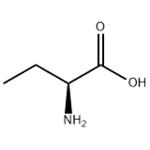
-
2026-09-30
- CAS:1492-24-6
- Min. Order: 1kg
- Purity: 99%
- Supply Ability: 1T+
|
| | L(+)-2-Aminobutyric acid Basic information |
| | L(+)-2-Aminobutyric acid Chemical Properties |
| Melting point | 300 °C | | alpha | 21.6 º (c=2, 5N HCl) | | Boiling point | 215.2±23.0 °C(Predicted) | | density | 1.2300 (estimate) | | refractive index | 1.4650 (estimate) | | storage temp. | room temp | | solubility | 22.7 g/100 mL (22°C) | | pka | 2.29(at 25℃) | | form | Crystalline Powder | | color | White to beige | | biological source | Porcine kidney
microbial
plant | | Water Solubility | 22.7 g/100 mL (22 ºC) | | Merck | 14,428 | | BRN | 1720935 | | Major Application | peptide synthesis | | InChI | 1S/C4H9NO2/c1-2-3(5)4(6)7/h3H,2,5H2,1H3,(H,6,7)/t3-/m0/s1 | | InChIKey | QWCKQJZIFLGMSD-VKHMYHEASA-N | | SMILES | CC[C@H](N)C(O)=O | | CAS DataBase Reference | 1492-24-6(CAS DataBase Reference) | | NIST Chemistry Reference | (l)-2-Aminobutanoic acid(1492-24-6) | | EPA Substance Registry System | Butanoic acid, 2-amino-, (2S)- (1492-24-6) |
| Hazard Codes | Xi | | Risk Statements | 43 | | Safety Statements | 36/37 | | WGK Germany | 3 | | Hazard Note | Irritant | | TSCA | TSCA listed | | HS Code | 29224999 | | Storage Class | 11 - Combustible Solids | | Hazard Classifications | Skin Sens. 1 |
| | L(+)-2-Aminobutyric acid Usage And Synthesis |
| Chemical Properties | White Crystalline Solid | | Uses | aminobutyric acid is an amino acid with water-binding properties and possible anti-inflammatory capacities. | | Uses | L-(+)-2-Aminobutyric acid is used in the biosynthesis of nonribosomal peptides. It acts as a receptor antagonist. It is also used as a chiral reagent. Further, it is used in the determination of substrate of glutamyl cysteine acid synthase. In addition to this, it is also utilized as a drug intermediate. | | Definition | ChEBI: An optically active form of alpha-aminobutyric acid having L-configuration. | | Synthesis Reference(s) | Journal of the American Chemical Society, 68, p. 450, 1946 DOI: 10.1021/ja01207a032 | | General Description | L-2-Aminobutyric acid is synthesized from L-threonine and L-aspartic acid through a -transamination reaction. It is an L-alanine analogue with an ethyl side chain. | | Biochem/physiol Actions | L-α-Aminobutyric acid (AABA) is an isomer of the non-natural amino acid aminobutyric acid with activity in the γ-glutamyl cycle that regulates glutathione biosynthesis. Recently AABA has been studied as a supplement to in vitro maturation medium (NCSU 23 medium) for culture of oozytes and embryos. This product has been qualified for use in cell culture. AABA is also used as a substitute amino acid for alanine in studies on peptide function. | | Synthesis | The preparation of l-2-aminobutyric acid (l-ABA) is mainly achieved by chemical synthesis or enzymatic conversion. In chemical methods, synthesis of l-ABA has been extensively reported, including ammonolysis of α-halogen acid, reduction reaction, ammoniation hydrolysis reaction and butanone acid reduction. However, the obvious disadvantages of chemical synthesis, such as poor selectivity, harsh reaction conditions, various byproducts, and the difficulty in separation and purification, limited its development. It is reported that l-ABA was synthesized in a transamination reaction from α-ketobutyric acid and l-aspartic acid as substrates using aromatic aminotransferase or produced from α-ketobutyric acid and benzylamine using ω-aminotransferase. l-ABA could also be produced from the reduction of α-keto acids with l-leucine dehydrogenase or glutamate dehydrogenase[1].
| | Purification Methods | Crystallise butyrine from aqueous EtOH, and the melting point depends on heating rate but has m 303o in a sealed tube. [Greenstein & Winitz The Chemistry of the Amino Acids J. Wiley, Vol 3 p 2399 IR: 2401 1961, Beilstein 4 III 1294, 4 IV 2584.] | | References | [1] Xu, Jian-Miao et al. “Fermentative production of the unnatural amino acid L-2-aminobutyric acid based on metabolic engineering.” Microbial cell factories vol. 18,1 43. 28 Feb. 2019, doi:10.1186/s12934-019-1095-z.
|
| | L(+)-2-Aminobutyric acid Preparation Products And Raw materials |
|