


Anthranilic acid
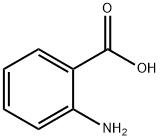
- CAS No.
- 118-92-3
- Chemical Name:
- Anthranilic acid
- Synonyms
- 2-AMINOBENZOIC ACID;O-AMINOBENZOIC ACID;2-aa;Anthranilic acid (VitaMin L1);2-Abz;Antranilic acid;Vitamin L;anthranilic;Anthranilic Acid 99 %;1-AMINO-2-CARBOXYBENZENE
- CBNumber:
- CB8852906
- Molecular Formula:
- C7H7NO2
Lewis structure

- Molecular Weight:
- 137.14
- MDL Number:
- MFCD00007712
- MOL File:
- 118-92-3.mol
- MSDS File:
- SDS
| Melting point | 144-148 °C(lit.) |
|---|---|
| Boiling point | 251.96°C (rough estimate) |
| bulk density | 500kg/m3 |
| Density | 1.412 |
| vapor density | 4.7 (vs air) |
| vapor pressure | 0.1Pa at 52.6℃ |
| refractive index | 1.5323 (estimate) |
| Flash point | 150°C |
| storage temp. | Store at 0°C |
| solubility | ethanol: may be clear to slightly hazy |
| pka | 2.108(at 25℃) |
| form | powder |
| color | White to pale yellow crystalline |
| PH Range | Non-B uorescence (1.5) light blue B uorescence (3.0) |
| Water Solubility | 5.7 g/L (25 ºC) |
| Merck | 14,422 |
| BRN | 471803 |
| Henry's Law Constant | 2.6×10⁵ mol/(m3Pa) at 25℃, HSDB (2015) |
| Stability | Stable. Incompatible with strong oxidizing agents. |
| Major Application | bottom antireflective coatings, semiconductor devices, inks, hair dyes, cosmetics, treatment of chronic inflammatory diseases, depression |
| Cosmetics Ingredients Functions | SKIN CONDITIONING - MISCELLANEOUS |
| InChI | 1S/C7H7NO2/c8-6-4-2-1-3-5(6)7(9)10/h1-4H,8H2,(H,9,10) |
| InChIKey | RWZYAGGXGHYGMB-UHFFFAOYSA-N |
| SMILES | Nc1c(cccc1)C(=O)O |
| LogP | 0.99 at 23℃ and pH3.7 |
| Toxicology and Carcinogenesis | Bioassay of Anthranilic Acid for Possible Carcinogenicity (CASRN 118-92-3) |
| CAS DataBase Reference | 118-92-3(CAS DataBase Reference) |
| EWG's Food Scores | 1 |
| FDA UNII | 0YS975XI6W |
| IARC | 3 (Vol. 16, Sup 7) 1987 |
| NIST Chemistry Reference | Anthranilic acid(118-92-3) |
| EPA Substance Registry System | Anthranilic acid (118-92-3) |
| UNSPSC Code | 12352106 |
| NACRES | NA.22 |
SAFETY
Risk and Safety Statements
| Symbol(GHS) |  GHS05 |
|||||||||
|---|---|---|---|---|---|---|---|---|---|---|
| Signal word | Danger | |||||||||
| Hazard statements | H318 | |||||||||
| Precautionary statements | P280-P305+P351+P338 | |||||||||
| Hazard Codes | Xi | |||||||||
| Risk Statements | 36-37-36/37/38 | |||||||||
| Safety Statements | 26-36-39 | |||||||||
| WGK Germany | 2 | |||||||||
| RTECS | CB2450000 | |||||||||
| Autoignition Temperature | >530°C | |||||||||
| TSCA | TSCA listed | |||||||||
| HS Code | 29224300 | |||||||||
| Storage Class | 11 - Combustible Solids | |||||||||
| Hazard Classifications | Eye Dam. 1 | |||||||||
| Hazardous Substances Data | 118-92-3(Hazardous Substances Data) | |||||||||
| REACH Registrations | Active | |||||||||
| NFPA 704 |
|
Anthranilic acid price More Price(16)
| Manufacturer | Product number | Product description | CAS number | Packaging | Price | Updated | Buy |
|---|---|---|---|---|---|---|---|
| Sigma-Aldrich | A89855 | Anthranilic acid reagent grade, ≥98% | 118-92-3 | 100g | $112 | 2026-04-30 | Buy |
| Sigma-Aldrich | 8.20112 | Anthranilic acid for synthesis | 118-92-3 | 100g | $38.6 | 2026-04-30 | Buy |
| Sigma-Aldrich | 8.20112 | Anthranilic acid for synthesis | 118-92-3 | 1kg | $219 | 2026-04-30 | Buy |
| Sigma-Aldrich | A89855 | Anthranilic acid reagent grade, ≥98% | 118-92-3 | 2kg | $978 | 2023-06-20 | Buy |
| Cayman Chemical | 18708 | Anthranilic Acid ≥98% | 118-92-3 | 10mg | $39 | 2026-04-30 | Buy |
Anthranilic acid Chemical Properties, Uses, Production
Chemical Properties
White to off white crystalline powder
Uses
Dyes, drugs, perfumes, and pharmaceuticals.
Uses
Anthranilic acid can be used in organic synthesis to generate the benzyne intermediate. It is used as an intermediate for production of dyes, pigments, and saccharin. It and its esters are used in preparing perfumes to imitate jasmine and orange, pharmaceuticals and UV-absorber as well as corrosion inhibitors for metals and mold inhibitors in soya sauce.
Application
2-Aminobenzoic acid is called vitamin L1; it enhances the milk production of cows. The major use of 2-aminobenzoic acid is as an intermediate for dyes. As its occurrence suggests, it is an intermediate for indigo synthesis. Mordant Brown 40 and Vat Violet 13 are other derivatives. 4-Hydroxy-1-methyl-carbostyril [1677- 46-9] is an important derivative used in making dyes and pigments. Its methyl and ethyl esters are used as fragrances for toiletries. In the pharmaceutical industry, it is used as an intermediate for tranquilizers and antiphlogistics.
Definition
ChEBI: An aminobenzoic acid that is benzoic acid having a single amino substituent located at position 2. It is a metabolite produced in L-tryptophan-kynurenine pathway in the central nervous system.
Synthesis Reference(s)
Chemical and Pharmaceutical Bulletin, 29, p. 1159, 1981 DOI: 10.1248/cpb.29.1159
Journal of the American Chemical Society, 107, p. 5008, 1985 DOI: 10.1021/ja00303a038
General Description
Odorless white to pale-yellow or tan crystalline powder with a sweetish taste.
Air & Water Reactions
Anthranilic acid may be sensitive to prolonged exposure to air and light. Insoluble in water.
Reactivity Profile
Anthranilic acid is incompatible with strong oxidizers.
Hazard
Questionable carcinogen.
Fire Hazard
Anthranilic acid is combustible.
Safety Profile
Moderately toxic by ingestion and intraperitoneal routes. Experimental reproductive effects. Human mutation data reported. Questionable carcinogen with experimental tumorigenic data. Combustible. When heated to decomposition it emits toxic fumes of NOx.
Purification Methods
Crystallise anthranilic acid from water (charcoal). It has also been recrystallised from 50% aqueous acetic acid. It sublimes in a vacuum. [Beilstein 14 IV 1004.]
Anthranilic acid Preparation Products And Raw materials
Raw materials
1of2
Preparation Products
1of8
