|
|
| | 2,4-Dimethylbromobenzene Basic information |
| Product Name: | 2,4-Dimethylbromobenzene | | Synonyms: | 4-BROMO-1,3-DIMETHYLBENZENE;1-Bromo-2,4-dimethyL;2,4-DIMETHYLBROMOBENZENE;4-Bromo-1,3-dimethylbenzene~2,4-Dimethylbromobenzene;4-BROMO-M-XYLENE 97%;4-BROMO-M-XYLENE, TECH., 90%;4-Bromo-m-xylene,97%;4-Bromo-m-xylene,98% | | CAS: | 583-70-0 | | MF: | C8H9Br | | MW: | 185.06 | | EINECS: | 209-517-8 | | Product Categories: | Aryl;Building Blocks;C8;Chemical Synthesis;Halogenated Hydrocarbons;Organic Building Blocks;Halogen toluene;Benzene derivates;Bromine Compounds;Aromatic Hydrocarbons (substituted) & Derivatives | | Mol File: | 583-70-0.mol | 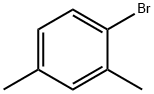 |
| | 2,4-Dimethylbromobenzene Chemical Properties |
| Melting point | -17°C | | Boiling point | 214 °C(lit.) | | density | 1.37 g/mL at 25 °C(lit.) | | refractive index | n20/D 1.551(lit.) | | Fp | 174 °F | | storage temp. | Sealed in dry,Room Temperature | | Water Solubility | Insoluble in water | | form | Liquid | | color | Clear colorless | | InChI | 1S/C8H9Br/c1-6-3-4-8(9)7(2)5-6/h3-5H,1-2H3 | | InChIKey | YSFLQVNTBBUKEA-UHFFFAOYSA-N | | SMILES | Cc1ccc(Br)c(C)c1 | | CAS DataBase Reference | 583-70-0(CAS DataBase Reference) | | NIST Chemistry Reference | Benzene, 1-bromo-2,4-dimethyl-(583-70-0) | | EPA Substance Registry System | 4-Bromo-m-xylene (583-70-0) |
| Hazard Codes | Xi | | Risk Statements | 36/37/38 | | Safety Statements | 26-36-37/39 | | WGK Germany | 3 | | TSCA | TSCA listed | | HazardClass | IRRITANT | | HS Code | 29039990 | | Storage Class | 10 - Combustible liquids | | Hazard Classifications | Eye Irrit. 2
Skin Irrit. 2
STOT SE 3 |
| | 2,4-Dimethylbromobenzene Usage And Synthesis |
| Chemical Properties | Clear colourless to light yellow liquid | | Uses | 4-Bromo-m-xylene is synthesized by the bromination of alkylbenzene substrates by N-bromosuccinimide. | | General Description | Gold-catalyzed coupling reaction of pyrazine with 1-bromo-2,4-dimethylbenzene has been reported. 1-Bromo-2,4-dimethylbenzene reacts with Mg and DMF, followed by the reaction with I2 and aq.NH3 to afford the corresponding aromatic nitrile. | | Synthesis | General procedure for the synthesis of 2,4-dimethylbromobenzene from m-xylene: N-bromosuccinimide (NBS, 1.0 mmol) and Catalyst 1 (gold loading of 0.1 or 1 mol% of the substrate) were accurately weighed and added to a 10 mL sealed reaction vessel, followed by 1,2-dichloroethane (DCE, 2 mL) and m-xylene (1.0 mmol). The reaction mixture was stirred at a set temperature for a specified time. After completion of the reaction, the catalyst was separated using a magnet and the reaction solution was concentrated under reduced pressure and purified by column chromatography. | | References | [1] Russian Journal of Applied Chemistry, 2006, vol. 79, # 6, p. 949 - 956
[2] Canadian Journal of Chemistry, 2009, vol. 87, # 2, p. 440 - 447
[3] Tetrahedron Letters, 2013, vol. 54, # 9, p. 1063 - 1066
[4] Russian Journal of Organic Chemistry, 2005, vol. 41, # 11, p. 1631 - 1636
[5] Catalysis Letters, 2012, vol. 142, # 3, p. 378 - 383 |
| | 2,4-Dimethylbromobenzene Preparation Products And Raw materials |
|