


Cyclohexanone

- CAS No.
- 108-94-1
- Chemical Name:
- Cyclohexanone
- Synonyms
- HEXANONE;Anon;ANONE;Nadone;FEMA 3909;Cicloesanone;Cykloheksanon;Hexanon;Sextone;CYCLOHEXANONE REAGENT (ACS)
- CBNumber:
- CB8347660
- Molecular Formula:
- C6H10O
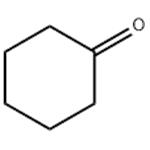
Lewis structure

- Molecular Weight:
- 98.14
- MDL Number:
- MFCD00001625
- MOL File:
- 108-94-1.mol
- MSDS File:
- SDS
- TDS File:
- TDS
| Melting point | -47 °C (lit.) |
|---|---|
| Boiling point | 155 °C (lit.) |
| Density | 0.947 g/mL at 25 °C (lit.) |
| vapor density | 3.4 (vs air) |
| vapor pressure | 3.4 mm Hg ( 20 °C) |
| refractive index |
n |
| FEMA | 3909 | CYCLOHEXANONE |
| FLAVIS Number | 07.148 | Cyclohexanone |
| Flash point | 116 °F |
| storage temp. | Store at +5°C to +30°C. |
| solubility | 90g/l |
| pka | 17(at 25℃) |
| form | Liquid |
| color | APHA: ≤10 |
| Relative polarity | 0.281 |
| PH | 7 (70g/l, H2O, 20℃) |
| Odor | Like peppermint and acetone. |
| Odor Type | minty |
| biological source | synthetic |
| explosive limit | 1.1%, 100°F |
| Water Solubility | 150 g/L (10 ºC) |
| Thermal Conductivity | 0.144 W/(m·K) at 25 ℃ |
| Specific Heat Capacity | Cp(liquid): 1.86 J/(g·K), at 25℃ |
| JECFA Number | 1100 |
| Merck | 14,2726 |
| BRN | 385735 |
| Henry's Law Constant | 1.2 x 10⁻⁵ atmm3/mol at 25 °C (Hawthorne et al., 1985) 6.92 x 10⁻⁵ atmm3/mol at 60.00 °C, 10.7 at 70.00 °C, 16.4 at 80.00 °C (headspace-GC, Hovorka et al., 2002) |
| Dielectric constant | 18.2(20℃) |
| Exposure limits | PC-TWA: 50 mg/m3 |
| Stability | Stable. Combustible. Incompatible with strong oxidizing agents. |
| Major Application | flavors and fragrances |
| Cosmetics Ingredients Functions |
PERFUMING SOLVENT |
| InChI | 1S/C6H10O/c7-6-4-2-1-3-5-6/h1-5H2 |
| InChIKey | JHIVVAPYMSGYDF-UHFFFAOYSA-N |
| SMILES | O=C1CCCCC1 |
| LogP | 0.86 at 25℃ |
| Surface tension | 33.74mN/m at 298.15K |
| CAS DataBase Reference | 108-94-1(CAS DataBase Reference) |
| Substances Added to Food (formerly EAFUS) | CYCLOHEXANONE |
| FDA 21 CFR | 177.2250 |
| EWG's Food Scores | 10 |
| FDA UNII | 5QOR3YM052 |
| NIST Chemistry Reference | Cyclohexanone(108-94-1) |
| IARC | 3 (Vol. 47, 71) 1999 |
| EPA Substance Registry System | Cyclohexanone (108-94-1) |
| UNSPSC Code | 41116107 |
| NACRES | NB.61 |
SAFETY
Risk and Safety Statements
| Symbol(GHS) |    GHS02,GHS06,GHS08 |
|||||||||
|---|---|---|---|---|---|---|---|---|---|---|
| Signal word | Danger | |||||||||
| Hazard statements | H311+H331-H302-H315-H319-H361-H371-H370-H372-H341-H351-H335-H336-H305-H226 | |||||||||
| Precautionary statements | P501-P270-P202-P240-P260-P210-P233-P201-P243-P241-P242-P271-P264-P280-P370+P378-P331-P337+P313-P305+P351+P338-P308+P311-P361+P364-P303+P361+P353-P332+P313-P301+P310-P304+P340+P311-P403+P233-P403+P235-P405 | |||||||||
| target organs | Respiratory system | |||||||||
| PPE | Eyeshields, Faceshields, Gloves, type ABEK (EN14387) respirator filter | |||||||||
| Hazard Codes | Xn | |||||||||
| Risk Statements | 10-20-41-38-20/21/22 | |||||||||
| Safety Statements | 25-36/37/39-26 | |||||||||
| OEB | A | |||||||||
| OEL | TWA: 25 ppm (100 mg/m3) [skin] | |||||||||
| RIDADR | UN 1915 | |||||||||
| WGK Germany | 1 | |||||||||
| RTECS | GW1050000 | |||||||||
| Autoignition Temperature | 788 °F | |||||||||
| TSCA | TSCA listed | |||||||||
| HS Code | 2914 22 00 | |||||||||
| HazardClass | 3 | |||||||||
| PackingGroup | III | |||||||||
| Storage Class | 3 - Flammable liquids | |||||||||
| Hazard Classifications | Acute Tox. 4 Dermal Acute Tox. 4 Inhalation Acute Tox. 4 Oral Eye Dam. 1 Flam. Liq. 3 Skin Irrit. 2 STOT SE 3 |
|||||||||
| Hazardous Substances Data | 108-94-1(Hazardous Substances Data) | |||||||||
| Toxicity | LD50 orally in rats: 1.62 ml/kg (Smyth) | |||||||||
| IDLA | 700 ppm | |||||||||
| REACH Registrations | Active | |||||||||
| Limited Quantities | 5.0 L (1.3 gallons) (liquid) | |||||||||
| Excepted Quantities | Max Inner Pack (30g or 30ml) and Max Outer Pack (1Kg or 1L) | |||||||||
| NFPA 704 |
|
Cyclohexanone price More Price(77)
| Manufacturer | Product number | Product description | CAS number | Packaging | Price | Updated | Buy |
|---|---|---|---|---|---|---|---|
| Sigma-Aldrich | W390909 | Cyclohexanone 99.8% | 108-94-1 | 1 each | $58 | 2026-04-30 | Buy |
| Sigma-Aldrich | CX2335 | Cyclohexanone Meets ACS Specifications GR ACS | 108-94-1 | 1 unit | $300 | 2026-04-30 | Buy |
| Sigma-Aldrich | CX2335 | Cyclohexanone Meets ACS Specifications GR ACS | 108-94-1 | 4L | $597 | 2026-04-30 | Buy |
| Sigma-Aldrich | CX2335 | Cyclohexanone Meets ACS Specifications GR ACS | 108-94-1 | 20L | $1730 | 2026-04-30 | Buy |
| Sigma-Aldrich | CX2335 | Cyclohexanone Meets ACS Specifications GR ACS | 108-94-1 | 200L | $9120 | 2026-04-30 | Buy |
Cyclohexanone Chemical Properties, Uses, Production
Chemical properties
Cyclohexanone is a colorless, clear liquid with soil smell; its impure product appears as light yellow color. It is miscible with several other solvents. easily soluble in ethanol and ether. The lower exposure limit is 1.1% and the upper exposure limit is 9.4%. Cyclohexanone may be incompatible with oxidizers and nitric acid.
Cyclohexanone is a primarily used in industry, up to 96%, as a chemical intermediate in the production of nylons 6 and 66. Oxidation or conversion of cyclohexanone yields adipic acid and caprolactam, two of the immediate precursors to the respective nylons. Cyclohexanone can also be used as a solvent in a variety of products, including paints, lacquers, and resins. It has not been found to occur in natural processes.
Application
Cyclohexanone is mostly captively consumed, either isolated or as a mixture, in the production of nylon intermediates (adipic acid and Caprolactam). Around 4% is consumed in markets other than nylon, such as solvents for paints, dyes and pesticides. Cyclohexanone is also used in the manufacture of pharmaceuticals, films, soaps and coatings.
Fibrant is one of the largest producers of Cyclohexanone, a raw material used in the production of Caprolactam.
Uses
Cyclohexanone is an important chemical raw material, being the major intermediates of making nylon, caprolactam and adipic acid. It is also an important industrial solvent, for example, for paints, especially for those containing nitrocellulose, vinyl chloride polymers and their copolymers or methacrylate polymer paints. Used as an excellent solvent for pesticides such as organophosphate insecticide. It is used as a solvent for dyes, viscous solvents for piston aviation lubricants, solvents for greases, waxes and rubbers. Also used as leveling agent for dyeing and fading silk; degreasing agents for polishing metal; wood coloring paint; also used for cyclohexanone stripping, decontamination and spot removal. Cyclohexanone and cyanoacetic acid can have condensation reaction to generate cyclohexylidene acetic acid, and then followed by elimination and decarboxylation to get cyclohexene acetonitrile, and finally giving cyclohexene ethylamine by hydrogenation [3399-73-3]. Cyclohexene ethylamine is a intermediate for some drugs.
Production method
In the 1940s, the industrial production of cyclohexanone mainly applied hydrogenation of phenol to generate cyclohexanol, followed by dehydrogenation to give cyclohexanone. In the 1960s, with the development of petrochemical industry, the cyclohexane oxidation production method gradually dominated. In 1967, the one step method of phenol hydrogenation, developed by the Netherlands National Mining Company (DSM) was industrialized. This method has short production process, good product quality and high yield, but the raw materials of phenol and catalyst are expensive, so the majority of the industry still adopts the cyclohexane oxidation method.
1. Phenol method takes nickel as a catalyst; first apply hydrogenation of phenol to give cyclohexanol, followed by dehydrogenation to give cyclohexanone using zinc as the catalyst for zinc.
2. Cyclohexane oxidation method uses cyclohexane as the raw material; first apply non-catalyst condition; use oxygen-rich air for oxidation to give cyclohexyl hydroperoxide, followed by decomposition into the mixture of cyclohexanol, cyclohexanone, alcohol and ketone in the presence of tert-butyl chromate catalyst; further apply a series of distillation refinement to get qualified products. Raw material consumption quota: cyclohexane (99.6%) 1040kg / t.
3. Benzene hydrogenation oxidation method; benzene subjects to hydrogenation (with hydrogen) at 120-180 ℃ in the presence of nickel catalyst to generate cyclohexane; cyclohexane has oxidation reaction with air at 150-160 ℃, 0.908MPa to obtain the mixture of cyclohexanol and cyclohexanone; separate them to obtain the cyclohexanone product. Cyclohexanol is dehydrogenated at 350-400 ° C in the presence of a zinc-calcium catalyst to produce cyclohexanone. Raw material consumption quotas: benzene (99.5%) 1144kg / t, hydrogen (97.0%) 1108kg / t, caustic soda (42.0%) 230kg / t.
Description
Cyclohexanone, a colorless liquid is a cyclic ketone. It is an important building block for the synthesis of a variety of organic compounds. Majority of the cyclohexanone synthesized is utilized as an intermediate in the synthesis of nylon.
Used as a polyvinyl chloride (PVC) solvent, cyclohexanone caused contact dermatitis in a woman manufacturing PVC fluidotherapy bags. Cyclohexanone probably does not cross react with cyclohexanone resin. A cyclohexanone-derived resin used in paints and varnishes caused contact dermatitis in painters.
Chemical Properties
Cyclohexanone is a water-white to slightly yellow liquid with a peppermint-like or acetone-like odor. The Odor Threshold is 0.12 0.24 ppm in air.
Physical properties
Clear, colorless to pale yellow, oily liquid with a peppermint-like odor. Experimentally determined detection and recognition odor threshold concentrations were identical: 480 μg/m3 (120 ppmv) (Hellman and Small, 1974).
Occurrence
Reported present in Cistus labdaniferus.
Uses
Industrial solvent for cellulose acetate resins, vinyl resins, rubber, and waxes; solventsealer for polyvinyl chloride; in printing industry; coating solvent in audio and videotape production
Uses
Cyclohexanone is used as an industrial solvent and paint remover. It acts as a precursor to nylon 6,6 and nylon 6 and cyclohexanone oxime, which gives caprolactam on rearrangement. Further, it is used as a chemical reaction medium, adhesives, sealants and agricultural products.
Uses
Cyclohexanone is used in the productionof adipic acid for making nylon; in thepreparation of cyclohexanone resins; and asa solvent for nitrocellulose, cellulose acetate,resins, fats, waxes, shellac, rubber, and DDT..
Definition
ChEBI: A cyclic ketone that consists of cyclohexane bearing a single oxo substituent.
Synthesis Reference(s)
Canadian Journal of Chemistry, 62, p. 1031, 1984 DOI: 10.1139/v84-171
Tetrahedron Letters, 25, p. 3309, 1984 DOI: 10.1016/S0040-4039(01)81371-X
General Description
A colorless to pale yellow liquid with a pleasant odor. Less dense than water . Flash point 111°F. Vapors heavier than air. Used to make nylon, as a chemical reaction medium, and as a solvent.
Air & Water Reactions
Flammable. Soluble in water.
Reactivity Profile
Cyclohexanone forms an explosive peroxide with H2O2, and reacts vigorously with oxidizing materials (nitric acid).
Health Hazard
Inhalation of vapors from hot material can cause narcosis. The liquid may cause dermatitis.
Health Hazard
The toxicity of cyclohexanone in test specieswas found to be low to moderate. Exposureto its vapors can produce irritation in the eyesand throat. Splashing into the eyes can damagethe cornea. Throat irritation in humansmay occur from 3–5 minute exposure to a50-ppm concentration in air. The symptomsof chronic toxicity in animals from its inhalationwere liver and kidney damage, as wellas weight loss. However, its acute toxicitywas low below 3000 ppm. The symptomsin guinea pigs were lacrimation, salivation,lowering of heart rate, and narcosis. Exposureto 4000 ppm for 4–6 hours was lethalto rats and guinea pigs.
The oral toxicity of this compound waslow. Ingestion may cause narcosis and depressionof the central nervous system. It canbe absorbed through the skin.
LD50 value, dermal (rabbits): 1000 mg/kg
LD50 value, intraperitoneal (rats): 1130 mg/kg.
Fire Hazard
HIGHLY FLAMMABLE: Will be easily ignited by heat, sparks or flames. Vapors may form explosive mixtures with air. Vapors may travel to source of ignition and flash back. Most vapors are heavier than air. They will spread along ground and collect in low or confined areas (sewers, basements, tanks). Vapor explosion hazard indoors, outdoors or in sewers. Runoff to sewer may create fire or explosion hazard. Containers may explode when heated. Many liquids are lighter than water.
Flammability and Explosibility
Flammable
Chemical Reactivity
Reactivity with Water No reaction; Reactivity with Common Materials: No reaction; Stability During Transport: Stable; Neutralizing Agents for Acids and Caustics: Not pertinent; Polymerization: Not pertinent; Inhibitor of Polymerization: Not pertinent.
Contact allergens
Used as a polyvinyl chloride solvent, cyclohexanone caused contact dermatitis in a woman manufacturing PVC fluidotherapy bags. Cyclohexanone probably does not cross-react with cyclohexanone resin. A cyclohexanone-derived resin used in paints and varnishes caused contact dermatitis in painters
Safety Profile
Suspected carcinogen. Moderately toxic by ingestion, inhalation, subcutaneous, intravenous, and intraperitoneal routes. A skin and severe eye irritant. Human systemic effects by inhalation: changes in the sense of smell, conjunctiva irritation, and unspecified respiratory system changes. Human irritant by inhalation. Mdd narcotic properties have also been ascribed to it. Human mutation data reported. Experimental reproductive effects. Flammable liquid when exposed to heat or flame; can react vigorously with oxidizing materials. Slight explosion hazard in its vapor form, when exposed to flame.Reaction with hydrogen peroxide + nitric acid forms an explosive peroxide. To fight fire, use alcohol foam, dry chemical, or COa. When heated to decomposition it emits acrid smoke and irritating fumes. See also KETONES and CYCLOHEXANE.
Synthesis
It may be synthesized on a laboratory scale by the oxidation of cyclohexanol.
Potential Exposure
May form explosive mixture with air. Contact with oxidizing agents or nitric acid may cause a violent reaction. Do not use brass, copper, bronze, or lead fittings. Attacks many coatings and plastic materials.
First aid
If this chemical gets into the eyes, remove anycontact lenses at once and irrigate immediately for at least15 min, occasionally lifting upper and lower lids. Seek medical attention immediately. If this chemical contacts theskin, remove contaminated clothing and wash immediatelywith soap and water. Seek medical attention immediately. Ifthis chemical has been inhaled, remove from exposure,begin rescue breathing (using universal precautions, including resuscitation mask) if breathing has stopped and CPR ifheart action has stopped. Transfer promptly to a medical facility. When this chemical has been swallowed, get medical attention. Give large quantities of water and inducevomiting. Do not make an unconscious person vomit.
Carcinogenicity
IARC considers the animal data for cyclohexanone as inadequate evidence of carcinogenicity and listed cyclohexanone as not classifiable for carcinogenicity (IARC Category 3).
Environmental Fate
Biological. In activated sludge inoculum, 96.0% COD removal was achieved. The average rate
of biodegradation was 30.0 mg COD/gh (Pitter, 1976).
Photolytic. Atkinson (1985) reported an estimated photooxidation rate constant of 1.56 x 10⁻¹¹
cm3/moleculesec for the reaction of cyclohexanone and OH radicals in the atmosphere at 298 K.
Chemical/Physical. Cyclohexanone will not hydrolyze because it has no hydrolyzable
functional group.
At an influent concentration of 1,000 mg/L, treatment with GAC resulted in effluent
concentration of 332 mg/L. The adsorbability of the carbon used was 134 mg/g carbon (Guisti et
al., 1974). Similarly, at influent concentrations of 10, 1.0, 0.1, and 0.01 mg/L, the GAC adsorption
capacities were 36, 6.2, 1.1, and 0.19 mg/g, respectively (Dobbs and Cohen, 1980).
storage
Color Code—Red: Flammability Hazard: Store ina flammable liquid storage area or approved cabinet awayfrom ignition sources and corrosive and reactive materials.Prior to working with Cyclohexanone you should be trainedon its proper handling and storage. Before entering confinedspace where this chemical may be present, check to make sure that an explosive concentration does not exist.Cyclohexanone must be stored to avoid contact with oxidizers (such as perchlorates, peroxides, chlorates, nitrates, andpermanganates), since violent reactions occur. Store intightly closed containers in a cool well-ventilated area awayfrom heat, sparks, and flames. Metal containers involvingthe transfer of this chemical should be grounded andbonded. Where possible, automatically pump liquid fromdrums or other storage containers to process containers.Drums must be equipped with self-closing valves, pressurevacuum bungs, and flame arresters. Use only nonsparkingtools and equipment, especially when opening and closingcontainers of this chemical. Sources of ignition, such assmoking and open flames, are prohibited where this chemical is used, handled, or stored in a manner that could createa potential fire or explosion hazard. Wherever this chemicalis used, handled, manufactured, or stored, use explosionproof electrical equipment and fittings.Cyclohexanone requires a “FLAMMABLELIQUID” label. It falls in Hazard Class 3 and PackingGroup II
Shipping
UN1915 Cyclohexanone, Hazard Class: 3; Labels: 3-Flammable liquid.
Purification Methods
Dry cyclohexanone with MgSO4,CaSO4, Na2SO4 or Linde type 13X molecular sieves, then distil it. Cyclohexanol and other oxidisable impurities can be removed by treatment with chromic acid or dilute KMnO4. More thorough purification is possible by conversion to the bisulfite addition compound, or the semicarbazone, followed by decomposition with Na2CO3 and steam distillation. [For example, equal weights of the bisulfite adduct (crystallised from water) and Na2CO3 are dissolved in hot water and, after steam distillation, the distillate is saturated with NaCl and extracted with Et2O which is then dried (anhydrous MgSO4 or Na2SO4), filtered and the solvent evaporated prior to further distillation.] FLAMMABLE [Beilstein 7 III 14, 7 IV 15.]
Incompatibilities
May form explosive mixture with air. Contact with oxidizing agents or nitric acid may cause a violent reaction. Do not use brass, copper, bronze, or lead fittings. Attacks many coatings and plastic materials.
Toxics Screening Level
The initial threshold screening level (ITSL) for cyclohexanone has been changed from 1000 μg/m3 (8-hour averaging time) to 800 μg/m3 (8-hour averaging time).
Waste Disposal
Dissolve or mix the material with a combustible solvent and burn in a chemical incinera- tor equipped with an afterburner and scrubber. All federal, state, and local environmental regulations must be observed.


Cyclohexanone Preparation Products And Raw materials
Raw materials
1of3
Preparation Products
1of8
| Supplier | Tel | Country | ProdList | Advantage | |
|---|---|---|---|---|---|
| Jinan Feiyue Chemical Co., Ltd | 18615221057 | 913474026@qq.com | China | 129 | 58 |
| Jinan Trands Chemical Co. LTD | 15154153272 15154153272 | 1343989492@qq.com | China | 95 | 58 |
| Shanghai Aladdin Bio-Chem Technology Co.,LTD | 400-6206333 13167063860 | anhua.mao@aladdin-e.com | China | 29977 | 65 |
| Liaocheng Tongda Chemical Co. LTD | 18963573761; 18963573761 | 18963573761@163.com | China | 126 | 58 |
| Liling Chuangli Technology Co. LTD | 0534-8101711 13606437406 | sales@chuanglichem.com | China | 49 | 58 |
| Jinan Chengyuan Chemical Co., LTD | 0531-88274992; 15064038081 | 1278740859@qq.com | China | 41 | 58 |
| Shandong Mantang Hongxin Material Co. , Ltd. | 13065055261 | 3923611010@qq.com | China | 881 | 58 |
| Shandong Weijin Chemical Technology Co., Ltd. | 13583305620 13583305620 | 845492826@qq.com | China | 60 | 58 |
| Liaocheng Runheng Chemical Trade Co., Ltd | 17862588818 | 1457995158@QQ.com | China | 112 | 58 |
| Guangzhou Kangyang Chemical Co., Ltd. | 19520963397 | 695129422@qq.com | China | 204 | 58 |
Related articles
- Cyclohexanone: Chemical and physical properties, Production and Uses
- Cyclohexanone is a six-carbon ring molecule with a ketone functional group. It is a colourless to pale yellow oily liquid with....
- Apr 26,2024
- Cyclohexanone: Toxicity and Safety
- The passage introduces the toxicity and safety of Cyclohexanone.
- Nov 21,2022
- A pharmaceutical intermediate:Cyclohexanone
- Cyclohexanone appears as a colorless to pale yellow liquid with a pleasant odor. Less dense than water . Flash point 111°F. Va....
- Mar 16,2022
Related Questions
Ask a questionView Latest Price from Cyclohexanone manufacturers
| Image | Update time | Product | Price | Min. Order | Purity | Supply Ability | Manufacturer | |
|---|---|---|---|---|---|---|---|---|
 |
2026-09-18 | Cyclohexanone
108-94-1
|
1000kg | 99.5% | 200 tons | Boxuan Chemical (Shandong) Co., Ltd. | ||
 |
2026-09-02 | Cyclohexanone
108-94-1
|
20kg | 99.0% | 20 tons | Qingdao RENAS Polymer Material Co., Ltd. | ||
 |
2026-08-21 | Cyclohexanone
108-94-1
|
1kg | 99.5% | 300tons | Hebei Dangtong Import and export Co LTD |
-
- Cyclohexanone
108-94-1
- $0.00
- 99.5%
- Boxuan Chemical (Shandong) Co., Ltd.
-
- Cyclohexanone
108-94-1
- $0.00
- 99.0%
- Qingdao RENAS Polymer Material Co., Ltd.
-
- Cyclohexanone
108-94-1
- $0.60
- 99.5%
- Hebei Dangtong Import and export Co LTD
108-94-1 (Cyclohexanone) Related Search:
1of4
