


Piperazin

- CAS No.
- 110-85-0
- Chemical Name:
- Piperazin
- Synonyms
- Piperazin;DIETHYLENEDIAMINE;Piperzine Anhydrous;1,4-DIAZACYCLOHEXANE;Piperazidine;Pipersol;HEXAHYDROPYRAZINE;Piperazine Hexahydrtae;Anhydrous Piperazine (PIP);Upixon
- CBNumber:
- CB00129267
- Molecular Formula:
- C4H10N2
Crystal structure

- Molecular Weight:
- 86.14
- MDL Number:
- MFCD00005953
- MOL File:
- 110-85-0.mol
- MSDS File:
- SDS
- TDS File:
- TDS
| Melting point | 109-112 °C (lit.) |
|---|---|
| Boiling point | 145-146 °C (lit.) |
| Density | 1,1 g/cm3 |
| bulk density | 400kg/m3 |
| vapor pressure | 0.8 mm Hg ( 20 °C) |
| refractive index | 1.4460 |
| FEMA | 4250 | PIPERAZINE |
| FLAVIS Number | 14.141 | Piperazine |
| Flash point | 65 °C |
| storage temp. | Store below +30°C. |
| solubility | H2O: 0.1 M at 20 °C, clear, colorless |
| pka | 9.83(at 23℃) |
| form | Crystalline Flakes |
| color | White to slightly yellow |
| PH | 11.0-12.5 (25℃, 0.1M in H2O) |
| Odor | at 0.10 % in dipropylene glycol. ammoniacal |
| Odor Type | ammoniacal |
| biological source | rabbit |
| explosive limit | 14% |
| Water Solubility | 150 g/L (20 ºC) |
| Sensitive | Air Sensitive & Hygroscopic |
| λmax |
λ: 260 nm Amax: 0.035 λ: 280 nm Amax: 0.010 |
| JECFA Number | 1615 |
| Merck | 14,7464 |
| BRN | 102555 |
| Henry's Law Constant | 4.5×10³ mol/(m3Pa) at 25℃, Nguyen (2013) |
| Exposure limits | ACGIH TLV-TWA:0.03 ppm (0.1 mg/m3 ),Inhalable fraction,and vapor,measured as piperazine |
| Stability | Stable. Hygroscopic. Light sensitive. Flammable. Incompatible with strong oxidizing agents. |
| InChI | 1S/C4H10N2/c1-2-6-4-3-5-1/h5-6H,1-4H2 |
| InChIKey | GLUUGHFHXGJENI-UHFFFAOYSA-N |
| SMILES | C1CNCCN1 |
| LogP | -1.24 at 20-25℃ |
| CAS DataBase Reference | 110-85-0(CAS DataBase Reference) |
| Substances Added to Food (formerly EAFUS) | PIPERAZINE |
| FDA 21 CFR | 175.105; 175.320; 177.2550 |
| EWG's Food Scores | 2-3 |
| FDA UNII | 1RTM4PAL0V |
| ATC code | P02CB01 |
| NIST Chemistry Reference | Piperazine(110-85-0) |
| EPA Substance Registry System | Piperazine (110-85-0) |
| UNSPSC Code | 41116107 |
| NACRES | NA.41 |
SAFETY
Risk and Safety Statements
| Symbol(GHS) |    GHS05,GHS07,GHS08 |
|||||||||
|---|---|---|---|---|---|---|---|---|---|---|
| Signal word | Danger | |||||||||
| Hazard statements | H312+H332-H303-H314-H361-H370-H372-H317-H334-H335-H402 | |||||||||
| Precautionary statements | P501-P273-P272-P260-P270-P202-P201-P271-P264-P280-P284-P342+P311-P308+P311-P362+P364-P303+P361+P353-P333+P313-P301+P330+P331-P304+P340+P310-P305+P351+P338+P310-P403+P233-P405 | |||||||||
| PPE | Eyeshields, Faceshields, Gloves, type P3 (EN 143) respirator cartridges | |||||||||
| Hazard Codes | C,Xn | |||||||||
| Risk Statements | 34-42/43-52/53-62-52-63 | |||||||||
| Safety Statements | 22-26-36/37/39-45-61 | |||||||||
| RIDADR | UN 2579 | |||||||||
| WGK Germany | 1 | |||||||||
| RTECS | TK7800000 | |||||||||
| F | 3-8-23 | |||||||||
| Hazard Note | Harmful/Corrosive | |||||||||
| TSCA | TSCA listed | |||||||||
| HS Code | 2933 59 95 | |||||||||
| HazardClass | 8 | |||||||||
| PackingGroup | III | |||||||||
| Storage Class | 4.1B - Flammable solid hazardous materials | |||||||||
| Hazard Classifications | Eye Dam. 1 Flam. Sol. 1 Repr. 2 Resp. Sens. 1B Skin Corr. 1B Skin Sens. 1B |
|||||||||
| Hazardous Substances Data | 110-85-0(Hazardous Substances Data) | |||||||||
| Toxicity | LD50 orally in Rabbit: 2600 mg/kg LD50 dermal Rabbit 8300 mg/kg | |||||||||
| REACH Registrations | Active | |||||||||
| Limited Quantities | 5.0 L (1.3 gallons) (liquid) or 5.0 kg (11 lbs) (solid) | |||||||||
| Excepted Quantities | Max Inner Pack (30g or 30ml) and Max Outer Pack (1Kg or 1L) | |||||||||
| NFPA 704 |
|
Piperazin price More Price(79)
| Manufacturer | Product number | Product description | CAS number | Packaging | Price | Updated | Buy |
|---|---|---|---|---|---|---|---|
| Sigma-Aldrich | 80621 | Piperazine BioUltra, anhydrous, ≥99.0% (T) | 110-85-0 | 25g | $98.7 | 2026-04-30 | Buy |
| Sigma-Aldrich | HPA052035 | Anti-KCTD11 antibody produced in rabbit Prestige Antibodies? Powered by Atlas Antibodies, affinity isolated antibody, buffered aqueous glycerol solution | 110-85-0 | 100μL | $667 | 2026-04-30 | Buy |
| Sigma-Aldrich | HPA028605 | Anti-EPB41L3 antibody produced in rabbit Prestige Antibodies? Powered by Atlas Antibodies, affinity isolated antibody, buffered aqueous glycerol solution | 100μL | $667 | 2026-04-30 | Buy | |
| Sigma-Aldrich | 8.07325 | Piperazine anhydrous for synthesis | 110-85-0 | 5G | $17.7 | 2026-04-30 | Buy |
| Sigma-Aldrich | 8.07325 | Piperazine anhydrous for synthesis | 110-85-0 | 250g | $65 | 2026-04-30 | Buy |
Piperazin Chemical Properties, Uses, Production
Important pharmaceutical intermediates
Piperazine is an important pharmaceutical intermediate, is mainly used for the production of anthelmintic piperazine phosphate, piperazine citrate and fluphenazine, strong pain, rifampicin, adipic acid piperazine, piperazine guanidine methyl tetracycline, quinoline piperazine phosphate, piperazine thiazole nitrate, enoxacin, hydroxyzine hydrochloride, trifluoperazine, diethylcarbamazine citrate, cinnarizine, flunarizine, decloxizine strong carbamazepine, prednisolone sodium phosphate, dexamethasone sodium phosphate, PPA, norfloxacin, ciprofloxacin, easy to cough piperazine, a piperazine Lee vancomycin, trimethoprim-triazine and other drugs. It is Also used for the production of surfactants products such as wetting agents, emulsifying agents,and dispersing agents ,and the production of plastic additives such as antioxidants, preservatives, stabilizers and rubber additives. It is derived from Dichloroethane by alcohol solution of ammonia.

Figure 1 The structural formula of piperazine.
Pharmacology and mechanism of action
Piperazine is a heterocyclic organic base widely used as an anthelminthic. It was originally developed for the treatment of gout. Its first successful use in helminthiasis was reported by Mouriquand et al. in 1951 [1]. Presently the drug is used in the treatment of infections caused by Ascaris lumbricoides and Enterobius vermicularis.
The drug causes flaccid paralysis in susceptible worms and the parasites lose their attachment to the intestinal wall, and are swept away by the normal bowel peristalsis. The biochemical mechanism behind this action is uncertain. Piperazine causes hyperpolarization of the Ascaris muscle rendering it unresponsive to acetylcholine [2].
Indications
Treatment of infections due to Ascaris lumbricoides and Enterobius vermicularis. When cost and availability are not a consideration, safer and more effective drugs such as mebendazole or albendazole should be used instead.
Side effects
Side effects commonly encountered with the recommended doses of piperazine are nausea, vomiting, abdominal cramps and diarrhoea which are usually mild and self-limiting. Although absolute incidence is unknown, severe side effects reported in the literature are rare. They can be classified into:
1. Allergic reactions such as urticaria, exantema, hypersensitivity, lacrimation, rhinorrea, productive cough, and bronchospasm[3,4].
2. Neuro-psychological reactions[5-11]:
(a) cerebral type such as vertigo, dizziness, tremor, incoordination, ataxia and hypotonia with EEG changes;
(b) psychic type such as depersonalization, hallucination and paranoic reactions;
(c) miscellaneous such as headache, visual disturbances, somnolence, coma and an increase in the number of petit mal attacks.
Neuro-psychological reactions are rare. Most cases reported concern children with pre disposing factors like neurological symptoms, renal diseases or those who have been treated with high doses of piperazine.
One case of haemolytic anaemia in a patient with G6PD deficiency [12], and one case of toxic hepatitis[13] have also been reported. However, no causal relationships can be established from these cases.
Nitrosation of piperazine to the potential carcinogen N-mononitrosopiperazine in the stomach of patients treated with normal therapeutic doses has been reported[14]. However, carcinogenicity related to the use of piperazine has not been reported despite the use of the drug over many years. In any case, this is unlikely to have any clinical implications with the short treatment period of nematodes.
Contraindications and precautions
Piperazine should not be given to patients with hypersensitivity or with neurological diseases,especially epileptic patients.
Interactions
In rats and mice, piperazine 1–5 g/kg subcutaneously, potentiates the side effects of chlorpromazine [15]. However, this is unlikely to have any clinical significance. Piperazine is antagonistic to pyrantel, bephenium and levamisole , but no potential clinical interactions have been reported.
Preparations
Several preparations, apart from the one mentioned below, containing various piperazine salts are available.
• Antepar® (Wellcome). Oral suspension 150 mg piperazine hexahydrate/ml. Tablets 500 mg piperazine hexahydrate.
Acute oral toxicity
rat LD50: 1900 mg/kg; Oral-Mouse LD50: 600 mg/kg
Data Skin irritation
rabbit 500 mg Mild; Eyes-rabbit 0.25 mg/24 hours of severe
References
1. Mouriquand G, Roman E, Coisnard J (1951). Essai de traitement de l’oxyurose par la piperazine. J Méd Lyon, 32, 189–195.
2. del Castillo J, De Mello WC, Morales T (1964). Mechanism of the paralysing action of piperazine on Ascaris muscle. Br J Pharmacol, 22, 463–477.
3. Macmillan AL (1973). Generalized pustular drug rash. Dermatologia, 146, 285–291.
4. McCullagh SF (1968). Allergenicity of piperazine: a study in environmental aetiology. Br J Ind Med, 25, 319–325.
5. Belloni C, Rizzoni G (1967). Neurotoxic side-effects of piperazine. Lancet, ii, 369.
6. Berger JR, Globus M, Melamed E (1979). Acute transitory cerebellar dysfunction associated with piperazine adipate. Arch Neurol, 36, 180–181.
7. Bomb RS, Bedi HK (1976). Neurotoxic side-effects of piperazine. Trans R Soc Trop Med Hyg, 70, 358.
8. Gupta SR (1976). Piperazine neurotoxicity and psychological reaction. J Ind Med Ass, 66, 33–34.
9. Parsons AC (1971). Piperazine neurotoxicity. ‘Worm wobble’. BMJ, 4, 790–792.
10. Vallat JN, Vallat JM, Texier J, Léger J (1972). Les signes neurologiques d’intoxication par la piperazine. Bordeaux Médicale, 5, 394–400.
11. Nickey LN (1966). Possible precipitation of petit mal seizures with piperazine citrate. J Am Med Ass, 195, 193–194.
12. Buchanan N, Cassel R, Jenkins T (1971). G-6-PD deficiency and piperazine. BMJ, 2, 110.
13. Hamlyn AN, Morris JS, Sarkany I, Sherlock S (1976). Piperazine hepatitis. Gastroenterology, 70, 1144–1147.
14. Bellander T, sterdahl B-G, Hagmar L (1985). Formation of N-mononitrosopiperazine in the stomach and its excretion in the urine after oral intake of piperazine. Toxicol Appl Pharmacol, 80, 193–198.
15. Sturman G (1973). Interaction between piperazine and chlorpromazine. Br J Pharmacol, 50, 153–155.
Flammability and hazardous characteristics
Combustible; decomposition of toxic nitric oxide gas in case of thermal
Storage characteristics
Treasury ventilation low-temperature drying; and stored separately from acid.
Since piperazine is corrosive, the flakes are stored in barrels lined with a polyethylene sack. To avoid yellowing, the barrels should be air tight and not exposed to direct sunlight. The aqueous solution is stored at 50 – 60 ℃ in insulated iron tanks that can be heated.
Extinguishing agent
Water spray, dry powder, carbon dioxide, alcohol-resistant foam
Professional standards
TWA 1 mg/m³; STEL 5 mg/m
Description
Piperazine is contained in pyrazinobutazone, an equimolecular sah of piperazine and phenylbutazone. Among occupational cases, most were reported in the pharmaceutical industry or laboratory, in nurses and in veterinarians.
Description
Piperazine (Item No. 24019) is an analytical reference standard categorized as a piperazine. This product is intended for research and forensic applications.
Chemical Properties
Colorless to yellow solid; salty taste.
Chemical Properties
Piperazine is white to cream-colored needles or powder. Characteristic ammonia-like odor. Combustible solids that do not easily ignite.
Uses
Labelled Piperazine
Uses
keratolytic, antiseborheic
Uses
Piperazine is used as an intermediate in themanufacture of dyes, pharmaceuticals, polymers,surfactants, and rubber accelerators.
Indications
Piperazine (Vermizine) contains a heterocyclic ring that
lacks a carboxyl group. It acts on the musculature of the
helminths to cause reversible flaccid paralysis mediated
by chloride-dependent hyperpolarization of the muscle
membrane. This results in expulsion of the worm.
Piperazine acts as an agonist at gated chloride channels
on the parasite muscle.
Piperazine has been used with success to treat A.
lumbricoides and E. vermicularis infections, although
mebendazole is now the agent of choice. Piperazine is
administered orally and is readily absorbed from the intestinal
tract. Most of the drug is excreted in the urine
within 24 hours.
Piperazine is an appropriate alternative to mebendazole
for the treatment of ascariasis, especially in the
presence of intestinal or biliary obstruction. Cure rates
of more than 80% are obtained following a 2-day regimen.
Side effects occasionally include gastrointestinal distress,
urticaria, and dizziness. Neurological symptoms of
ataxia, hypotonia, visual disturbances, and exacerbations of epilepsy can occur in patients with preexisting
renal insufficiency. It should not be used in pregnant
women because of the formation of a potentially carcinogenic
and teratogenic nitrosamine metabolite.
Concomitant use of piperazine and chlorpromazine or
pyrantel should be avoided.
Definition
ChEBI: An azacycloalkane that consists of a six-membered ring containing two nitrogen atoms at opposite positions.
brand name
Pincets (Marion Merrell Dow); Pinsirup (Marion Merrell Dow);Adelmintex;Adipalis;Adipalit;Adiver;Ancaris thenium;Ancazine;Antelmina;Antepar (b-w);Anterobius;Anthalazine;Anthelmina;Anticucs;Antivermine;Ascalix;Ascarinex;Ascarivet;Asca-trol no.3;Asepar;Askaripar;Averamexan;Bel-zine;Bioxurin;B-piperazine;Brirel;Candizine;Carudol;Ciperazin;Citrazine;Coopane;Dak;Demovermil;Diatesurico;Dicevermin;Digesan;Dilaurazine;Dispermin;Diurazina;Dowzene;Ecosan;Endorid;Entazin;Equizole-a;Escovermin;Esteropipate;Etaphylline (acetyllinate);Gentiazina;Glycopiparsol;Heksapar;Helmacid;Helmezin;Helmicide;Helmifren;Helmipar;Helmirazine (adipate);Helmirazine (citrate);Helmitin;Helmizin;Herb royal round worm treatment;Hexanthelin;Ismiverm;Janes liquid permifu;Jarabe neox;Jetsan supp. (adipate);Justalmin;Kennel-maid;Kihomato;Kontipar;Lamboxil;Lombricida tropico;Lombrifher;Lombrikal;Lombrimade;Mapiprin;Maskito;Noxiurotan;Ogen;Okuside;Optiverm;Oxiril syrup (hydrate);Oxiuran (hydrate);Oxiurasin;Oxiustip elix;Oxivermin;Oxizin;Oxucid;Oxuril;Oxypip;Oxyzin;P.c. (citrate);Padrax;Paravermin;Pariamate;Par-tega;Perin;Piavermit;Pincide;Pipan;Pip-a-ray;Pipenin;Piperacid;Piperamicin;Piperascat;Piperaskat;Piperate;Piperaverm;Piperazinal;Piperazine (adipate);Pipercrean;Piperex;Piperiod;Piperital od;Piperitol;Piper-jodina;Piperol fort;Piperone;Piperoverm;Pipertox;Piperver;Piperzinal;Pipeverm;Pipezol;Pipizan citrate;Pipracid;Piprazid;Piprazyl;Pipricide;Piptelate;Piverma;Polo-verm;Polyquil;Pripsen;Provtovermil;Razinol;Rondelim;Rondoxyl;Santoban;Siropar;Supraverm;Taenifigin;Teniver;Tivazine;Toxocan;Uricida;Uridina;Uroclear (hexamine);Urodan (phosphate);Urosolvina;Uvilon syrup (hydrate);Vanpar (hydrate);Veripar;Vermazine;Vermenter;Vermicompren;Vermidol;Vermifug;Vermilass;Vermipan;Vermiphsarmette;Vermiquimpe;Vermiquimyc;Vermisit;Vermitox;Vermofrik;Verocid;Wairmex;Wurmex;Wurmsirup siegfried Multifuge;Multifuj;Nea-vermiol;Nemafugan;Nemasin;Nematocton;Nematorazine;Neo-ifusa;.
World Health Organization (WHO)
Piperazine was first used as a treatment for gout earlier this century and its anthelminthic activity was discovered in 1949. It is also considerably cheaper than other anthelminthic drugs. In some countries where ascariasis is not endemic and where piperazine was used predominantly for the treatment of pinworm it has been withdrawn from use on the grounds that other more effective and less toxic drugs are now available (see full list). In other such countries, however, piperazine remains available in over-the-counter preparations. Clinical dosages occasionally induce transient neurological signs and concern has been expressed that in some circumstances the drug may generate small amounts of nitrosamine in the stomach. However, it is widely considered that these trace doses are unlikely to give rise to a significant carcinogenic potential. (Reference: (WHODIB) WHO Drug Information Bulletin, 1: 5, , 1983)
General Description
Needle-like white or colorless crystals. Shipped as a solid or suspended in a liquid medium. Very corrosive to skin, eyes and mucous membranes. Solid turns dark when exposed to light. Flash point 190°F. Used as a corrosion inhibitor and as an insecticide.
Air & Water Reactions
Flammable. Absorbs water and carbon dioxide from air. Soluble in water.
Reactivity Profile
1,4-Diazacyclohexane neutralizes acids in exothermic reactions to form salts plus water. May be incompatible with isocyanates, halogenated organics, peroxides, phenols (acidic), epoxides, anhydrides, and acid halides. Absorbs carbon dioxide from the air, which can cause dry crystals to seem to melt. May generate hydrogen, a flammable gas, in combination with strong reducing agents such as hydrides. 1,4-Diazacyclohexane is sensitive to light; 1,4-Diazacyclohexane absorbs water and carbon dioxide from air. 1,4-Diazacyclohexane may be corrosive to aluminum, magnesium and zinc. .
Health Hazard
TOXIC; inhalation, ingestion or skin contact with material may cause severe injury or death. Contact with molten substance may cause severe burns to skin and eyes. Avoid any skin contact. Effects of contact or inhalation may be delayed. Fire may produce irritating, corrosive and/or toxic gases. Runoff from fire control or dilution water may be corrosive and/or toxic and cause pollution.
Health Hazard
Piperazine is a corrosive substance. The solidand its concentrated aqueous solutions areirritants to the skin and eyes. The irritanteffect in rabbits’ eyes was severe.
The toxic symptoms from ingestion ofpiperazine include nausea, vomiting, excitement,change in motor activity, somnolence,and muscle contraction. The toxicity of thiscompound is low, however. The oral LD50value in rats is 1900 mg/kg. The inhalationtoxicity is very low. The inhalation LC50value in mice is 5400 mg/m3/2 h.
Fire Hazard
Combustible material: may burn but does not ignite readily. When heated, vapors may form explosive mixtures with air: indoors, outdoors and sewers explosion hazards. Contact with metals may evolve flammable hydrogen gas. Containers may explode when heated. Runoff may pollute waterways. Substance may be transported in a molten form.
Flammability and Explosibility
Highly flammable
Pharmaceutical Applications
A synthetic chemical, most commonly formulated as the citrate, but also available as the adipate, edetate calcium and tartrate salts.
Contact allergens
Piperazine is contained in pyrazinobutazone, an equimolar salt of piperazine and phenylbutazone. Among occupational cases, most were reported in the pharmaceutical industry or laboratory workers, in nurses, and in veterinarians.
Mechanism of action
Piperazine increases the resting potential of the somatic musculature of nematodes, especially in the syncytial region, by increasing the permeability of the membrane to chloride ions. This results in flaccid paralysis of the parasites, which are expelled from the intestine .
Pharmacokinetics
Activity against intestinal worms requires that a substantial amount remains in the gut. However, after oral administration a variable amount is rapidly absorbed from the small intestine and subsequently excreted in the urine. Its half-life is extremely variable.
Clinical Use
Hexahydropyrazine or diethylenediamine (Arthriticine,Dispermin) occurs as colorless, volatile crystals of the hexahydratethat are freely soluble in water. After the discoveryof the anthelmintic properties of a derivative diethylcarbamazine,the activity of piperazine itself was established.Piperazine is still used as an anthelmintic for the treatmentof pinworm (Enterobius [Oxyuris] vermicularis) and roundworm(Ascaris lumbricoides) infestations. It is available invarious salt forms, including the citrate (official in the USP)in syrup and tablet forms. Piperazine blocks the response of the ascaris muscleto acetylcholine, causing flaccid paralysis in the worm,which is dislodged from the intestinal wall and expelled inthe feces.
Clinical Use
Ascariasis
Pinworm
Side effects
Some people develop hypersensitivity, requiring cessation of treatment. Transient, mild gastrointestinal or neurological symptoms may occur.
Safety Profile
Moderately toxic by ingestion, skin contact, intravenous, and subcutaneous routes. Mildly toxic by inhalation. A skin and severe eye irritant. Excessive absorption can cause urticaria, vomiting, diarrhea, blurred vision, and weakness. Combustible when exposed to heat or flame; can react vigorously with oxidizing materials. Explodes on contact with dicyanofurazan. To fight fire, use alcohol foam, mist, dry chemical, water spray. When heated to decomposition it emits highly toxic fumes of NOx.
Synthesis
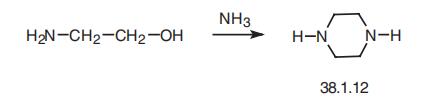
Piperazine (38.1.12) is a bulk product in organic synthesis. It is made from ethanolamine by heating it in ammonia at a temperature of 150¨C220C and a pressure of 100¨C250atm. It is used as a drug in the form of a salt, and as a rule, in the form of adipinate.
Potential Exposure
(Piperazine): Primary irritant (w/o allergic reaction),
Veterinary Drugs and Treatments
Piperazine is used for the treatment of ascarids in dogs, cats, horses, swine and poultry. Piperazine is considered safe to use in animals with concurrent gastroenteritis and during pregnancy.
Drug interactions
Potentially hazardous interactions with other drugs
Pyrantel: antagonises effect of piperazine.
Carcinogenicity
No increase in lung adenomas was produced in mice administered 0.69–18.75mg of piperazine/ kg in drinking water for 20–25 weeks and sacrificed 10–13 weeks later. Mice fed the equivalent of 938 mg/kg in the diet for 28 weeks and sacrificed at 40 weeks failed to show any significant increase in the incidence of lung adenomas. An increase in lung adenomas was produced in this bioassay by administration of piperazine together with sodium nitrate, suggesting the formation of the active nitroso derivative. Sodium ascorbate inhibited tumor formation, in theory, by preventing piperazine nitrosation (304). Coadministration of 250 ppm piperazine and 500 ppm sodium nitrate in drinking water did not produce tumors in rats. None of these studies were conducted using currently accepted methods for evaluating carcinogenic potential but piperazine alone, in these assays, was noncarcinogenic.
Environmental Fate
This molecule has a simple chemical structure and molecular weight of 86.14. It has a strong alkaline base soluble in water (1:18), glycerol, and glycols, but is only sparingly soluble in alcohol and insoluble in ether. Piperazine is not expected to hydrolyze in water. The photodegradation half-life is approximately 0.8 h. The piperazine molecule is easily denaturalized by diverse environmental factors and has a low potential for bioaccumulation or biomagnification. To improve its stability, it is usually formulated as different salts such as adipate, citrate, phosphate, hexahydrate, and sulfate. Most piperazine salts are white crystalline powders that are readily soluble in water.Exceptions are adipates, which dissolve to only a maximum concentration of 5% in water, and phosphate, which is insoluble.
Metabolism
About 25% is metabolised in the liver. Piperazine is
nitrosated to form N -mononitrosopiperazine (MNPz)
in gastric juice, which is then metabolised to N-nitroso-3-
hydroxypyrrolidine (NHPYR).
It is excreted in the urine mainly as metabolites.
Shipping
UN2579 Piperazine, Hazard class: 8; Labels: 8-Corrosive material.
Purification Methods
Piperazine crystallises from EtOH or anhydrous *benzene and is dried at 0.01mm. It can be sublimed under vacuum and purified by zone melting. The hydrochloride has m 172-174o (from EtOH), and the dihydrochloride crystallises from aqueous EtOH and has m 318-320o (dec, sublimes at 295-315o). The picrate has m ~200o, and the picrolonate crystallises from dimethylformamide ( m 259-261o). [Beilstein 23 H 4, 23 I 4, 23 II 3, 23 III/IV 15, 23/1 V 30.]
Toxicity evaluation
Piperazine blocks transmission by hyperpolarizing nerve membranes at the neuromuscular junction, leading to parasite immobilization by flaccid paralysis and consequent removal from predilection and death. Piperazine is a selective agonist of GABA receptors, resulting in the opening of chloride channels and hyperpolarization of the membrane of the muscle cells of nematode parasites.
Incompatibilities
Aqueous solution is a strong base. Violent reaction with strong oxidizers and dicyanofurazan. Incompatible with oxidizers (chlorates, nitrates, peroxides, permanganates, perchlorates, chlorine, bromine, fluorine, etc.); contact may cause fires or explosions. Keep away from alkaline materials, strong bases, strong acids, oxoacids, epoxides, nitrogen compounds, carbon tetrachloride. Attacks aluminum, copper, nickel, magnesium and zinc.


Piperazin Preparation Products And Raw materials
Raw materials
1of2
Preparation Products
1of8
| Supplier | Tel | Country | ProdList | Advantage | |
|---|---|---|---|---|---|
| Jinan Chuangshi Chemical Co., LTD | 0531-18854143038 18854143038 | 3686420496@qq.com | China | 765 | 58 |
| Shanghai Aladdin Bio-Chem Technology Co.,LTD | 400-6206333 13167063860 | anhua.mao@aladdin-e.com | China | 29985 | 65 |
| Shandong Mantang Hongxin Material Co. , Ltd. | 13065055261 | 3923611010@qq.com | China | 881 | 58 |
| Jiangsu Aowei New Materials Technology Co., Ltd | 13335217656; 13335217656 | 694153640@qq.com | China | 205 | 58 |
| JINANHAIHAO | 15194129561 | 753164080@qq.com | China | 17 | 58 |
| Pand (Shanghai) international trade Co., LTD | 80159919 18662931292 | 3404730042@qq.com | China | 4978 | 58 |
| JIANGSU BSECHEM CHEMICAL TECHNOLOGY Co., Ltd | 87161895 15651337098 | 15651337098@163.com | China | 4995 | 58 |
| Jinan Fuzhe New Material Co., Ltd. | 00-15169181 15169181281 | 15169181281@163.com | China | 262 | 58 |
| Shandong Xinhe new material co.,ltd | 15665828542 15662672320 | 2360124261@qq.com | China | 481 | 58 |
| Meryer (Shanghai) Chemical Technology Co., Ltd. | 4006356688 18621169109 | market03@meryer.com | China | 40202 | 62 |
Related articles
- Applications of Piperazine in Medicinal Chemistry
- Piperazine-based bioactive molecules represent a versatile class of compounds with broad therapeutic potential. It is commonly....
- Jul 28,2026
- Uses and production of ?Piperazine
- ?Piperazine is an organic compound that consists of a six-membered ring containing two opposing nitrogen atoms. First used as ....
- Jul 12,2022
View Latest Price from Piperazin manufacturers
| Image | Update time | Product | Price | Min. Order | Purity | Supply Ability | Manufacturer | |
|---|---|---|---|---|---|---|---|---|
 |
2024-08-07 | 1-(diphenylmethyl)-piperazin
841-77-0
|
1Kg | ≥99.0% | 10 Tons | Xuchang Hengsheng Pharmaceutical Co., Ltd | ||
 |
2020-02-26 | Acefylline piperazin
18833-13-1
|
100g | 99%+ | 800 tons | Shaanxi Dideu Medichem Co. Ltd | ||
 |
2019-07-06 | Piperazin-2-one
5625-67-2
|
$8.00 | 1kg | 99% | 10tons | Career Henan Chemical Co |
-
- 1-(diphenylmethyl)-piperazin
841-77-0
- $0.00
- ≥99.0%
- Xuchang Hengsheng Pharmaceutical Co., Ltd
-
- Acefylline piperazin
18833-13-1
- 99%+
- Shaanxi Dideu Medichem Co. Ltd
-
- Piperazin-2-one
5625-67-2
- $8.00
- 99%
- Career Henan Chemical Co
110-85-0 (Piperazin) Related Search:
1of4
